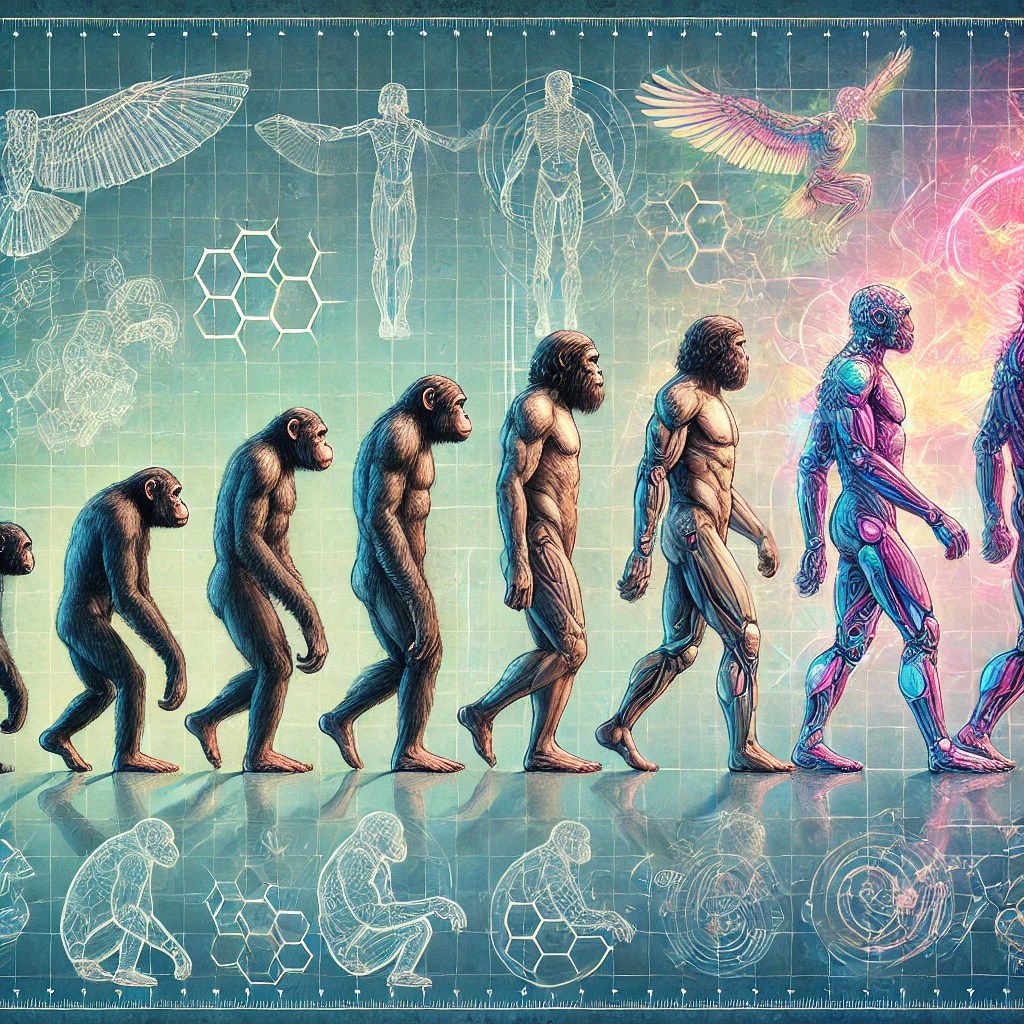
The second step in this series is to show that a reasonable scientific model does not contradict the functional model that I proposed in the first post. It should be noted also that I’m no geneticist, so I won’t go into ridiculous detail and, of course, much of what I’m saying here is piggybacking off what people much smarter than me have said. I also won’t talk about abiogenesis in this post since this is more concentrated on the first ‘man’ rather than the first biological creature – I’ll have more thoughts to share on that in part 5.
Similarly to the first post, I will lay out some theses which I will seek to defend and provide evidence for in this post.
Thesis 1: There is good, although not conclusive, evidence for macroevolution.
Thesis 2: Adam and Eve likely come from a small population of individuals, but this does not disprove the Biblical account of origins.
Thesis 3: There is reasonable evidence to suggest that an imago-Dei Adam and Eve came from a small population of individuals 40000 to 80000 years ago
(2) and (3) seem similar, but they will be made more distinct when you read them.
Prologue: Defining ‘Evolution’
The first thing I want to do is to clear the air about what evolution is, and what it is not. In both the theistic and non-theistic spheres, we have people straw-manning, and mass-producing caricatures of what ‘evolution’ asserts. To be fair, it’s not necessarily people’s fault.
In contemporary biology, ‘evolution’ can refer to (1), change over time, (2), universal common ancestry, and (3), the natural mechanisms that produce change in organisms. To be more specific, we need to make the word longer:
- Microevolution: involves smaller-scale changes within a species or population over shorter periods. These changes typically result from mechanisms such as mutation, natural selection, gene flow, and genetic drift.
- Macroevolution: refers to the broad pattern of evolutionary changes that occur over long periods, often resulting in the emergence of new species, genera, families, or higher-level taxa. In this post, ‘evolution’ will refer to the process by which these evolutionary changes produce these new species with a common ancestor.
- Weak Naturalistic Evolution (WNE): affirms macroevolution, and claims that a natural process is sufficient to explain how the present diversity of living ancestors came from a common ancestor (without denying that the common ancestor/universe was created by God). This isn’t incompatible with scripture but requires work.
- Strong Naturalistic/Atheistic Evolution (SNE): The ‘evolution’ you are most familiar with. Affirms macroevolution but denies that there is a God involved at any stage in cosmic history. This is incompatible with scripture.
- Deistic Evolution (DE): Affirms macroevolution, affirms a God created the universe and perhaps fine-tuned the initial conditions to such an extent that a common ancestor would form and evolve into other organisms – however, this God does not intervene after the universe is created. This is incompatible with scripture because scripture affirms that God interacts with creation after the beginning of the universe.
- Theistic Evolution/Evolutionary Creationism (TE): affirms macroevolution and affirms that there is a God who created the universe and intervened in the history of the universe. This goes further than WNE and DE, as it affirms God’s existence and his interaction with creation, post-creation.
I fall into the Evolutionary Creationist category, but not dogmatically. I am fairly open to Old Earth creationism, and I make this decision based on evaluating the current scientific evidence and seeing how it coheres with what I think are the affirmations of the Biblical text. I will leave my current reasons for preferring TE over OEC for part 4.
Thesis 1: There is good, although not conclusive, evidence for macroevolution.
The first thing to do is to present the evidence for the possibility of evolution itself.
Evidence 1: Genetic evidence
- Mutation Frequency
One genetic point of evidence that humans and other homo-species were not created instantly, but rather hold a common ancestor, comes through evidence from ‘mutation frequency’.
For example, when lining up the two sequences of DNA of humans and chimpanzees side by side, we get a disparity of only 1.2-1.4%. Of course, not all of both sequences can be lined up together, but the parts that can’t be lined up (i.e., parts present in one sequence but not in another) only constitute an extra 1.2-1.4% difference – resulting in a ~97% similarity.
By analysing the DNA sequence in both human and chimpanzee children relative to parents, scientists see that about 70 of the ~3 billion coding units have mutated/changed, and so scientists presume a rough rate of 70 changes per generation.
Now, for 1.2-1.4% (approx. 35 million) single-unit code changes, presuming a rate of 70 changes per generation, we would presume 35,000,000 / 70 / 2 [2 – because of changes in each sequence of DNA] = 250,000 generations, which is very close to 300,000. This also presumes a roughly constant mutation rate between the two species which, allegedly, is a reasonable approximation based on scientific data.
Based on fossil evidence, this is roughly how many generations have transpired since the common ancestor (6-7 million years ago) – which is quite interesting.
Another point to make is the types of changes that occur themselves. Some of the 70 changes that occur per generation are about tenfold more likely than others (for molecular reasons), and scientists refer to these regions as ‘hotspots’ for mutations. If the code differences are the result of mutations, then we would expect to see this specific code difference at a tenfold higher rate when comparing generations, and lo and behold, when comparing the DNA in chimps to that of humans, the difference between the two is about ten times greater at known hotspots – indicating that they have arisen through mutation in each branch.
- Genetic Scars
Another line of evidence, although much rarer, is the common genetic scars that humans share in their genomes with other species.
Basically, small blocks of DNA are deleted/inserted (which is caused by cuts in the DNA followed by reattachment at the cut sites). These cuts are passed onto further generations (which is why they are called ‘scars’) and so can be tracked by ancestral lineage.
If both humans and chimpanzees share the same ancestor, we would expect to have the same scars in our gene code – and that is what is found. Thousands of common scars exist between humans and chimpanzees (at a resolution of precision 0.00000034 mm), which is why virtually all geneticists believe that humans and chimps share a common ancestor.
An objection: Presupposes naturalism (i.e., only mechanistic processes can be used to explain the universe and phenomena within – excluding God from the outset). Shared genetic features could instead reflect common design rather than descent.
Response: I am not a naturalist, but if things can be sufficiently explained naturally then generally, I will tend toward a natural explanation. Also, this doesn’t necessarily presuppose naturalism. It could simply be that God set into motion the hyperparameters at the beginning of the universe such that at some point humans and chimps would emerge from the same ancestor. My point here is not to show that all aspects of creation can be explained through naturalism (I severely doubt that), but simply that there is good evidence for common descent.
Evidence 2: Archaeological evidence
Generically speaking, the fossil record of the apes (family ‘Hominidae’ in the mammalian order Primates…
[remember, Keep {Kingdom} Ponds {Phylum} Clean {Class} Or {Order} Frogs {Family} Get {Genus} Sick {Species})
…has many species, and is scattered across the Old World (Africa and Eurasia), and extends about 25 million years into the past. At the time of writing this, no fossil apes have been located in the New World (North and South America). A subfamily of this ‘Hominidae’ includes many fossil species, for example, the modern African Great Apes and Humans, and this subfamily is rooted in European forms that date back to about 12 million years ago, but beginning about 6 million years ago, apes appeared in Africa. These apes are regarded by Archaeologists as significant for detecting human ancestry. Humans share unique anatomical characteristics with the more restrictive group of modern African apes, one of which is the fusion of two of the standard mammalian wrist bones – and it is these common characteristics that prompt biologists to place humans and apes in the same class.
Now, to say that Humans and ‘Apes’ are part of the same family is not to say that they are identical concerning the ‘imago Dei’ or possess the same rational or phenomenological qualities. Just as humans being of the vertebrate class doesn’t entail that all vertebrates have equivalent capacities; I am simply laying out the archaeological evidence that points toward common descent.
During the 19th century, fossils of archaic hominids (=hominidae) began to come to light. These were later called ‘Neanderthals’ because they were discovered first in the Neander Valley in Germany. In the same century, but towards the back end, remains of modern-aspect humans (“Cro-Magnons”) were also discovered in European caves that chronologically overlapped the occupancies of the Neanderthals – suggesting that modern-looking humans had replaced Neanderthal populations.
Now, there is much more I could write on the fossil record here, but I think that would be overkill. Essentially, a sequence of ape-like creatures with gradually increasing brain sizes can be traced through the Old World over the past 5 million years, leading up to groups such as the Neanderthals, although this record is not without gaps and uncertainties.
Thesis 2: Adam and Eve likely come from a small population of individuals, but this does not disprove the Biblical account of origins.
Honestly, contrary to the prevailing fundamentalist assertion, there is not strong evidence at all for only two initial human ancestors.
Genetically, it is a well-established fact that all males today have a Y chromosome that is derived from one male, and current data indicates that this person lived in Africa about 240,000 years ago. Similar studies address the origin of mitochondria (the part of our cell dedicated to generating the energy to run our bodies). All currently living humans’ mitochondria are derived from one female who lived in Africa somewhere around 165,000 years ago – but notice that this doesn’t necessarily mean that there was only one human pair present at the time of either of these people. Calculations indicate that there was much more likely never a time when human populations dipped below 10,000.
For those wondering how this could be the case if all males have a Y Chromosome from one male and mitochondria from one female, here’s a brief explanation:
- If a male has no sons, the lineage of his Y chromosome (males have XY chromosomes, but females have XX) stops with him. In 240,000 years, there are about 8000 generations. Over thousands of generations in a world with only ten thousand or so persons, many of the Y chromosome lineages are terminated because a male has no male child, and the same goes for females passing down mitochondrial DNA – the mathematics virtually guarantees that over that much time, all descendants of an original population will share a grandparent.
Essentially, a lot of branch lineages die out, and a core root lineage tends to remain.
I will briefly name the four lines of evidence that mathematicians have used to get this conclusion, which nerdier people can look up if interested:
- Calculations based on gene coalescent times
- Calculations based on genetic diversity
- Calculations based on linkage disequilibrium
- Calculations based on the diversity of transposable element insertion points
The Dilemma:
It seems, that either we dismiss the Bible’s claim for the original couple, and follow the lead of contemporary science, or we hold on to the Bible and ignore the mathematical and genetic evidence. What do we do?
A solution:
In this thesis, I simply want to bring in themes from my first part to illustrate why this is a false dilemma. I will provide a more informed model in the next thesis.
Remember, I said that Genesis 1 is a creation account using an ancient model of cosmology, so even with Genesis 1’s position of the creation of man being ‘functional’ and more generically applicable to the human species, we can dismiss it as non-informative on this specific thesis. Genesis 2, as I have already said, can be said to ‘zoom in’ on Eden, a localised sacred space, where two appointed people, Adam and Eve were supposed to reflect God’s image among creation. Genesis is also actually silent on whether other non-imago-Dei humans existed outside of Eden. (I know that I haven’t explicitly stated what ‘imago-Dei’ really means yet, but bear with me for now).
A point that can be put forward to give evidence to the possibility of non-imago-Dei contemporary humans would be Genesis 4:15:
‘ But the Lord said to him, “All right then, if anyone kills Cain, Cain will be avenged seven times as much.” Then the Lord put a special mark on Cain so that no one who found him would strike him down. ‘
More clearly, if Cain has referred to himself as a ‘homeless wanderer’ on the Earth, and he is certain that ‘whoever finds [him] will kill [him]’ it seems much more reasonable that there were people other than Adam and Eve (as ‘whoever’ implies personhood) that existed around that time that hadn’t been named. This seems to cohere well with the minimum population of about 10,000 and successfully provides a model in which contemporary science does not refute the Biblical model of origins.
An objection could be raised with Genesis 5:3-4:
‘ When Adam had lived 130 years he fathered a son in his own likeness, according to his image, and he named him Seth. The length of time Adam lived after he became the father of Seth was 800 years; during this time, he had other sons and daughters. ‘
The point is obvious. The text seems to say that Seth came into existence before Cain and Abel, and so ‘anyone’ would necessarily refer to Adam’s other descendants, along with the other sons and daughters. However, all you need to do is go back to the end of the previous chapter. Genesis 4:25 reads:
‘ And Adam had marital relations with his wife again, and she gave birth to a son. She named him Seth, saying, “God has given me another child in place of Abel because Cain killed him.” ‘
From this, it seems my point is secured again. Cain and Abel came before Seth – at some point in Adam’s ‘130’ years.
Thesis 3: There is reasonable evidence to suggest that an imago-Dei Adam and Eve came from a small population of individuals 40000 to 80000 years ago
By now, we have established that there is good, although incomplete evidence for common descent, and that Genesis’ origins account does not contradict contemporary findings since the Bible doesn’t seem to eliminate the possibility of the existence of other non-Adamic persons (of some form) at the time of Cain and Abel, but we haven’t really answered the glaring questions:
- What is the imago Dei – are there other apes made in God’s image?
- When did Adam and Eve actually appear?
- How did the anatomical curses of Genesis 3 manifest?
So… well, here we go!
What is the imago Dei – are there other ‘apes’ made in God’s image?
The first, and most important question, is to figure out what exactly it means to be made in the ‘image’ of God. The reason this question is important, especially for my model, is because of the following problems with my model:
- If only Adam and Eve were made in the image of God, and the image is merely anatomical, then what do I say about the other non-Adamic ‘persons’ that existed at the time of Abel? How can they be persons (presumably human) yet not be made in God’s image, if humans were supposed to be made in the image of God?
- If the image is anatomical, then it seems like persons these non-Adamic persons also HAD to be made in God’s image, which not only breaks the idea that Adam and Eve were the first animals made in God’s image, but the fall seems unjustified. Why did God select Adam and Eve and have everyone else who didn’t commit the sin of the fall somehow lose that image?
- If the image is anatomical, how do I explain curses such as the pangs of childbirth in women, which, evidentially, likely started when the anatomical changes associated with bipedalism and brain enlargement, which began around 4 to 6 million years ago?
Thankfully, I’m an apostolic Christian, so I can give a more dogmatic account than other Christians can. From the above problems, a common theme underlies the issues, and therefore, I can simply say:
The imago Dei is not merely anatomical.
The Catholic Church’s Catechism makes some points:
- The divine image is present in every man. It shines forth in the communion of persons, in the likeness of the unity of the divine persons among themselves. [1702]
- Of all visible creatures, only man is “able to know and love his creator”… he alone is called to share, by knowledge and love, in God’s own life. [356]
- Being in the image of God the human individual possesses the dignity of a person, who is not just something, but someone. He is capable of self-knowledge, of self-possession and of freely giving himself and entering into communion with other persons. And he is called by grace to a covenant with his Creator, to offer him a response of faith and love that no other creature can give in his stead. [357]
Now, I don’t want to get too much into the weeds of psychology and personal ontology, but it needs to be said that I am a hylomorphic dualist. Essentially, this means that when it comes to ‘man’, the soul is the acting rational principle (the form) that moves the man to act through intellect and will.
The points above effectively convey that the body is an ‘enabler’ of the soul, and the imago Dei provides ‘capacities’ for man to share by knowledge and love, in God’s own life. It provides a higher level of self-awareness and reasoned thought which enables us to have moral responsibility. It also allows us to, as prefaced in part 1, take part in the royal function/office of human beings as God’s representatives and agents in the world. This is what, I would say, it is to be a ‘true’ human, with a rational soul – which I think is consistent with how Humani Generis, 37 reads.
For this reason, and although I would affirm that animals have souls that are not distinctly rational like humans’, I would tend toward an ensoulment model – which affirms that Adam and Eve are the first ‘ensouled’ representatives of humanity, and the contemporary population – capable to a much higher extent of the above-mentioned capacities than the other anatomical ‘humans’, and therefore morally responsible stewards of creation.
With this said, I think I can give substantive answers to each question:
- The image of God is not merely anatomical. It is rooted in the soul and is a capacity actualised through an anatomically human body. However, it does not follow from the fact that just because one has an anatomically human body, they share in the imago Dei.
- One may raise a contentious objection that Homo erectus, Homo neanderthalensis, Homo floresiensis and Homo sapiens are all distinct species but could all be regarded as biological humans and therefore be considered part of the imago Dei. (For context it should be known that many scientists nowadays would define an anatomical human as the whole Homo genus which emerged around 2.3 million years ago, as opposed to the species of homo sapiens alone).
To respond to this, it should be remembered that my model does not require that one who bears the image of God to be simply biological humans, but to be an ‘anatomical human that possesses the image of God’ – i.e., is also capable of exercising the qualities I mentioned earlier (a, b, c).
- One may raise a contentious objection that Homo erectus, Homo neanderthalensis, Homo floresiensis and Homo sapiens are all distinct species but could all be regarded as biological humans and therefore be considered part of the imago Dei. (For context it should be known that many scientists nowadays would define an anatomical human as the whole Homo genus which emerged around 2.3 million years ago, as opposed to the species of homo sapiens alone).
- This starts with a false premise. The imago Dei, as I have said, is not merely anatomical. Although there may have been ‘anatomical’ human beings at the time of Adam and Eve, I would argue that Adam and Eve were select representatives with the image of God imprinted on their being – capable of qualities a, b and c that I mentioned earlier.
- This will be answered later.
When did Adam and Eve actually appear?
There are quite a few models of the appearance of Adam and Eve. We have already seen one possible one – Mitochondrial Eve and Y-Chromosomal Adam. However, given historical and archaeological findings, I think it is more plausible to date the ensoulment of the first representatives, and therefore ‘man’ to 40,000 to 80,000 years ago.
For those relatively familiar with this sort of topic, you might be familiar with the common theory of placing Y-Chromosomal Adam, and Mitochondrial Eve in the moulds of Adam and Eve – because that would ensure that everyone alive today would be their genetic descendants – and would make the solution seem very pretty, however, I do not think the anthropological evidence supports this, and there is also not good contemporary evidence that they both existed at the same time.
I tend to place Adam and Eve at some point within the last 40,000 to 80,000 years – and I instead claim that Adam and Eve were genealogical ancestors of all of what can be deemed ‘true human’ (i.e., imago Dei, anatomical humans).
For those a little confused with the distinction between emphasizing genetic versus genealogical descent – here’s a summary:
- Genetic Descent: Analyses specific DNA sequences passed down through direct genetic lines, such as mitochondrial DNA and Y chromosomes. This approach is limited to particular segments of the genome and focuses on genetic contributions to an individual’s DNA.
- Genealogical Descent: Encompasses all ancestors in a person’s family tree, considering the broad network of ancestral connections without focusing on the specific genetic material inherited. It provides a comprehensive view of how ancestry is interconnected across generations.
This is a very plausible model also. Joshua Swamidass (a computational biologist) tells us that, first, we have multiple ‘universal’ genealogical ancestors. That is to say, we have multiple people who are paternally or maternally related to all the people alive today. This makes complete sense – considering that if you have one genealogical ancestor, this would mean that all people in that person’s family tree above them, would also be genealogically related to you. Swamidass also tells us that it takes about 3000 to 5000 years for universal genealogical ancestors to arise, and this is a higher estimate.
With migration, interbreeding, and widespread genealogical connections, this is not at all a stretch to say that the ‘imago Dei’ population that the Bible specifies could have begun to exist in this time frame, and easily be the universal ancestors of all humans on Earth as of at least 20000 years ago, as I also affirm that there were ‘people’ outside of the garden that Cain interbred with, and due to Cain’s adamic lineage – all of his descendants would also share in the imago Dei.
The reason I pick this time frame specifically is because of what anthropologists refer to as ‘the great leap forward’. A moment when a sociocultural revolution occurred, and when there were sudden significant advancements in human activity.
[Start of ChatGPT section]
This period is estimated to have occurred around 40,000 to 50,000 years ago. Some evidence suggests it might have started as early as 70,000 years ago, particularly in Africa, but the most pronounced changes are generally dated to around 40,000 to 45,000 years ago.
Some key developments (thanks GPT, wasn’t going to write this bit myself :)):
- Advanced Toolmaking:
- Stone Tools: There was a marked improvement in the complexity and variety of stone tools. This included blades, burins, and microliths, which were more refined and specialized compared to the tools of the Middle Paleolithic.
- Composite Tools: The creation of tools made from multiple components, such as hafted tools where stone points were attached to wooden shafts, became common.
- Art and Symbolism:
- Cave Paintings and Carvings: Some of the earliest known examples of art, such as the cave paintings in Lascaux and Chauvet in France and the rock art in Spain, date to this period.
- Portable Art: Objects like the Venus figurines, which are small statuettes of female figures, and carved animal figures, reflect a new level of symbolic thinking and artistic expression.
- Music:
- Musical Instruments: The discovery of bone flutes, such as those found in the Swabian Jura region of Germany, indicates the presence of music and possibly complex communication or ritual practices.
- Burial Practices:
- Ritual Burials: Evidence of intentional burial with grave goods, such as beads and tools, suggests that humans had developed concepts of life after death and ritualistic practices.
- Social Structures:
- Expanded Social Networks: There is evidence of more extensive social networks and trade routes. Items like shell beads and obsidian tools found far from their sources indicate long-distance trade and communication.
- Language and Communication:
- Complex Language: While direct evidence of language is scarce, the complexity of the tools, art, and social structures suggests that sophisticated spoken language likely played a crucial role in these developments.
The Great Leap Forward represents a critical juncture in human evolution. The advancements made during this period are often seen as the defining characteristics of modern Homo sapiens. These changes reflect a significant cognitive shift that allowed for greater creativity, social complexity, and adaptability, which were crucial for the survival and expansion of human populations across diverse environments.
[End of ChatGPT section]
As you can see, ChatGPT seems to agree that there was a sudden, ‘significant cognitive shift’ around 40,000 to 80,000 years ago, and I would argue that an event such as the happenings of Genesis 2-3 (the instantiation of a rational soul in anatomically human beings, and the fall) seems to explain this very well. Especially the beginning of burial practices – why do you think death became so significant?
What was the manner of creation?
I would likely affirm that pure evolution may only be sufficient, with the help of some supernatural initial miracle (i.e., prebiotic primordial soup/RNA world) to create the biological matter, to create an anatomically human being, but I would not be so certain that the marks of the imago Dei I have specified can be properly explained by natural processes, along with consciousness – this is something I will delve into more in part 5. I would say that the manner of creation specified in Genesis 2 coheres well with this. I think God took a pre-existing anatomical human from the already existing ‘human’ population which had been “formed…from the soil of the ground” (Gen 2:7) and “breath[ed]… life” into him, and I explore what I think are the implications of this breath of life in a previous post. I think the same could have been done with Eve.
- Alternatively, it could be that the section regarding Eve and Adam’s side details that God ‘moved’ humans from asexual reproduction to sexual reproduction millions of years before.
- It could even be that both Adam and Eve are created ‘de-novo’ (brand-new) at this point – and this is a theory that Swamidass says there ‘is no evidence for, or against’.
Ultimately, I think some form of supernatural creation (whether ‘soul’ and/or body) was necessary, but it is important to say that Adam and Eve were not reproductively isolated from the ‘humans’ outside the garden, which is why I favour the ‘being taken from the existing population’ hypothesis – it seems to make more sense and raise less questions.
Eve’s Curse?
My initial question to myself was:
If the image is anatomical, how do I explain curses such as the pangs of childbirth in women, which, evidentially, likely started when the anatomical changes associated with bipedalism and brain enlargement, which began around 4 to 6 million years ago?
The thrust of the question is this:
- The image is merely anatomical.
- Women started to feel horrible pain from childbirth much before the fall.
- This pain seems unjustified or doesn’t cohere with the anthropological timeline.
- Therefore, your model, given Christian theism, is very weak – or unjustifiable.
Let’s go through all of these step by step.
- The image is merely anatomical.
The first point to make is that I have already affirmed that the imago Dei is not merely anatomical. So with that, the question seems to lose a lot of force.
- Women started to feel horrible pain from childbirth much before the fall.
Possibly, yes, but also, possibly, not. It should be noted, that all I really need to do is to show that this model is possible. It should be noted that the curse of Genesis 3 doesn’t actually say that women ‘began’ to feel the pain of childbirth after the fall. Rather it says:
“I will greatly increase your labour pains; with pain you will give birth to children.”
i.e., It could be the case that women before Adam and Eve did feel pain due to childbirth, but it wasn’t nearly as strong (note ‘greatly increase’) as it is today. A reason for this pain could be to truly appreciate the value of giving birth – similarly to how going to a workout and suffering with the lactic acid seeping through your veins can help you to better appreciate the body that is sculpted by the effort.
Secondly, this could be turned into a theodicy against animal suffering, which would go something like this:
- Womens’ childbirth suffering was increased after gaining rational souls and the fall.
- The type of soul influences one’s capacity to be sentient.
- An increase in sentience leads to an increase in the potential to be aware of pain.
- Animals are less sentient than humans.
- Conclusion – animals do not ‘suffer’ pain as much as humans do.
Now, it’s clear that a lot would have to be fleshed out here to properly present this as a good case, but I’m just putting this out there.
- This pain seems unjustified or doesn’t cohere with the anthropological timeline.
Arguably, no. If my theodicy works or holds any sort of weight with regard to premise 3, it could be the case that pain felt by animals and anatomical human existence before imago-Dei human existence is not as bad as we experience it.
- Therefore your model, given Christian theism, is very weak – or unjustifiable.
Plausibly, this is also false. Creation was created ‘good’, not ‘perfect’, and so the presence of some forms of pain is not incompatible – i.e., if Adam was tilling the ground in Eden and accidentally tripped over – it’s not unreasonable to expect him to have felt some minor discomfort.
All in all, my attempt with this model has not been to provide a sweet dogmatic kill-shot to the problem of origins – rather, it has been to provide a plausible, defensible model, that makes decent sense of the Biblical, and scientific accounts.
Naturally, people much smarter than me will offer strong objections to some points here, and I’d love to hear them – though, reasonably, I cannot respond to every single one. I pray this will serve as a starting point for those curious about this topic.
I hope you enjoyed the heavy read, and I’ll see you all in the next part, where I will answer some common objections.
Thanks,
Rookie
Sources:
- The Genealogical Adam and Eve – Joshua Swamidass
- The Origin of Humanity and Evolution – Andrew Loke
- Old Earth or Evolutionary Creation – Kenneth Keathley, Biologos, Reasons to Believe
 RookieApologises