If you’ve been paying good attention to my writings throughout this series, you may have noticed me consistently affirming that ‘there are things I do not think naturalism can explain’ – along with bits and pieces of reasons throughout. Of course, I have purely philosophical reasons, in addition to historical arguments for the resurrection and a testimony of personal experience to rationally justify my Christian belief. Aside from my last point, this specific post is largely aimed at providing mostly scientific (though largely philosophical at the end) reasons for which I do not hold to a Strong Naturalistic view of Evolution, but rather a model of Evolutionary Creation.
My reasons can be summarised as follows:
- Cellular Functional Information and Abiogenesis
- The Emergence of Sexual Reproduction
- The Mind
- Dominance
To be fair, point 1 could support a Deistic model, but when adding 2, 3, and 4 I think that, overall, my reasons are more expected from a more strictly judeo-Christian God.
#1: Cellular Functional Information and Abiogenesis
Quite uncontroversially, information can be defined as ‘a sequence of characters that produces some specific effect’. According to information theory, information and probability are inversely correlated. Although the longer a sequence of characters is, the more information-carrying capacity it has, it would also mean that it is less likely to convey meaningful content because it is more likely that it would contain useless characters.
For example, the sequence ‘mp’ doesn’t contain any useful information (at least, in the context of the formal English language), but all you need to do is switch the ‘p’ for an ‘e’ and all of a sudden the sequence not only carries information but meaning.
There are 262 two-letter, alphabetical sequences, and only a small fraction of these are actual formal English words. If you lengthen the word to something like ‘messy’, you do get something longer. However, presuming random selection, you also reduce the probability of landing on a formal English word (as there are now 265 possible combinations), showing the inverse proportionality.
Why is this relevant? I’m glad you asked.
It is quite well known that DNA is the information storage centre of the cell, but not many have stopped to think what exactly it means to be ‘information’. Abiogenesis, simply put, is the idea that life arose from non-life about 3.5 billion years ago on Earth. It tries to propose a natural explanation for the origin of such information, and Strong Naturalistic Evolutionists would essentially have to prove that the following stages are reproducible under prebiotic conditions:
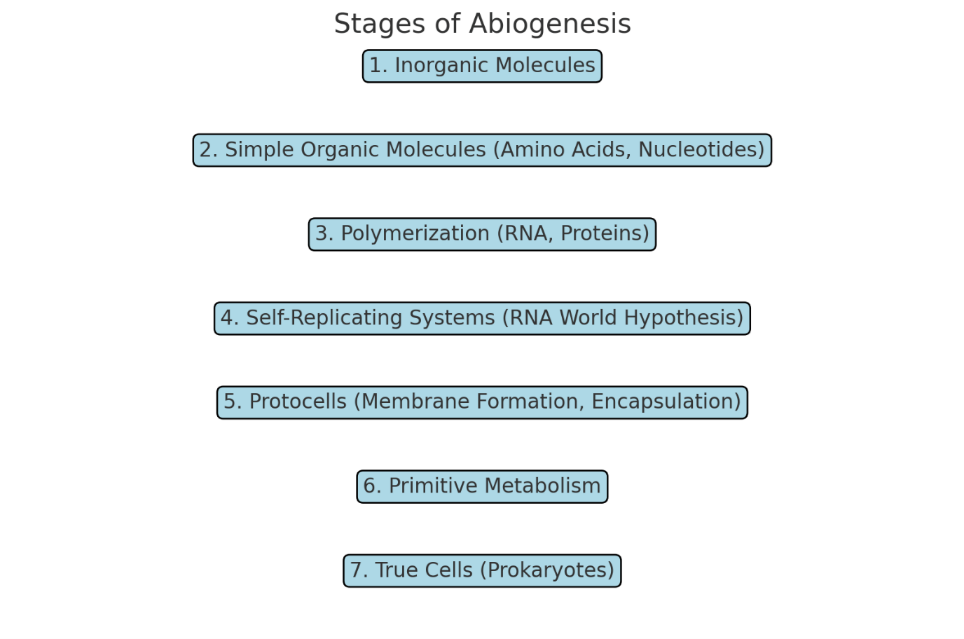
The stages are explained as follows:
- Inorganic Molecules: The starting point involves simple inorganic compounds like water (H₂O), carbon dioxide (CO₂), methane (CH₄), and ammonia (NH₃).
- Simple Organic Molecules: These inorganic compounds combine under the right conditions (e.g., lightning, UV radiation) to form basic organic molecules like amino acids and nucleotides.
- Polymerization: These organic molecules must link together to form more complex structures like RNA strands and proteins. This stage involves creating long chains from simpler building blocks.
- Self-Replicating Systems: The emergence of molecules capable of self-replication (like RNA) marks a critical step. The “RNA World Hypothesis” suggests that RNA could store information and catalyze its own replication.
- Protocells: Self-replicating molecules must become encapsulated within membrane-like structures, forming protocells that maintain an internal environment distinct from the outside.
- Primitive Metabolism: These protocells need basic metabolic pathways to harness energy and sustain themselves, possibly involving simple redox reactions.
- True Cells: Finally, these primitive systems evolve into the first simple cells, resembling prokaryotes, capable of growth, division, and evolution.
Proteins (stage 3) are large, complex molecules that are made up of amino acids that are joined up in a specific sequence, and this sequence determines the protein’s structure and function. These amino acids that constitute them are smaller organic molecules, and they are determined by a corresponding sequence of things called ‘codons’ in something else called messenger-RNA (mRNA) – more simply, you get a specific amino acid because of a specific sequence of mRNA, and this mRNA is formed by a transcription of DNA. DNA, specifically, depends on certain sequences of nucleotide bases – these are adenine [A], thymine [T], cytosine [C], and guanine [G]. The picture should be starting to clear up a little now, but essentially, our genome can be seen as one very long ‘word’ that specifies extremely complex behaviour within our bodies.
But wait, that’s not all.
Proteins aren’t two-dimensional. Their three-dimensional shapes exhibit complex shapes, irregular arrangements, and most importantly, specificity. This is to say, some features must either be exactly what they are or within very fine boundaries for the overall protein to function. But, remember, these things are all determined by a sequence of nucleotide base pairs in a given DNA sequence.
Hypothesis 1: Chance
Now, take all this dizzying complexity, and plug it into a ‘chance theory’ of abiogenesis, which is one of the two (or maybe three) real options open to the Strong Naturalistic evolutionist, we start to see some glaring problems.
Firstly, specificity requires the correct letter-by-letter creation of a protein, however, this seems very improbable presuming you are going with some form of primordial soup starting point – i.e., the idea that these organic molecules had somehow formed and ‘knocked into each other until something happened’.
Secondly, such formation also requires solely peptide bonds, which roughly halves the probability because non-peptide bonds also form. Another thing to note is that the subset of proteins that are functional among all the combinations of amino acids is extremely low.
Thirdly, well, let’s actually run the numbers:
- Most functional proteins are made of hundreds of amino acids, with an average size of about 300 amino acids2 – but presuming amino acids in a prebiotic soup may be simpler – let’s take a number on the smaller side – 150.
- As stated, peptide bonds between amino acids form with a probability of about ½, so the probability of an amino acid forming by chance is about 1 x (½)150 = 1 chance in 1045.
- Next, in nature every amino acid found in proteins (with one exception) has a distinct mirror-image of itself. There is one left-handed version (L-form) and one right-handed version (D-form), called optical isomers. Functional proteins only tolerate left-handed amino acids, so we need to square the previous probability – to get 1 chance in 1090
- Maxwell Professor of Molecular Biology at Biola University, Douglas Axe shared in 2007 his calculation of the ratio of (a) the number of 150 amino acid sequences that produce any functional proteins whatsoever to (b) the number of possible amino acid sequences of 150 amino acids to be 1 chance in 1074.
All we have to do is multiply these independent probabilities together – 1090 + 74 = 164. This is the probability of getting even one functional protein of modest length, from prebiotic soup.
With all of these charges, one could raise the point – “Surely given all the possibilities and chances in the universe, such things could happen?” It’s a fair question, so let’s look at what probabilistic ‘resources’ the universe has to offer.
We can do this by calculating the number of possible events that could have happened since the beginning of the universe. By doing this, we can establish an upper boundary for how many ‘event resources’ the observable universe could possibly work with:
- There are about 1080 elementary particles in the observable universe, and because there is an upper limit on the speed of light, only those parts of the universe that are observable (i.e., could have affected events on Earth) are relevant to this calculation – as otherwise would be presuming that some events can break lightspeed.
- There are also about 1017 seconds that have passed since the Big Bang.
- Due to the properties of gravity, matter, and electromagnetic radiation, physicists have determined that there is a limit on the number of physical transitions that can occur from one state to another within a given unit of time. According to physicists, a physical transition from one state to another cannot take place faster than light can traverse the smallest significant unit of distance – the Planck length (10-33 cm), which takes light 10-43 seconds to travel.
This would put an upper bound of 1080 + 17 + 43 = 140possible atomic events/collisions in the observable universe since the origin of the universe. Other calculations have been made, and this is a higher bound, but it won’t help the naturalists’ case.
Using these generous numbers that we have found, we notice that, by chance, the universe does not have enough opportunities (10140) to even compensate for functional proteins forming by chance alone (1 chance in 10164). This does not mean that this would be impossible, but it would mean that if it did happen, doing some simple statistical hypothesis testing would show that almost certainly there would have been some other cause ‘helping it out’.
Hypothesis 2: Necessity
A second hypothesis put forward is the ‘necessity’ hypothesis – i.e., that there are some biochemical laws that exert themselves upon matter to make it such that the first cell was physically ‘predestined’. It also claims that chemical processes are deterministic (i.e., always produce the same outputs given the same inputs), and it must prove a couple of things:
- Reproducibility in Laboratory Conditions
- That there are multiple pathways to life
- One may ask – isn’t it sufficient to show just one pathway?
In a sense, yes, however, this single pathway may just easily be dismissed as a fluke, rather than an inevitable result. If there are multiple pathways – even with different starting points or slightly different conditions – it supports the idea that life will emerge as long as basic biochemical/environmental criteria are met.
- One may ask – isn’t it sufficient to show just one pathway?
- Predictive models: The hypothesis should produce models that predict the environmental conditions under which life is likely to arise
- Universality of principles: The hypothesis would need to show that the principles leading to life are universal, applying not just to Earth, but any environment with similar conditions
Multiple models have been put forward to try to propose some form of necessity. Dean Kenyon and Gary Steinman co-authored Biochemical Predestination in 1969, proposing a deterministic model and theorizing that the specific properties of amino acids and other biomolecules drive them to self-organize into complex structures, but Kenyon later retracted his support for this idea, moving toward intelligent design.
Michael Polanyi, a philosopher and scientist, critiqued purely materialistic and deterministic models of life’s origin, arguing that life and biological information cannot be reduced solely to chemistry and physics – for example, the bonding properties of each nucleotide are specified below – the image is taken from Stephen Meyer’s book – Signature in the Cell:
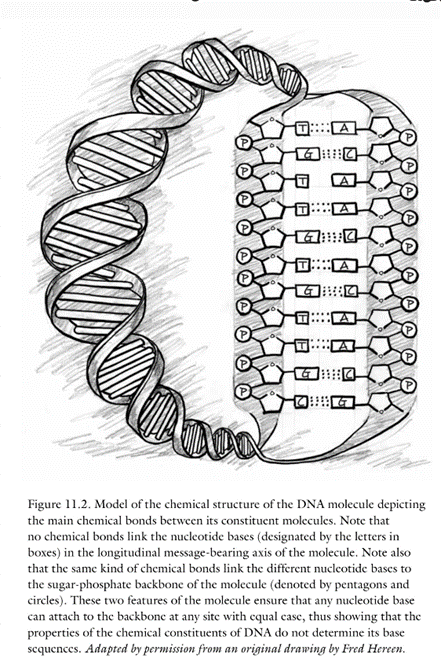
Just as the properties of building blocks do not determine a building, the bases do not determine DNA, and indeterminacy is actually necessary for complexity, because determinism leads to repetitiveness, not specificity.
Another model proposed is by Stuart Kaufmann, who has proposed models based on the idea of self-organization, but Meyer says that Kaufmann’s model doesn’t properly answer the specificity of sequencing itself, but rather presupposes specificity (which is begging the question).
Therefore, necessitarian models do not sufficiently explain the data we have at hand, so the most popular approach nowadays is to merge hypotheses 1 and 2.
Hypothesis 3: Chance and Necessity
The most popular hypothesis today is what is known as the RNA world hypothesis. This hypothesis states that RNA molecules were the first to both store genetic information and catalyse chemical reactions.
Without getting too much into the weeds of things, the RNA world hypothesis needs to show five things:
- The plausible prebiotic formation of nucleotides and their assembly into RNA.
- The emergence of functional, self-replicating RNA molecules.
- The stability and persistence of RNA in prebiotic environments.
- The formation of protocells that could contain and protect RNA.
- The transition from RNA-based life to the DNA-protein world.
However, the hypothesis faces significant challenges:
- RNA molecules are hard to synthesize and easy to destroy, especially in aqueous environments, where it can easily degrade through hydrolysis – which means that it is very difficult to replicate such processes as would be expected in prebiotic scenarios.
- RNA-based replication systems are also ridiculously hard and maybe even impossible to create. While some ribozymes have been shown to catalyze RNA replication in lab settings, fully self-sustaining RNA replication with high fidelity is far from being realized.
- The hypothesis also doesn’t explain the origin of biological information. Remember that RNA already has functional information contained inside of it in its nucleotides. So, such models basically presuppose a mix of a random and necessitarian formation of such nucleotides and sequences.
In essence, even the RNA world hypothesis begs the question. If RNA itself needs functional information to form, then this model is almost certainly inherently incapable of explaining the origin of functional information without deferring to random natural processes – which, although necessary for complexity as we have seen, is incredibly improbable on its own.
Ultimately, whether “Chance and Necessity” is able to explain the emergence of life on Earth isn’t really a problem for my model at all. Since I am taking a more abductive approach, all I need to really show in this section is that even if it does, or somehow will in the future – the sheer improbability of these circumstances coming to be on their own is almost certainly enough to rationally justify, or lend credence to a conscious external source of information – especially since information almost always comes from such source.
However low a probability someone would like to assign to such source is up to them – and whether they think this source is a super-intelligent alien is not really my concern, but I don’t think it can be reasonably driven as low as probabilities required by some form of chance hypothesis necessitated by naturalism’s view that the universe operates solely according to natural laws and forces. I think this is sufficient evidence to justify a belief in, at least, one supernatural initial miracle to get evolution started (if it even did) for my model.
#2: The Emergence of Sexual Reproduction
This point is something I’ve thought about and haven’t got a real source for, and not much will really be said here. The problem is as follows:
Naturalistic hypotheses almost always propose the formation of initial organisms that will reproduce via asexual means because sexual reproduction necessitates the existence of multiple organisms that ‘know’ about each other (to reproduce) – therefore needing them to account for at least two reproductively compatible species or organisms. Even if this is not the case, such processes must account for species that, at some point in the past, had some common ancestor that just ‘decided’ (in some way, either through chemical randomness or necessity) to start reproducing via sexual means.
One could propose that two separate ancestor species started copulating with each other and that the organisms on Earth that reproduce this way are descended from this species, but one also needs to account for the probability of such an occurrence given naturalism, given Earth’s conditions, given reproductive compatibility, given probability of ‘meeting’ (i.e., being in the same place at the same time) and other concerns such as survivability of offspring. At the very least, it seems like such an occurrence is much more probable under Theism (“it is not good for the man to be alone”).
There do exist proposed solutions to this problem, but it is certainly not yet solved. For example, the ‘gradual transition’ hypothesis and the belief that early eukaryotes are believed to have first reproduced sexually still suffer from questions relating to the origin of DNA, and specifically the DNA for such a process, which I have proposed above. Although the ‘Red Queen Hypothesis’ suggests that sexual reproduction likely helps species ‘keep up’ in the evolutionary arms race against rapidly evolving parasites and pathogens, the question being asked here is not whether this process is beneficial, but rather how it, presupposing only natural forces and laws, came to be at all. Gradual processes involving incremental steps toward full sexual reproduction such as gene transfer might provide some sort of explanation, but surely anyone can see that this seems to get dangerously close to the teleology and purposiveness of such biological processes which, again, seems vastly more probable under Theism.
#3: The Mind
Firstly, it should be noted that not all naturalists are ‘physicalists’. When it comes to predominantly Atheist viewpoints, there are ‘hierarchies’ of permissiveness when it comes to how ‘material’ people are about reality.
I’ll lean on a very smart Atheist philosopher, Graham Oppy, to define Naturalism for me:
“…there are two bits to naturalism…all of the causal entities that there are natural entities, and all the causal properties that there are natural properties…and the natural entities are just—the properties and entities that are amenable to study by the sciences, very broadly construed, right? So by “sciences,” I don’t just mean the formal sciences and the physical sciences, I mean the social sciences as well.”
For the sake of this post, we can limit the type of naturalism we are investigating to physicalists – those who believe that all that exists is the physical world. The distinction between physicalism and naturalism is this:
- Physicalism states that reality is entirely physical, and therefore entails that reality can be explained by some ‘proper understanding’ of physics.
- Reductive physicalists believe that everything can be ultimately reduced to physics and physical reality is all that exists.
- Non-reductive physicalists believe that not everything cannot be ultimately reduced to physics, such as mental states or social phenomena – these phenomena are said to ‘emerge’ from physical processes.
- Naturalism states that the only explanations are explanations afforded by the natural sciences, which could be biology, chemistry, or any other social sciences – not just limiting explanations to physics.
Now, it’s not for me to defend either of these positions, but the reason it is relevant this post is that there are a couple of things that naturalism needs to account for:
- Intentionality: this would be the ‘directness’ or the ‘aboutness’ of thought toward some object/objective
- Qualia: this would be the raw, qualitative, phenomenal ‘feel’ associated with experiences and other conscious mental states
- Privacy: this is first person, privileged, subjective access to one’s own conscious states
- Rationality: the ability to intellectually grasp abstract and universal concepts and propositions, and apply formal rules of inference
Now, we have already seen that, quite plausibly, the laws of biology cannot be reduced to pure physical phenomena (due to functional information), so it seems that mental properties, which are at least at that level, cannot be reduced to purely physical phenomena also. Therefore, I don’t really have much more to say directly to reductive physicalists.
Moving on to non-reductive physicalists, again, it seems like we don’t really have very good empirical evidence to verify at what point the mental phenomena above really begin to ‘emerge’ – what the dividing line is such that functional information simply ‘emerges’ from a structure or becomes irreducible (at least, presupposing a purely physical reality).
Furthermore, briefly, a physicalist view also seems to struggle empirically with distinguishing what parts of a causal process are actually relevant to an entire causal series.
For example, presume that the mind is purely physical and every thought you have either (1) emerges from some neurons firing or (2) is directly caused by it. To what extent can we really say that these neurons were the sole relevant cause of the thought? Can we not say that the wind that blew, causing your eyes to look somewhere else caused a chain reaction that eventually led to the neurons firing is also equally relevant? In that case, to what extent can we really say that that which is ‘you’ is really just a biological substance – is it wrong to add the wind too? Why?
This seems to conflict with the reality of intentionality and qualia – the truly subjective feel of one’s experience and the directedness that we all experience. Worst of all, it seems to directly challenge the persistence of identity through time. In this case, how exactly would we be able to directly point at something essential that remains with you and makes you “you”, at any point in your life?
There are also difficulties in verifying the relationship between brain activity and mental activity, in that brain scans seem to necessarily struggle with accounting for mental processes. At most, brain scans might be just said to be able to explain the correlation between some phenomenological property and some given brain activity – but it is a large leap to claim that this is a causal relationship. For if it were, the Neuroscience community would likely be screaming ‘victory’ by now.
The points raised are similar to the ‘philosophical zombie’ argument that is popular in the field of the philosophy of Mind, which entertains the metaphysical possibility of beings that are physically identical to humans, yet do not experience consciousness. i.e.,
Premise 1: If it is conceivable that zombies could exist, then it is metaphysically possible that they exist.
Premise 2: If it is metaphysically possible for zombies to exist, then consciousness is not identical to or reducible to physical properties.
Conclusion: Therefore, physicalism is false because it cannot account for consciousness.
Now, one may doubt that conceivability entails metaphysical possibility – and I would actually agree with this person. I think imagination (which is like forming a material mental representation based on sensory information) entails metaphysical possibility, but not conception (which is just forming a notion or idea of something). However, simply the fact that my brain is not numerically identical (i.e., exactly the same as) to my mother’s, yet we both (arguably) experience mental phenomena shows that there is something common between human brains that likely allows for mental phenomena that likely can’t be reduced to physics, or purely emerges from physics. I suppose that the physicalist would need to show (at some point in the far future maybe) what such commonality is that entails such experiences. Now, whether the Zombie argument works isn’t really my point here – rather, I simply want to show the sheer difficulty the natural sciences have when it comes to explaining mental properties through physics or natural sciences alone – Theism seems to have much fewer problems.
As for Naturalism as a whole, well, I think the whole of point 1 can be devoted to providing an evidential argument against it. As I said in that section, if you wish to credit the beginning of humanity’s existence to a hyper-intelligent alien, that is up to you. However, I think later blog posts will help us to zero in on what kind of cause best explains other data.
The Naturalist could always object that ‘we don’t know enough yet’. Of course, but what we do know is that information does arise from conscious agents. Therefore, it seems to make sense that an agent that can impart information in another seems to be a better explanation for the origin of information than some non-conscious agent – especially since information generally degrades over time in a purely natural system – as stated by the idea of entropy in information theory:
As entropy increases, the system becomes less organized and more random, leading to the degradation of information content.
Lastly, a Naturalist also needs to explain our ability to grasp non-physical phenomena such as numbers, propositions, moral values, meaningful symbols and probably most interestingly, beauty – such as artistic beauty or music.
#4: Dominance
This part will be short, and I’ll largely quote from some points I made in my “God doesn’t exist.” post from last year.
It seems quite evident that the pure probability of our dominance over other much-stronger and faster species presuming Strong Naturalistic Evolution and natural selection is very unlikely. When considering dangers, alongside natural disasters – it seems quite interesting that such a resilient, yet feeble species would eventually possess such a strong command over the natural world. Although intelligence is a very powerful trait, I suppose it is dubitable that intelligence alone (1) could have emerged naturally and (2) could have coupled itself so nicely with our other biological qualities to have us reign so supremely.
Ultimately, I think I have given good reason to support why a theistic model of evolutionary creation is preferable to a naturalist version. My argument has not been deductive, but rather abductive. I am not saying that naturalists will never be able to explain these things, but rather, that Theism will likely always provide a much better explanation for things such as the origin of DNA, the origin of sexual reproduction, mental phenomena, and our intellectual dominance.
If you’ve got any thoughts or objections, go ahead and leave them below!
Thanks,
Rookie
Sources:
- Point 1 relies heavily on material taken from Signature in the Cell by Stephen C. Meyer
- The 300 Amino Acid average is taken from Alberts, B., et al. “Molecular Biology of the Cell.” 6th edition. Garland Science, 2014
- Other sources are linked throughout
 RookieApologises