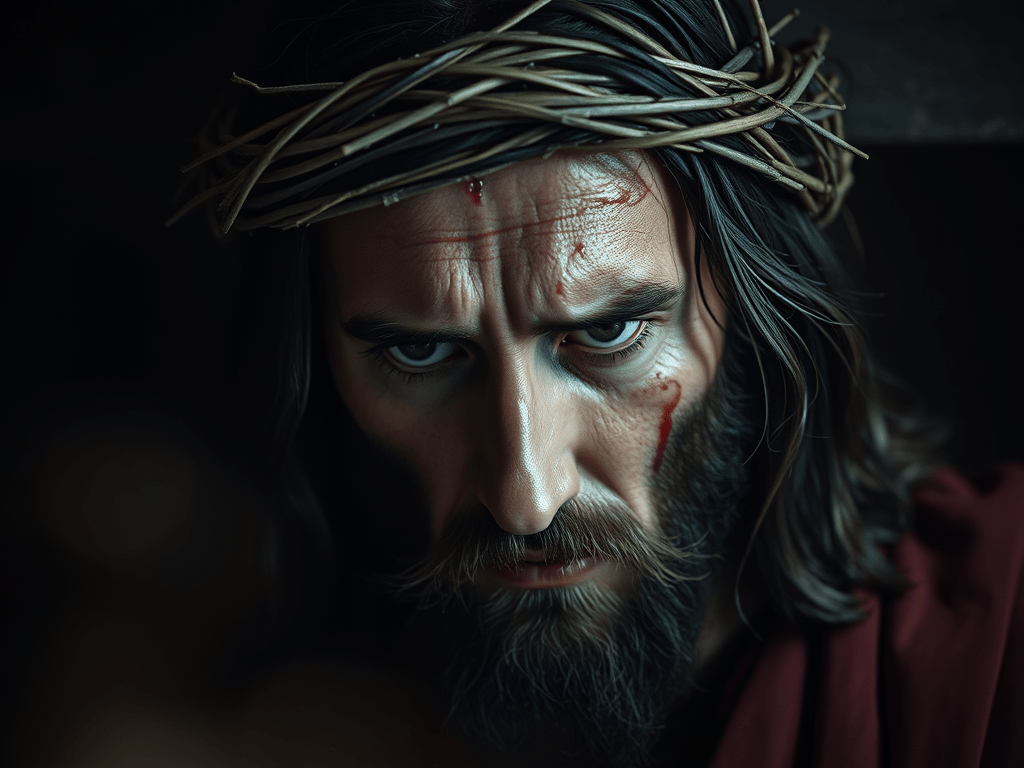
The previous two parts proved that (1), according to historical testimony, we can be certain that Jesus of Nazareth existed and was crucified and (2), the authors of the gospels are almost certainly who they are claimed to be. Next is to provide a short explanation as to why we can be certain that Jesus did not survive this crucifixion. It might seem a little pointless, but some will doubt this. Secondly, I think this would really help as to elucidate what he really went through. Much of the following will be taken from a collection of YouTube videos on this topic, along with books. They are linked at the bottom.
Initial Mental State
Jesus was known to be an early riser (Mark 1:35), and there is no reason to suggest that he did anything differently on the day he ate his last supper with the disciples. From the time that he woke up on the day of the last supper to his crucifixion, he had been awake for about 36 hours.
At the beginning of his ordeal, Jesus underwent haematidrosis (Luke 22:44) – which is what occurs when one undergoes immense stress or anxiety and begins to sweat blood. One could ask why this didn’t cause him to bleed to death, but provided the Judean climate, the blood would also be able to chill during the night, with the cold air causing the blood vessels to constrict.
Scourging
Scourging (John 19:1, Mark 15:15, Matthew 27:26) is also something that was limited to slaves and criminals, due to how barbaric it was. Typically, the victim is stripped completely naked, and tied by the wrist to a post/wall with his back exposed. The victim would be whipped from the back of his arms down to his shoulders and back, all the way down to his heels. Traditionally, this would be limited to 39 lashes from two well-built Roman legionnaires. The actual weapon used for this was called a ‘flagellum’ or ‘flagrum’. This was a whip, which was “knotted with [sheep or cattle] bones or heavy indented circles of bronze or terminated by hooks, in which case it was aptly denominated a scorpion”[1]. One lash of this weapon could easily produce a wound that could take 20 stitches to close, as this could easily rip out flesh and skeletal muscle. It wasn’t uncommon for individuals to die from the flogging alone. Again, one could ask how the man did not bleed to death, but it ought to be remembered that this would have happened in the early morning, where the night’s chill was still present.
The King’s Crown
The crown of thorns (Matthew 27:29, Mark 15:17, John 19:2) forced onto Jesus’ head would have used thorns that were about an inch and a half to two inches long. The thorns would be strong enough to penetrate the outer skull and, quite clearly, the pain from this would have been ridiculous.
He’s still alive?
From what has been noted so far, one could ask how Jesus wasn’t already dead, but it should be known that Jesus was a healthy man in his early thirties. He slept outside, did carpentry work, walked everywhere he went. The man would have held an impressive physical stature. As such, it isn’t unreasonable to use this as justification as to why we see no signs of Jesus undergoing mental shock through his torture. He likely felt everything. However, all of this battery is exactly what contributed to a different kind of shock, “hypovolemic shock” – caused by severe dehydration or blood loss.
The Cross
The cross would not be a ‘finished’ piece of wood – with all of the splinters and unfinished work being shown in all of its glory. The victim would be carrying this themselves (John 19:17), all the while the cross bar digging into their back.
The nails would be driven into the wrists – due to the fact the muscle in the hand would not be able to support one’s weight. The nail would be driven through the median nerve, an extremely sensitive nerve that would limit blood loss but would cause otherworldly pain. The ordeal at the feet was similar, with the nails being driven through the plantar nerves.
Death by…asphyxiation?
Whilst on the cross, as the diaphragm drops into the abdomen it pulls in air and the body being set to the ‘inhale’ position, so someone hanging on the cross had not difficultly pulling air in. The difficulty was in breathing air out. For a crucifixion victim to exhale, they would have to pull up against the spikes with their hands and push up against the spikes with their feet. All the while the splinters from the cross digging into their scourged back, naked, and wrists and feet pierced.
As the person exhausts, they go into ‘respiratory acidosis’, which is where the carbon dioxide in the blood begins to dissolve as carbonic acid, causing the acidity of the blood to increase and the person’s heart rate to increase. Likely, this is how Jesus would have known it was his time, and he would have died of cardiac arrest. Even before he died, the hypovolemic shock that would have caused a sustained elevated heart rate would have contributed to fluid in the membrane around the heart – a pericardial effusion – as well as around the lungs – a pleural effusion, which is exactly what we see in John 19:34, when Jesus is stabbed to check his death.[2] By this point, Jesus is certainly dead.
…the odd one out?
Generally, the faster way to kill a victim was simply to break their legs. This would prevent a person pushing up to breathe, and therefore dying due to asphyxiation. However, John 19 tells us that Jesus was already dead by the time the other two criminals had had their legs broken. The blood and water gushing out (John 19:34) tells us that Jesus was likely dead for up to an hour at this point, and with the soldiers not breaking Jesus’ legs (John 19:33) along with high stakes in this matter (Mark 14:44-45), it’s quite difficult to argue that the guards would not have been certain that they had killed Jesus. It can be argued that this is even a prophecy fulfilled, as Psalm 34:19-20 seems to describe something awfully similar…
For me, this line of evidence swings pretty hard. It’s not clear what kind of mental state one would have to be in to willingly put themselves through this sort of suffering, but John 10:18 clarifies a lot.
Thanks for reading,
Rookie
Sources:
- https://penelope.uchicago.edu/Thayer/E/Roman/Texts/secondary/SMIGRA*/Flagrum.html#:~:text=The%20flagellum%20was%20chiefly%20used,was%20aptly%20denominated%20a%20scorpion.
- Strobel, 2016, Chapter 11, The Case for Christ
- https://www.youtube.com/watch?v=0B3kgiLxybY&list=PLeKucYCm8gBVu_1WIu5Oe22WDCIOgiCMl&index=5&ab_channel=UnChainedByGraceMinistries
 RookieApologises