• About
  • Posts
  • The Library

RookieApologises

  • On the Origin of Man – 5: …but why add Theism?

    Oct 27th, 2024

    If you’ve been paying good attention to my writings throughout this series, you may have noticed me consistently affirming that ‘there are things I do not think naturalism can explain’ – along with bits and pieces of reasons throughout. Of course, I have purely philosophical reasons, in addition to historical arguments for the resurrection and a testimony of personal experience to rationally justify my Christian belief. Aside from my last point, this specific post is largely aimed at providing mostly scientific (though largely philosophical at the end) reasons for which I do not hold to a Strong Naturalistic view of Evolution, but rather a model of Evolutionary Creation.


    My reasons can be summarised as follows:

    1. Cellular Functional Information and Abiogenesis
    2. The Emergence of Sexual Reproduction
    3. The Mind
    4. Dominance

    To be fair, point 1 could support a Deistic model, but when adding 2, 3, and 4 I think that, overall, my reasons are more expected from a more strictly judeo-Christian God.

    #1: Cellular Functional Information and Abiogenesis

    Quite uncontroversially, information can be defined as ‘a sequence of characters that produces some specific effect’. According to information theory, information and probability are inversely correlated. Although the longer a sequence of characters is, the more information-carrying capacity it has, it would also mean that it is less likely to convey meaningful content because it is more likely that it would contain useless characters.

    For example, the sequence ‘mp’ doesn’t contain any useful information (at least, in the context of the formal English language), but all you need to do is switch the ‘p’ for an ‘e’ and all of a sudden the sequence not only carries information but meaning.

    There are 262 two-letter, alphabetical sequences, and only a small fraction of these are actual formal English words. If you lengthen the word to something like ‘messy’, you do get something longer. However, presuming random selection, you also reduce the probability of landing on a formal English word (as there are now 265 possible combinations), showing the inverse proportionality.

    Why is this relevant? I’m glad you asked.

    It is quite well known that DNA is the information storage centre of the cell, but not many have stopped to think what exactly it means to be ‘information’. Abiogenesis, simply put, is the idea that life arose from non-life about 3.5 billion years ago on Earth. It tries to propose a natural explanation for the origin of such information, and Strong Naturalistic Evolutionists would essentially have to prove that the following stages are reproducible under prebiotic conditions:
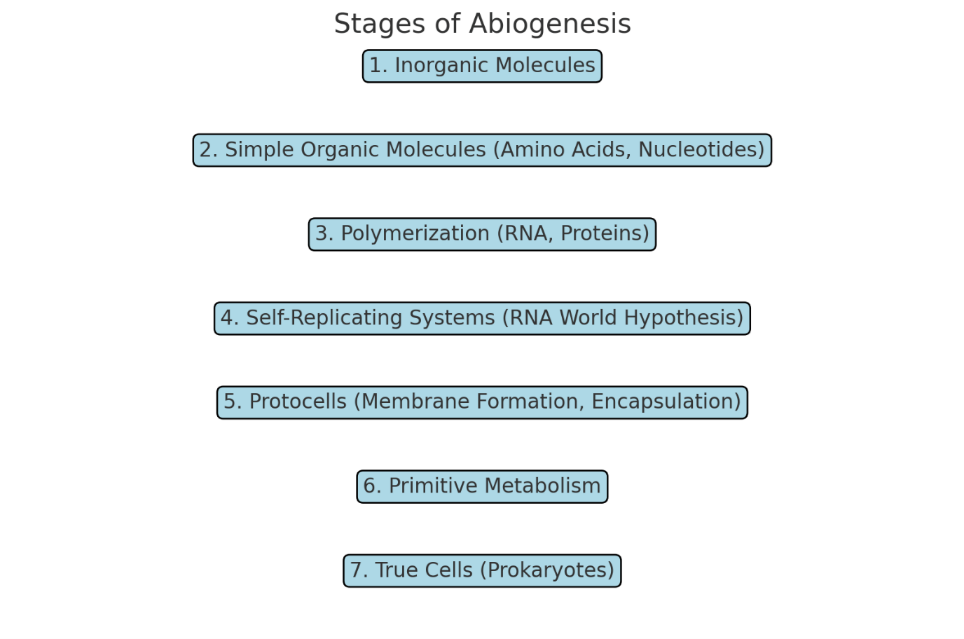
    The stages are explained as follows:

    1. Inorganic Molecules: The starting point involves simple inorganic compounds like water (H₂O), carbon dioxide (CO₂), methane (CH₄), and ammonia (NH₃).
    2. Simple Organic Molecules: These inorganic compounds combine under the right conditions (e.g., lightning, UV radiation) to form basic organic molecules like amino acids and nucleotides.
    3. Polymerization: These organic molecules must link together to form more complex structures like RNA strands and proteins. This stage involves creating long chains from simpler building blocks.
    4. Self-Replicating Systems: The emergence of molecules capable of self-replication (like RNA) marks a critical step. The “RNA World Hypothesis” suggests that RNA could store information and catalyze its own replication.
    5. Protocells: Self-replicating molecules must become encapsulated within membrane-like structures, forming protocells that maintain an internal environment distinct from the outside.
    6. Primitive Metabolism: These protocells need basic metabolic pathways to harness energy and sustain themselves, possibly involving simple redox reactions.
    7. True Cells: Finally, these primitive systems evolve into the first simple cells, resembling prokaryotes, capable of growth, division, and evolution.

    Proteins (stage 3) are large, complex molecules that are made up of amino acids that are joined up in a specific sequence, and this sequence determines the protein’s structure and function. These amino acids that constitute them are smaller organic molecules, and they are determined by a corresponding sequence of things called ‘codons’ in something else called messenger-RNA (mRNA) – more simply, you get a specific amino acid because of a specific sequence of mRNA, and this mRNA is formed by a transcription of DNA. DNA, specifically, depends on certain sequences of nucleotide bases – these are adenine [A], thymine [T], cytosine [C], and guanine [G]. The picture should be starting to clear up a little now, but essentially, our genome can be seen as one very long ‘word’ that specifies extremely complex behaviour within our bodies.

    But wait, that’s not all.

    Proteins aren’t two-dimensional. Their three-dimensional shapes exhibit complex shapes, irregular arrangements, and most importantly, specificity. This is to say, some features must either be exactly what they are or within very fine boundaries for the overall protein to function. But, remember, these things are all determined by a sequence of nucleotide base pairs in a given DNA sequence.

    Hypothesis 1: Chance

    Now, take all this dizzying complexity, and plug it into a ‘chance theory’ of abiogenesis, which is one of the two (or maybe three) real options open to the Strong Naturalistic evolutionist, we start to see some glaring problems.

    Firstly, specificity requires the correct letter-by-letter creation of a protein, however, this seems very improbable presuming you are going with some form of primordial soup starting point – i.e., the idea that these organic molecules had somehow formed and ‘knocked into each other until something happened’.

    Secondly, such formation also requires solely peptide bonds, which roughly halves the probability because non-peptide bonds also form. Another thing to note is that the subset of proteins that are functional among all the combinations of amino acids is extremely low.

    Thirdly, well, let’s actually run the numbers:

    • Most functional proteins are made of hundreds of amino acids, with an average size of about 300 amino acids2  – but presuming amino acids in a prebiotic soup may be simpler – let’s take a number on the smaller side – 150.
    • As stated, peptide bonds between amino acids form with a probability of about ½, so the probability of an amino acid forming by chance is about 1 x (½)150 = 1 chance in 1045.
    • Next, in nature every amino acid found in proteins (with one exception) has a distinct mirror-image of itself. There is one left-handed version (L-form) and one right-handed version (D-form), called optical isomers. Functional proteins only tolerate left-handed amino acids, so we need to square the previous probability – to get 1 chance in 1090
    • Maxwell Professor of Molecular Biology at Biola University, Douglas Axe shared in 2007 his calculation of the ratio of (a) the number of 150 amino acid sequences that produce any functional proteins whatsoever to (b) the number of possible amino acid sequences of 150 amino acids to be 1 chance in 1074.

    All we have to do is multiply these independent probabilities together – 1090 + 74 = 164. This is the probability of getting even one functional protein of modest length, from prebiotic soup.

    With all of these charges, one could raise the point – “Surely given all the possibilities and chances in the universe, such things could happen?” It’s a fair question, so let’s look at what probabilistic ‘resources’ the universe has to offer.

    We can do this by calculating the number of possible events that could have happened since the beginning of the universe. By doing this, we can establish an upper boundary for how many ‘event resources’ the observable universe could possibly work with:

    • There are about 1080 elementary particles in the observable universe, and because there is an upper limit on the speed of light, only those parts of the universe that are observable (i.e., could have affected events on Earth) are relevant to this calculation – as otherwise would be presuming that some events can break lightspeed.
    • There are also about 1017 seconds that have passed since the Big Bang.
    • Due to the properties of gravity, matter, and electromagnetic radiation, physicists have determined that there is a limit on the number of physical transitions that can occur from one state to another within a given unit of time. According to physicists, a physical transition from one state to another cannot take place faster than light can traverse the smallest significant unit of distance – the Planck length (10-33 cm), which takes light 10-43 seconds to travel.

    This would put an upper bound of 1080 + 17 + 43 = 140possible atomic events/collisions in the observable universe since the origin of the universe. Other calculations have been made, and this is a higher bound, but it won’t help the naturalists’ case.

    Using these generous numbers that we have found, we notice that, by chance, the universe does not have enough opportunities (10140) to even compensate for functional proteins forming by chance alone (1 chance in 10164). This does not mean that this would be impossible, but it would mean that if it did happen, doing some simple statistical hypothesis testing would show that almost certainly there would have been some other cause ‘helping it out’.

    Hypothesis 2: Necessity

    A second hypothesis put forward is the ‘necessity’ hypothesis – i.e., that there are some biochemical laws that exert themselves upon matter to make it such that the first cell was physically ‘predestined’. It also claims that chemical processes are deterministic (i.e., always produce the same outputs given the same inputs), and it must prove a couple of things:

    1. Reproducibility in Laboratory Conditions
    2. That there are multiple pathways to life
      • One may ask – isn’t it sufficient to show just one pathway?
        In a sense, yes, however, this single pathway may just easily be dismissed as a fluke, rather than an inevitable result. If there are multiple pathways – even with different starting points or slightly different conditions – it supports the idea that life will emerge as long as basic biochemical/environmental criteria are met.
    3. Predictive models: The hypothesis should produce models that predict the environmental conditions under which life is likely to arise
    4. Universality of principles: The hypothesis would need to show that the principles leading to life are universal, applying not just to Earth, but any environment with similar conditions

    Multiple models have been put forward to try to propose some form of necessity. Dean Kenyon and Gary Steinman co-authored Biochemical Predestination in 1969, proposing a deterministic model and theorizing that the specific properties of amino acids and other biomolecules drive them to self-organize into complex structures, but Kenyon later retracted his support for this idea, moving toward intelligent design.

    Michael Polanyi, a philosopher and scientist, critiqued purely materialistic and deterministic models of life’s origin, arguing that life and biological information cannot be reduced solely to chemistry and physics – for example, the bonding properties of each nucleotide are specified below – the image is taken from Stephen Meyer’s book – Signature in the Cell:
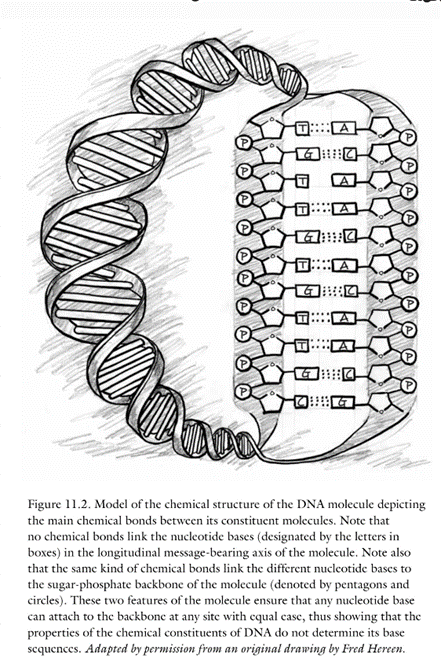
    Just as the properties of building blocks do not determine a building, the bases do not determine DNA, and indeterminacy is actually necessary for complexity, because determinism leads to repetitiveness, not specificity.

    Another model proposed is by Stuart Kaufmann, who has proposed models based on the idea of self-organization, but Meyer says that Kaufmann’s model doesn’t properly answer the specificity of sequencing itself, but rather presupposes specificity (which is begging the question).

    Therefore, necessitarian models do not sufficiently explain the data we have at hand, so the most popular approach nowadays is to merge hypotheses 1 and 2.

    Hypothesis 3: Chance and Necessity

    The most popular hypothesis today is what is known as the RNA world hypothesis. This hypothesis states that RNA molecules were the first to both store genetic information and catalyse chemical reactions.

    Without getting too much into the weeds of things, the RNA world hypothesis needs to show five things:

    1. The plausible prebiotic formation of nucleotides and their assembly into RNA.
    2. The emergence of functional, self-replicating RNA molecules.
    3. The stability and persistence of RNA in prebiotic environments.
    4. The formation of protocells that could contain and protect RNA.
    5. The transition from RNA-based life to the DNA-protein world.

    However, the hypothesis faces significant challenges:

    • RNA molecules are hard to synthesize and easy to destroy, especially in aqueous environments, where it can easily degrade through hydrolysis – which means that it is very difficult to replicate such processes as would be expected in prebiotic scenarios.
    • RNA-based replication systems are also ridiculously hard and maybe even impossible to create. While some ribozymes have been shown to catalyze RNA replication in lab settings, fully self-sustaining RNA replication with high fidelity is far from being realized.
    • The hypothesis also doesn’t explain the origin of biological information. Remember that RNA already has functional information contained inside of it in its nucleotides. So, such models basically presuppose a mix of a random and necessitarian formation of such nucleotides and sequences.

    In essence, even the RNA world hypothesis begs the question. If RNA itself needs functional information to form, then this model is almost certainly inherently incapable of explaining the origin of functional information without deferring to random natural processes – which, although necessary for complexity as we have seen, is incredibly improbable on its own.

    Ultimately, whether “Chance and Necessity” is able to explain the emergence of life on Earth isn’t really a problem for my model at all. Since I am taking a more abductive approach, all I need to really show in this section is that even if it does, or somehow will in the future – the sheer improbability of these circumstances coming to be on their own is almost certainly enough to rationally justify, or lend credence to a conscious external source of information – especially since information almost always comes from such source.
    However low a probability someone would like to assign to such source is up to them – and whether they think this source is a super-intelligent alien is not really my concern, but I don’t think it can be reasonably driven as low as probabilities required by some form of chance hypothesis necessitated by naturalism’s view that the universe operates solely according to natural laws and forces. I think this is sufficient evidence to justify a belief in, at least, one supernatural initial miracle to get evolution started (if it even did) for my model.

    #2: The Emergence of Sexual Reproduction

    This point is something I’ve thought about and haven’t got a real source for, and not much will really be said here. The problem is as follows:

    Naturalistic hypotheses almost always propose the formation of initial organisms that will reproduce via asexual means because sexual reproduction necessitates the existence of multiple organisms that ‘know’ about each other (to reproduce) – therefore needing them to account for at least two reproductively compatible species or organisms. Even if this is not the case, such processes must account for species that, at some point in the past, had some common ancestor that just ‘decided’ (in some way, either through chemical randomness or necessity) to start reproducing via sexual means.

    One could propose that two separate ancestor species started copulating with each other and that the organisms on Earth that reproduce this way are descended from this species, but one also needs to account for the probability of such an occurrence given naturalism, given Earth’s conditions, given reproductive compatibility, given probability of ‘meeting’ (i.e., being in the same place at the same time) and other concerns such as survivability of offspring. At the very least, it seems like such an occurrence is much more probable under Theism (“it is not good for the man to be alone”).

    There do exist proposed solutions to this problem, but it is certainly not yet solved. For example, the ‘gradual transition’ hypothesis and the belief that early eukaryotes are believed to have first reproduced sexually still suffer from questions relating to the origin of DNA, and specifically the DNA for such a process, which I have proposed above. Although the ‘Red Queen Hypothesis’ suggests that sexual reproduction likely helps species ‘keep up’ in the evolutionary arms race against rapidly evolving parasites and pathogens, the question being asked here is not whether this process is beneficial, but rather how it, presupposing only natural forces and laws, came to be at all. Gradual processes involving incremental steps toward full sexual reproduction such as gene transfer might provide some sort of explanation, but surely anyone can see that this seems to get dangerously close to the teleology and purposiveness of such biological processes which, again, seems vastly more probable under Theism.

    #3: The Mind

    Firstly, it should be noted that not all naturalists are ‘physicalists’. When it comes to predominantly Atheist viewpoints, there are ‘hierarchies’ of permissiveness when it comes to how ‘material’ people are about reality.

    I’ll lean on a very smart Atheist philosopher, Graham Oppy, to define Naturalism for me:

    “…there are two bits to naturalism…all of the causal entities that there are natural entities, and all the causal properties that there are natural properties…and the natural entities are just—the properties and entities that are amenable to study by the sciences, very broadly construed, right? So by “sciences,” I don’t just mean the formal sciences and the physical sciences, I mean the social sciences as well.”

    For the sake of this post, we can limit the type of naturalism we are investigating to physicalists – those who believe that all that exists is the physical world. The distinction between physicalism and naturalism is this:

    • Physicalism states that reality is entirely physical, and therefore entails that reality can be explained by some ‘proper understanding’ of physics.
      • Reductive physicalists believe that everything can be ultimately reduced to physics and physical reality is all that exists.
      • Non-reductive physicalists believe that not everything cannot be ultimately reduced to physics, such as mental states or social phenomena – these phenomena are said to ‘emerge’ from physical processes.
    • Naturalism states that the only explanations are explanations afforded by the natural sciences, which could be biology, chemistry, or any other social sciences – not just limiting explanations to physics.

    Now, it’s not for me to defend either of these positions, but the reason it is relevant this post is that there are a couple of things that naturalism needs to account for:

    1. Intentionality: this would be the ‘directness’ or the ‘aboutness’ of thought toward some object/objective
    2. Qualia: this would be the raw, qualitative, phenomenal ‘feel’ associated with experiences and other conscious mental states
    3. Privacy: this is first person, privileged, subjective access to one’s own conscious states
    4. Rationality: the ability to intellectually grasp abstract and universal concepts and propositions, and apply formal rules of inference

    Now, we have already seen that, quite plausibly, the laws of biology cannot be reduced to pure physical phenomena (due to functional information), so it seems that mental properties, which are at least at that level, cannot be reduced to purely physical phenomena also. Therefore, I don’t really have much more to say directly to reductive physicalists.

    Moving on to non-reductive physicalists, again, it seems like we don’t really have very good empirical evidence to verify at what point the mental phenomena above really begin to ‘emerge’ – what the dividing line is such that functional information simply ‘emerges’ from a structure or becomes irreducible (at least, presupposing a purely physical reality).

    Furthermore, briefly, a physicalist view also seems to struggle empirically with distinguishing what parts of a causal process are actually relevant to an entire causal series.
    For example, presume that the mind is purely physical and every thought you have either (1) emerges from some neurons firing or (2) is directly caused by it. To what extent can we really say that these neurons were the sole relevant cause of the thought? Can we not say that the wind that blew, causing your eyes to look somewhere else caused a chain reaction that eventually led to the neurons firing is also equally relevant? In that case, to what extent can we really say that that which is ‘you’ is really just a biological substance – is it wrong to add the wind too? Why?

    This seems to conflict with the reality of intentionality and qualia – the truly subjective feel of one’s experience and the directedness that we all experience. Worst of all, it seems to directly challenge the persistence of identity through time. In this case, how exactly would we be able to directly point at something essential that remains with you and makes you “you”, at any point in your life?

    There are also difficulties in verifying the relationship between brain activity and mental activity, in that brain scans seem to necessarily struggle with accounting for mental processes. At most, brain scans might be just said to be able to explain the correlation between some phenomenological property and some given brain activity – but it is a large leap to claim that this is a causal relationship. For if it were, the Neuroscience community would likely be screaming ‘victory’ by now.

    The points raised are similar to the ‘philosophical zombie’ argument that is popular in the field of the philosophy of Mind, which entertains the metaphysical possibility of beings that are physically identical to humans, yet do not experience consciousness. i.e.,

    Premise 1: If it is conceivable that zombies could exist, then it is metaphysically possible that they exist.

    Premise 2: If it is metaphysically possible for zombies to exist, then consciousness is not identical to or reducible to physical properties.

    Conclusion: Therefore, physicalism is false because it cannot account for consciousness.

    Now, one may doubt that conceivability entails metaphysical possibility – and I would actually agree with this person. I think imagination (which is like forming a material mental representation based on sensory information) entails metaphysical possibility, but not conception (which is just forming a notion or idea of something). However, simply the fact that my brain is not numerically identical (i.e., exactly the same as) to my mother’s, yet we both (arguably) experience mental phenomena shows that there is something common between human brains that likely allows for mental phenomena that likely can’t be reduced to physics, or purely emerges from physics. I suppose that the physicalist would need to show (at some point in the far future maybe) what such commonality is that entails such experiences. Now, whether the Zombie argument works isn’t really my point here – rather, I simply want to show the sheer difficulty the natural sciences have when it comes to explaining mental properties through physics or natural sciences alone – Theism seems to have much fewer problems.

    As for Naturalism as a whole, well, I think the whole of point 1 can be devoted to providing an evidential argument against it. As I said in that section, if you wish to credit the beginning of humanity’s existence to a hyper-intelligent alien, that is up to you. However, I think later blog posts will help us to zero in on what kind of cause best explains other data.

    The Naturalist could always object that ‘we don’t know enough yet’. Of course, but what we do know is that information does arise from conscious agents. Therefore, it seems to make sense that an agent that can impart information in another seems to be a better explanation for the origin of information than some non-conscious agent – especially since information generally degrades over time in a purely natural system – as stated by the idea of entropy in information theory:

    As entropy increases, the system becomes less organized and more random, leading to the degradation of information content.

    Lastly, a Naturalist also needs to explain our ability to grasp non-physical phenomena such as numbers, propositions, moral values, meaningful symbols and probably most interestingly, beauty – such as artistic beauty or music.

    #4: Dominance

    This part will be short, and I’ll largely quote from some points I made in my “God doesn’t exist.” post from last year.

    It seems quite evident that the pure probability of our dominance over other much-stronger and faster species presuming Strong Naturalistic Evolution and natural selection is very unlikely. When considering dangers, alongside natural disasters – it seems quite interesting that such a resilient, yet feeble species would eventually possess such a strong command over the natural world. Although intelligence is a very powerful trait, I suppose it is dubitable that intelligence alone (1) could have emerged naturally and (2) could have coupled itself so nicely with our other biological qualities to have us reign so supremely.


    Ultimately, I think I have given good reason to support why a theistic model of evolutionary creation is preferable to a naturalist version. My argument has not been deductive, but rather abductive. I am not saying that naturalists will never be able to explain these things, but rather, that Theism will likely always provide a much better explanation for things such as the origin of DNA, the origin of sexual reproduction, mental phenomena, and our intellectual dominance.

    If you’ve got any thoughts or objections, go ahead and leave them below!

    Thanks,

    Rookie


    Sources:

    1. Point 1 relies heavily on material taken from Signature in the Cell by Stephen C. Meyer
    2. The 300 Amino Acid average is taken from Alberts, B., et al. “Molecular Biology of the Cell.” 6th edition. Garland Science, 2014
    3. Other sources are linked throughout
  • On the Origin of Man – 4: Why not Young- or Old-Earth?

    Oct 6th, 2024

    I wasn’t certain whether this fourth post was even necessary, given that I think I have provided adequate justification for my position in parts one and two. Still, I suppose that there’s nothing wrong with me providing reasons for my not falling into either of these camps.
    Hopefully, this post won’t be nearly as long as either of the first two, and most of my justification will be aimed against Young-Earth Creationism (as I have already stated that I am not dogmatically averse to Old Earth models).


    Broadly, my reasons are as follows:

    1. Unreasonable presuppositions
    2. Novelty
    3. Empirical evidence
    4. Arbitrary stopping points

    Unreasonable Presuppositions

    The first, and most important reason that I do not fall into either camp is the presuppositions that they impose on scripture and exegesis, especially through their literalism.
    Young Earth Creationism specifically holds to both a chronological and literal viewing of Genesis 1.  The Bible is very much more a book detailing the story between God and mankind, than it is a book of science.
    Now, although I do not believe that it is metaphysically impossible for God to create the world as is literally described in Genesis 1, we also need to be wary of presuming that the Spirit’s inspiration intended to convey that Genesis 1 was literal. This is something I caution against in my first post, explaining the reasoning for my methodology.

    Novelty

    The following will be a summary of points raised in another excellent video by Inspiring Philosophy and will be directed specifically at Young Earth Creationists. I encourage you to watch his video yourself because the following is a summary.

    Secondly, and surprisingly to most, a non-literal interpretative method is not at all foreign to Christianity. Multiple Christians throughout the ages have interpreted Genesis allegorically or figuratively, such as St. Irenaeus of Lyons in the 2nd Century AD (Against Heresies 5.23.2, 5.28.3), St. Clement of Alexandria (Stromata (Miscellanies) 6.16), St. Augustine (The Literal Meaning of Genesis 4.27).

    Of course, the views of the aforementioned Church Fathers do vary, one holding to instantaneous creation (St. Clement), one holding to ‘thousand-year’ days (St. Irenaeus), and one holding to ‘God divided days’ (St. Augustine). Multiple other influential figures in the Church held to allegorical, or figurative interpretations, but the point to be made here is simply that non-literal interpretations of creation are not new within the Church.

    There have existed other individuals, such as Isaac Newton, Bishop Ussher, and Johannes Kepler who have agreed that the date of creation was around 4000 BC, however, at the time, the scientific research was very limited regarding the age of the Earth. Thus, these individuals held to this belief because the contemporary evidence supported it, and that was because there had not been research against it.

    Around the late Middle Ages, many Christians promoted something similar to what is called the ‘gap interpretation’ of Genesis 1:2. The text says that the Earth was ‘without form and void’  (or, ‘without shape and empty’ in the NET), such interpretation says that this could have been during an unspecified amount of time, during which there was only chaos that was later ‘reworked’ into creation. Some people even thought that this could have been millions of years.

    In 1865, Reverend Richard Main wrote:

    “Some school-books still teach to the ignorant that the Earth is 6000 years old.… No well-educated person of the present day shares that delusion”

    As a matter of fact, in a publication of the Geological Society called ‘Myth and Geology’, Historian Michael B. Roberts writes on pages 47-48:

    “Christian thinkers were open to a slightly longer time-scale long before geological evidence was apparent, as may be evidenced by Grotius, Mersenne, Burnett, Bishop Patrick and myriad others in the seventeenth century, who accepted a long duration of chaos and thus ‘deepish’ time, before there was any geological evidence for a great duration of time. And that is without going further back to the broader interpretations of Genesis of the Church Fathers such as Augustine…. Despite the date of 4004 BC being found in many English bibles a strict six-day creation was never the dominant view and was the official position of no church in Europe or America (until the late twentieth century)”

    Regarding evolution specifically, multiple Christians, even around the time of Darwin, were supportive and/or saw no conflict between the theory of evolution and Genesis. Examples of such are Botanist Asa Grey, Philosopher James McCosh and Geologist and Mineralogist James Dwight Dana. Palaeontologist Richard Owen and Zoologist St. George Jackson Mivart both promoted their own models of theistic evolution. Historian Ronald Numbers writes in his book ‘The Creationists, Expanded Edition’, writes:

    “Even in the conservative south, dominated culturally by Bible-believing Baptists, a number of Church-related colleges had been teaching the theory of evolution for decades.”

    This is not to say that there was no Christian resistance to the Theory of Evolution, but it is certainly overinflated by people who are uneducated on the history of this topic. The Christians who left writings behind were largely accommodating to the research that was available at the time.

    The ‘Young Earth’ movement, on the other hand, is quite modern.

    Within the period of 1900-1950, there was one group that was mostly comprised of Young-Earth creationists – the heretical Seventh Day Adventist movement, who elevated the visions of their ‘prophet’, Ellen G. White, to be on par with scripture. Ellen had a vision that God took her back to the time of creation and revealed to her that everything was created in six, literal, twenty-four-hour days.

    Among these Seventh-Day Adventists, was someone called George McCready Price – an ‘armchair’ geologist (as some have referred to him). He wrote several papers and books, arguing that the geological record had been formed as a result of Noah’s flood (which was what God had allegedly showed Ellen after the six days of creation), and he referred to this as ‘flood geology’, and taught that the Earth, and life on it, was 6000 years old, and was created in only six days. As a result, many arguments that Young-Earth Creationists use today date back to Price – not actual geological specialists.

    People didn’t really support Price initially. Some years later, Bernard Ramm, in 1954, exaggerated Price’s influence and criticised Price’s ‘flood Geology’ in his book ‘The Christian View of Science and Scripture’. However, this book instead inspired a young theologian – John Whitcomb JR., to write his doctoral dissertation defending Price and his Young Earth views. He tried to get his work published as a book with some backing from Geologists, but they were quite clear that the geological record could not be used to support his interpretation.

    Whitcomb decided to contact Henry Morris, who was not a Geologist, but rather, had a PhD in hydraulic engineering. Morris agreed to co-author the book, but since Price’s arguments had been rejected for decades by now, they had to add a ‘spin’ to his work. So, while recycling some of his arguments, they argued that in addition to the Earth being young, that the Universe was young also (Price only argued that the Earth, and life on it, was young, but had nothing to say on the age of the Universe). No Geologist endorsed the book, but in 1961, they had the book published – “The Genesis Flood: The Biblical Record and its Scientific Implications”.

    Although scientists themselves saw the obvious rehashing of previous arguments and rejected it as such, the populace wasn’t so well informed, and within about 25 years, the book had sold 200,000 copies. The writers became celebrities, and before long – the word ‘creationist’ quite quickly became synonymous with ‘young-earth creationist’.

    Quite simply, Christianity had never dogmatically affirmed Young Earth Creationism, and had been largely welcoming to the contemporary empirical research. Therefore, with this theory drawing much of its influence from a heretical ‘prophetess’, I think I have sufficient reason to reject it.

    Empirical Evidence

    I have already provided the results of empirical methods in part two to support my belief in the presence of macroevolution in creation, but multiple other lines of evidence can be used to rebut a 10000-year limit on the age of creation. Such are:

    1. Cosmic Background Radiation:
      1. This is light that is the oldest and most distant light in the universe. The blackbody spectrum that we can measure with it, with a peak temperature of about 2.7K, is exactly what you would expect from radiation that had been ‘stretched’ or red-shifted over billions of years.
    2. Carbon Dating methods:
      1. These methods are used to measure the ratio of Carbon-14 (which decays over time) to Carbon-12 in once-living materials. It is most reliable for samples up to 50,000 years old, but this is sufficient to press charges on a Young-Earth view.
    3. The Geological record:
      1. As stated earlier, the geological record does not support a young-earth view. For example:
        • Radiometric dating: Similarly to carbon dating, this technique measures isotope decay, but it measures it in rocks. The oldest rocks on Earth, found in western Greenland, have been dated to be 3.7-3.8 billion years old. Some zircon minerals in Australia have been dated to being around 4.4 billion years old.
        • Geological processes such as Erosion, Sedimentation and Plate Tectonics: These processes are slow. The formation of mountains, canyons and sedimentary rock layers through gradual processes like erosion and deposition takes millions to hundreds of millions of years – as evidenced through direct measurement (of erosion and sedimentation rates) and radiometric dating of geological layers.
        • Stratigraphy and the Fossil Record: The geological principle of superposition states that in undisturbed layers of rock, older layers lie beneath younger ones (which makes sense, right?). By studying these layers, the fossil record has shown a clear progression from simpler life forms in older strata to more complex organisms in recent layers, spanning billions of years.

    Many more lines of evidence can be given, and of course, these evidence do not each individually refute Young Earth creationism as a whole, however, they each singularly cast doubt on the premises of the Young Earth movement. From casting doubt on the age of the Earth to the creation of microorganisms and more. Fossil records may even cast doubt on some presentations of Old Earth models.

    Arbitrary Stopping Points

    Lastly, this specific section will give some extra reasons as to why I currently favour Evolutionary Creation models over de-novo Old Earth models, in addition to the ‘presuppositions’.

    I suppose that, simply put, I’m not really convinced with Old Earth models’ answers to the creation of Adam and Eve. For example, if you are going to take Genesis 1 literally, which I think is not loyal to the cultural context of the time, then, to me, it doesn’t make much more sense to not go the whole way and affirm a Young-Earth model, but as we have already seen, there is not strong evidence for it at all, and also, it gained much force from a heretic.

    Secondly, many models struggle to answer common-descent and genetic similarities between chimps and humans. Some have responded with ‘common design’, which I think is fair, but again, this just seems to be an arbitrary stopping point. Why use a common design if you are going to affirm a largely de-novo model?
    Of course, one could say that I also have a similar arbitrary point with adding God in, but I gave what I think was adequate justification for that, referring to the anthropological ‘Great Leap Forward’ and the sudden increase in human capacities. Further, I also think that there are things that natural processes cannot compensate for, but that is not for this post.


    To be honest, there’s not much more in the way of me accepting Old Earth Creationism, but that doesn’t mean that there isn’t much in total. The barriers of empirical evidence are quite high, and although the evidence for evolutionary creation is not perfect (for example, the fossil record does have some gaps and uncertainties), I think it is the strongest candidate, and I think I have given sufficient evidence to warrant that conclusion.

    Thanks,
    Rookie


    Sources: Again, are linked throughout the post 🙂

  • On the Origin of Man – 3: Objections

    Sep 15th, 2024

    There tend to be some standard objections to models of evolutionary creation. This post will be targeted at responding to them. They would be: 

    1. Evil, death, predation, suffering and …veganism? 
    2. Divine Inefficiency 
    3. “It’s unimpressive.”
    4. 6000 years
    5. “It’s ad-hoc.”

    Are there other objections? Yes.
    Is it my intention to respond to every conceivable objection? No.
    Not sure what else to say, so let’s get into it! 

    Objection 1: Evil, Death, Predation, Suffering and …veganism? 

    1.1. Evil and Death

    Prima facie, the first clear bumps in the road are moral evil and death. I mean, it’s common knowledge that Adam and Eve were immortal before they ate from the Tree of Knowledge, right? If death is a consequence of the fall, it seems pretty weird for it to retroactively apply to ‘people’, or any of creation, before the fall, no? The second problem is, how exactly does sin work pre-fall? Does this mean that there was sin before the first sin? 

    Actually, when looking at the text, the above reading doesn’t cohere very well at all. Let’s take each problem in turn. 

    1.1.1. Death 

    The first thing to note is that the text does not support the idea that Adam and Eve were immortal before the fall. There were two important trees in the garden. See Genesis 3:22: 

    ‘ And the Lord God said, “Now that the man has become like one of us, knowing good and evil, he must not be allowed to stretch out his hand and take also from the tree of life and eat, and live forever.” ‘ 

    So, it seems that a better reading of the curse of death seems to be that Adam and Eve lost the opportunity to become immortal with the sin they committed. It seems God would have allowed them to eat of the Tree of Life eventually, but the curse of death was bestowed upon humans, taking from these humans the opportunity to be immortal. Notice that this also implies that the animals (and this would include the non-imago-Dei contemporary humans also) were not given such a grace, or opportunity of immortal life. So, it seems that the Bible instead supports the fact of death before the fall.  

    One may have trouble that death could have existed before Eden, but it should be remembered, as Genesis 1 stresses, that the world was initially created ‘very good’, but not ‘perfect’. Therefore, pre-fall animal death is not an impossibility. 

    1.1.2. Evil (Moral) 

    This is a standard objection to models of evolutionary creation. However, I think those who have read the first two parts of this series, along with my other posts will realise that this doesn’t pose much of a threat to my model. It is also true that when objectors talk about the point of evil concerning these models, they are generally referring to natural evil – that is, disorder not caused by man, but I think it would be good to spell out my thoughts on the presence or existence of moral evil at Adam and Eve’s time, here. 

    Quite simply, a strong case can be made against the existence of moral evil by appeals to scripture, and understanding what moral evil is. For a longer treatment, one should like to read my response to objection #2 about Hell. Essentially, I think John 9:41 puts it best: 

    “Jesus replied, “If you were blind, you would not be guilty of sin, but now because you claim that you can see, your guilt remains.”” 

    Jesus makes the point that your ability to evaluate your actions significantly affects one’s culpability concerning sin. Of course, I also quote Luke 12:48 in that post, which says that one who does wrong without knowing fully will ‘receive a light beating’, however, it should be remembered that my model does not even necessarily implicate non-imago-Dei humans with such light beating, since I claim that the imago-Dei itself is what allows one to be morally responsible in the first place. Have a look at part 2 to see what I said. Therefore, non-imago-Dei humans and other animals would not be guilty of sin, and as such, moral evil did not exist. 

    1.2. Predation and Suffering

    About a year and a half ago, I wrote a short piece responding to Cosmic Skeptic/Alex O’Connor’s video – Christianity’s Biggest Problem, which put forward an argument on the incoherence of Christianity and animal suffering. I still think my responses there were good, but I’d like to give a more substantive response here in addition to my previous points. 

    Quite clearly, the most obvious objection to evolutionary views of creation is the issue of predation and suffering. How could an all-loving, all-knowing God draft up the laws of nature such that animals need to feed on each other to survive? And not just that, how could he have made it such that the manner by which this survival needed to take place would be so gruesome? With animals tearing each other limb from limb, living in constant fear of predators – how could God allow, or even worse, create such an existence?  

    Now, it seems like the dilemma can be split into two main horns. First is the scale of such horrific suffering, and second is the specific kind of brutal suffering that these animals undergo. 

    1.2.1 – The Problem of Increased Scale 

    The first thing to note is that if God has a sufficient reason for allowing a certain animal to go through a certain type of suffering, it seems that ‘doubling’ or ‘tripling’ the problem doesn’t overrule that justification, because that same justification can be repeated for each suffering individual in a similar circumstance (in this case, predation – or predator anxiety). 

    A more immediate example to explain this would be through vaccinations in humans. If a hospital is justified in vaccinating one individual (i.e., having them go through some temporary pain with regards to the injection and subsequent stiff shoulder), then they are justified in vaccinating a whole population – the increased scale doesn’t do anything to hurt said justification. Now, I know that the specific kind of suffering may be disanalogous to some, but remember, I am currently addressing the scale, not the kind. 

    Therefore, it seems that if scale really is a problem, then it’s not only a problem for evolutionary creationists, but for all sorts of creationists. If God has no justifying reason for allowing suffering in only one instance of horrific suffering, then all theistic frameworks that assert an omnibenevolent God seem to take a hit. Therefore, I think we can say that the true issue does not lie with the scale of suffering but rather the kind of suffering – since swapping animals out doesn’t change much, as I think the real problem lies with the ‘pain’ we associate with predation and with the anxiety we presume animals go through in the animal lifecycle. 

    I should also point out that simply looking at one side of the issue is, quite simply, cherry-picking – which is unhealthy for anyone who wants to avoid any sort of confirmation bias. More sufficient reasons will also be proposed in the next section, but in the meantime, I will provide some reasons why scale can also be a good thing. By increasing the scale of creation, God would also increase certain goods in creation – for example: 

    1. The good of existence itself. 
    2. The beauty of existence (don’t we say that nature is beautiful sometimes, even with the existence of predation?) 
    3. The diversity of creation can also be said to be a good thing, as it leads to the diversity of goods that proceed from these created instances. 
    4. The collaboration (which can be considered a good) it fosters between species – some species are even symbiotic, for example, sharks and pilot fish. 
    5. This also applies to interaction in general – for example, the more friends you take with you on a trip abroad (at least up to a point), the more fun you can have. 

    Objection: A person may object that even if God may have sufficient reason for predation and the terror caused by predator anxiety, something like the evil of extinction doesn’t seem to be justifiable at all. 

    Response: It’s not clear to me at all that extinction is, in fact, intrinsically evil. Although existence is a good, extinction clears the way for new species – it allows more diversity and is a means by which this is achieved. Furthermore, extinction seems to be a subjective problem – as it’s not the case that the animals are suffering themselves when they are gone, but we, who miss these animals. Lastly, well, it was Passenger who said ‘Only know you love her when you let her go’ – extinction also does teach us to truly value things. 

    1.2.2 – The Inherent Cruelty of Natural Selection 

    The thrust of this objection seems obvious. I already spelt out the essence of the problem in the introduction, so here I will give a list of, what I think are, plausible and non-mutually-exclusive reasons for why God may have allowed the world to be set up like this – but before that, it might be more helpful to give a more accurate description of what we are dealing with in the first place. 

    1. A more accurate description of the ecology of evolution 

    The first thing to note is that evolutionary models don’t require what might be considered a disproportionate amount of violent competition and predation. Of course, I know the term ‘disproportionate’ might be taken as subjective here, but I think we can agree that at the very least for a given population, if more than fifty per cent were predators, then we could have a problem.  

    The reasoning for this is obvious – not many animals survive solely by eating other animals because if there were too many predators then there would be no animals in the first place – as such, there are vastly more herbivores than carnivores in existence. 

    This ratio between herbivores and predators is supported by empirical evidence. Predators typically make up a smaller proportion of the ecosystem due to the inefficiency of energy transfer between trophic levels (food web/chain levels), which is about 10%. This low efficiency limits the number of predators that can be sustained by a given amount of prey. For example, a page on Nature.com reads “As predator populations increase, they put greater strain on the prey populations and act as a top-down control, pushing them toward a state of decline. Thus, both availability of resources and predation pressure affect the size of prey populations.” 

    To respond to the point specifically about predation anxiety – well, I think the proportion of animals that experience this is reasonably low – seeing that ‘constant danger’ incentivises unity (for example, wolves move in packs to protect themselves). This close-knittedness (which could be seen as a ‘good’) would mean that animals would feel more secure living together, as it gives reasons for predators to stay away. Also, one ought to wonder whether it is the case that animals generically experience ‘fear’ constantly. I am not saying that none do, but rather, I am highlighting the distinction to be made concerning a constant state of ‘fear’ as opposed to being constantly ‘alert’. I would argue that the majority of the time, wild animals are more often ‘alert’ – which is not necessarily a bad thing – reasons for which are given in my ‘Robust Creation’ section in section 1.2.2.3. 

    1. Edenic Justifications 

    Some reasons can be given concerning stewardship. I already illustrated some reasons in my rebuttal to Alex O’Connor, but I’d like to add some substance to that.  

    The Prescription to ‘Be fruitful and multiply’ 

    We all know what Genesis 1:26-8 says by now. With phrases like ‘fill the Earth and subdue it’ and ‘rule over…every creature that moves on the ground’ (which appears in both v.26 and v.28), it seems like Eden was the beginning point of a prescription to ‘expand’ the goodness of the garden all over the globe – after all, who ‘subdues’ something that is already perfect?  
    Reasonably, Eden represented a template or a starting place that humans would expand with God’s blessing as they grew across the surface of the Earth. This coheres well with my interpretation of day 5 in part 1. They were supposed to ‘rule over’ and ‘align’ such disorder, but with the fall, they lost that control they once maintained over nature – which nicely brings me to my second point. 

    A Didactic Justification 

    It seems that the disorder we see regarding the evolutionary system also serves as a constant reminder that we are now living in ‘the rest of the world’, as opposed to the beauty of Eden. It seems our souls remember how creation ‘ought’ to be, but we are faced with the consequences of being closed out of the garden, and not having dominion over nature as we were supposed to. 

    1. General Theistic Justifications 

    Robust Creation 

    I watched a conversation between Emerson Green and Perspective Philosophy on this topic, and although I disagree with some of the points Perspective Philosophy brought up, I did find one point quite interesting. Perspective said, ‘God wants to create a ‘robust’, [or ‘mature’] creation’, which in essence, he said, can see disaster, and ‘bounce back’. Now, it seems to me that this is a flavour of the soul-building theodicy, but applied at a macro level, and I like it.
    This does seem to apply as a general layer of justification. Although one can point to some instances of alleged cruelty brought about by this system, one can equally view the benefits of the adaptability of the evolutionary system. Animals can adapt to their surroundings and survive disasters – gaining fortitude and diversifying as a result which, as I have proposed earlier, provides its own goods. 

    Specific Instances of Cruelty 

    Later in the conversation, Emerson brings up the point that it seems that some instances of suffering have no sufficient reason. For example, a koala bear that burns to death in a forest fire in Australia. I think I can respond to this, but there is one thing I want to clarify first. 

    God does not owe us anything in virtue of our existence – we do not possess rights in relation to him. Now, this is not me assassinating the predictive power of theism, but just specifying where the nature of God’s actions is grounded. Note that I said ‘in virtue of our existence’ – God’s own existence grounds his actions, and in virtue of his nature, he makes promises and/or obligates himself to do things – not us. 

    Now, returning to the problem, well, on further inspection, I am not very certain that it is a strong objection, and here’s why.  
    It seems that although this specific instance likely causes horrible pain for a couple of minutes (and that is not even taking into account ‘shock’) for the dying koala (and similar reasoning can be given regarding animals that are eaten), if we are using a simple utilitarian metric to quantify suffering against pleasure, then what do we say when we take into account the rest of the koala’s life? What about the things the koala has enjoyed (food eaten, things seen)? Are we certain that the few minutes of pain for the koala necessarily outweighs the good that the koala has experienced?
    One may object – raising the problem concerning baby animals that haven’t lived very long, but aside from the dubitability of the animal’s ability to properly feel pain (depending on how young they are, of course), the amount of subjective suffering that animal undergoes as they die also reduces – given that the more youthful they are, the faster they die. Further, it can also be that even if there are specific instances such that pleasure is outweighed by pain, at a macro scale, animals experience more total pleasure than evil. 

    Here, I am trying to alert people to be sceptical of attempts to reduce the pain animals undergo to utilitarian metrics because it seems, as shown, that they can just as quickly count against objectors too. 

    I also think that my ‘didactic justification’ point could also work here. For those of us who know about such instances currently, or in the past, we are saddened by them – which may be a way of teaching us the effects of original sin, and with the possibility of an animal afterlife – the specific animal might be compensated also. 

    1.3. An additional retroactive justification?

    Some people (I am not one of them) propose a justification that goes along these lines: 

    “God knew Adam and Eve would sin, so he created the world in that way knowing that it was inevitable” 

    Now, I do hold that God’s knowledge isn’t causal, so I could use this, but this doesn’t seem to be how God works. At least, biblically, when God dishes out punishment – it is always for things that happened temporally before the punishment. So evidentially, it seems that this solution is not very strong. 

    Another, and I think, much stronger solution, is to use Alvin Plantinga’s, or CS Lewis ‘angelic fall’ theodicy. Dr. Erkki Vesa Rope Kojonen articulates this position briefly in a video on Capturing Christianity, quoting J.R Tolkien’s story in ‘The Silmarillion’: 

    “When God creates the world through singing with the angels, some of the angels want to take control of the song. They introduce a note of discord, which brings suffering into the world. However, in the end, God’s greatness is revealed by His ability to weave the angels’ rebellion into His creation song, ultimately making the resulting project even better. Thus, God can create something good out of the evil that the angels intended.” 

    *note that this is an edited quote – Dr. Rope’s English was slightly broken so I tried to clean it up a bit. 

    I think this is quite beautiful, and such a theory does have some scriptural support. For example, In Daniel 10:12-14, the angel tells Daniel that his prayers were heard from the first day he began to humble himself before God. The angel was sent in response but was delayed for 21 days by the “prince of the Persian kingdom” until Michael, one of the chief princes, helped him. So, it seems that all of creation is connected, and happenings in the Angelic realm can affect our world and vice versa. It seems that Eden represented an opportunity to turn that tide, yet the opportunity was wasted. 

    Objection: Now, an objector may raise a point – “Why let it affect us, or worse, the animals?” 

    Response: One could say that the fact that we are all Creation binds us in one sort of body. Although this infection of Satan led to evil, the good of collaboration can also be seen. For example, in the apostolic Churches (Catholic and Orthodox), there is a practice of ‘invocation’ – which is where the Church Militant (Christians on Earth) are believed to be able to ‘invoke’ or to petition the Church Triumphant (Christians in Heaven) to pray (or ‘intercede’) for them. These Christians also believe that Angels can be ‘invoked’ – and this collaboration does seem to reflect what the Catholics see to be a transcendental good – unity. 

    1.4. So… should Christians be vegans?

    Those who paid attention to my response to Alex O’Connor will see that I claimed that “It seems that God’s final intention was that those in Eden were never supposed to eat animals, and they were never supposed to eat themselves.” But, the interesting question is, does this force Christians into a dilemma?  

    i.e., If we say humans are allowed to eat animals, does that mean we are introducing the disorder that doesn’t seem to be allowed in Genesis 1? But if we say Christians are not, then how come so many Christians are doing it? 

    There are a couple of things that can be said. Firstly, it should be remembered that my model does not preclude the possibility that anatomical non-imago-Dei individuals before Adam ate animals. 
    I would still affirm that specifically in Eden, Adam and Eve were not supposed to eat animals, because it seems that a stronger case can be made for it. For example, humans are permitted in Genesis 9:3-4 to eat animals (in a more kosher way): 

    ‘ You may eat any moving thing that lives. As I gave you the green plants, I now give you everything. But you must not eat meat with its life (that is, its blood) in it. ‘ 

    If humans were allowed to eat animals in Eden, then it doesn’t seem like there’s any point in suddenly declaring something that people were already allowed to do. So, it seems at least in Eden and a little after, people were not directly mandated to eat animals. However, to what extent these rules were followed is unknown. 

    Quasi-objection: Joshua van Ee, who wrote a dissertation in 2013 called ‘Death in the Garden’, where he examines ‘Original Immortality, Vegetarianism, and Animal Peace in the Hebrew Bible and Mesopotamia’ notes that he thinks humans were originally allowed to eat meat in Genesis 1. He explains that the Hebrew word in Genesis 1:28 for ‘have dominion’ is harsh and includes using animals for food. He also notes that the covenant in Genesis 9 lacks temporal indicators and restates the rights and privileges humans had in Genesis 1, suggesting humans were probably allowed to eat meat before the fall.  

    Response: To an extent, I can agree with this (i.e., concerning the non-imago-Dei humans), but I’m not sure the ‘temporal indicators’ bit holds that much sway. Though he is sort of right with the temporal indicators (since a word-by-word translation of the Hebrew reads ‘every moving thing that it lives for you shall be for food just as the green herbs have I given you all things’), I’m not so sure how well that coheres with the text. To me, there is quite clearly an implication. 

    So, it seems we have good reason to think that only in Eden were humans not allowed to eat other animals – but we haven’t answered the question, why are Christians still allowed to eat meat? Is that not still partaking in, and ‘promulgating’ a disordered world? 

    A couple of reasons (that are not mutually exclusive) could be given: 

    1. Interbreeding with the non-imago-Dei would likely have introduced more animalistic tendencies among Adam’s offspring. It could be that this is another consequence of the fall. Instead of Eden ‘spreading out’, the outside world ‘overtook’ Eden and Adam’s offspring. 
    2. Further, it may be that this is a result that follows the ‘loss of vitality’ and God’s presence. This ‘numerical’ loss of vitality is something I will explore later in the section regarding the lineages of Genesis. 
    3. We can also note Genesis 3:17: 

    ‘ But to Adam he said, “Because you obeyed your wife and ate from the tree about which I commanded you, ‘You must not eat from it,’ cursed is the ground thanks to you; in painful toil you will eat of it all the days of your life.‘ 

    It seems also, that even the ground is cursed, and it’s not a stretch to say that its fertility was likely reduced also. Being allowed to eat animals could have been a mercy to Noah’s descendants that wasn’t available before him. 

    1. Lastly, it seems that there is always a didactic factor to these happenings. Such a change between Eden and ‘not Eden’ could have been so that Adam and Eve could see the difference between ‘with’ God, and ‘without’. One could also make the point that Adam had some knowledge of the world outside Eden by looking at Genesis 2. Notice God ‘created’ Adam and then he planted him in Eden – maybe, Adam already knew what the outside of the Garden was like before he entered the garden. 

    Why I’m not a vegan

    I’ll be real. I like meat. As of now, I haven’t really done much research regarding veganism, but it’s not exactly clear that vegan diets are as healthy for the human body as a non-vegan diet (which may be an intrinsic consequence of this disordered world we gave ourselves up to). For example, depending on how one goes about this diet you might also have potential nutrient deficiencies, such as vitamin B12, iron, calcium, and omega-3 fatty acids. I guess this is something I’d need to think about more. 

    Objection 2: Divine Inefficiency? 

    The next popular objection is another objection of ‘scale’. The objection normally goes as follows: 

    ‘Why would God spend 13.8 Billion Years* creating a ginormous universe only for such a tiny portion (us) to exist? How can we expect ourselves to have any sort of intrinsic value when we are so spatially and temporally insignificant – we’ve existed for not even a blink in the universe’s timespan!’ 

    * debatable depending on who you ask 

    When I first came across this objection, I thought it was quite potent, but after reflecting on it for a good while, I don’t see the force, and in fact, I think it counts for models of evolutionary creation rather than against it. 

    The first point is that size also does not unilaterally determine value, so the point about our existence being ‘a blink’ entailing that it has less meaning is just a non-sequitur. For example, if you had watched a two-hour, quite boring movie, but were told that a select five seconds were going to be the most beautiful thing you had ever seen in your life, I think a lot of people would consider watching it.  
    Of course, one can argue that the analogy isn’t completely accurate, considering proportions and all of that, but that would be missing the point. All I intend to show is that the size of something does not unilaterally decide its significance. If anything, the ‘boredom’ may help to contrast and bring out the beauty. The size of the universe undoubtedly inspires curiosity (if NASA has anything to say about it), it inspires ambition, it inspires humility, it adds to its beauty – I could keep going… 

    The second point to make is that, cosmologically speaking, the necessary parameters for humans to exist are mind-boggling. There are multiple lines of evidence I could give for this, which I will likely do in part 5, but simply put, the position of the sun concerning the earth, the position we are in the Milky Way, the gravitational constants… you get where I am going. All these factors together do not necessitate life, however, they are necessary for life to even emerge. The point is, that the size of the universe makes our existence much more probable (and this number is still low), but the higher it is, and the bigger the universe is, the more likely we are to come to be. 

    Thirdly, how God sees time could be debated, for example, 2 Peter 3:8 reads: 

    “’ Now, dear friends, do not let this one thing escape your notice, that a single day is like a thousand years with the Lord and a thousand years are like a single day. ‘” 

    So really, the issue about time being significant isn’t even a problem for us, but it’s a problem for God, and that’s if it even is one! If God sees things as one temporal cluster, then size doesn’t seem to have any bearing. 

    Some classes of objectors, and responses to them: 

    1. The Young Earth Creationist: I could simply ask you the same thing. Why did God choose seven days, as opposed to one? Why not one second? 
    2. Those that claim that God ought to be ‘efficient’: One may claim that it is more ‘efficient’ and therefore God would be ‘better’ if he created faster, but to this objector, I simply answer – “What makes efficiency a ‘great-making property’?” Efficiency is only significant for creatures with limited resources, but who needs to satisfy constraints when there are none to be satisfied? 
    3. The Divine Hiddenness proponent: Another objection may be raised about the size of the universe making it more lonely – and therefore harder to find God. Aside from using the story of Adam and Eve and Didactic justifications to respond to this, I intend to respond more fully to Schellenberg’s argument in due course, but for the intentions of this series, I think it suffices to say that God, now, maintains a delicate balance between people being able to ignore him, and people being able to know him if they search. 

    Objection 3: “It’s unimpressive.”

    This, I think, is a lower-tier objection than the previous one. The proponent generally has some presupposition that God ought not to use ‘natural’ processes to create due to the idea that humans cannot come from other species, or due to some different conception of the imago-Dei, or some other fundamentalist interpretation of the creation story, or some idea that natural processes remove the mystic glow of creation. 

    Quite simply, I disagree. I have already given a decent sketch of what I think the imago-Dei refers to in the previous part but, if anything, for a mind to so immaculately engineer the laws of nature and fundamental constants, as well as condescend to ‘breathe life’ into his creation seems to flow from the essence of Christianity. As Paul writes in 1 Corinthians 15:45-49: 

    ‘ So also it is written, “ The first man, Adam, became a living person ”; the last Adam became a life-giving spirit. However, the spiritual did not come first, but the natural, and then the spiritual. The first man is from the earth, made of dust; the second man is from heaven. Like the one made of dust, so too are those made of dust, and like the one from heaven, so too those who are heavenly. And just as we have borne the image of the man of dust, let us also bear the image of the man of heaven.’ 

    Something about the unity of love between something so holy, large, and powerful, and something so small and insignificant really speaks to me and is materialised in the typology between Adam and Christ explained so brilliantly here by Paul and the incarnation, but I suppose the position one takes here is going to depend on your perspective. 

    Objection 4: 6000 years

    For those who are unaware of this ‘problem’, I will briefly explain it. Essentially, the reason that ‘6000’ years is a popular number for the age of the Earth is that an interesting method of calculating the age of the Earth by Young Earth Creationists, unsurprisingly, is, to sum up all the ages of the people in Genesis 5 and 11, along with the biblical timeline, and presume that that is exactly how many years have transpired since Adam. Ultimately, there are two questions for my method to answer here: 

    1. How do I understand this chapter, are the ages supposed to be accurate when we have no empirical evidence of humans ever living this long? 
    1. If the passage is literal, have 6000 years transpired since the beginning of creation? If so, is this not another issue? 

    Question 1:

    Firstly, although the fact that having empirical evidence for these lineages would be helpful, having none wouldn’t unilaterally decide whether a historical event had happened or not – since this problem leans more to the side of historical scrutiny rather than empirical. Essentially, science is silent on whether these characters lived for this many years, so one should be wary about using ‘science alone’ to verify how long these characters truly lived. However, contemporary texts record humans living to about 70 or 80, so even on the historical level, the evidence that these characters really lived that long is not strong at all. 

    Therefore, I’ll lean very heavily on a video by Inspiring Philosophy to answer that question. I will summarize the points here, but keep in mind that the below is a summary. There is a lot more information in the video and you ought to watch it, as seeing the symbolism visually would be very helpful: 

    Ancient Near Eastern cultures often used numbers symbolically. Examples include Sargon II’s city wall measurement and symbolic numbers in Babylonian mathematics and astronomy. Similarly, numbers are also used symbolically in our culture, such as saying “My wife is a 10” or “I’ll be there in five minutes” – ‘10’ here is clearly understood to refer to your wife’s looks, and ‘five’ is quite obviously not meant to be the exact length of time within which you expect to arrive. Biblical authors, including those in Genesis, used numbers symbolically. 

    • One such example includes the heavy use of numerology in the Gospel of Matthew’s genealogy of Jesus from verses 1-16: Matthew splits the genealogy into 3 groups of 14 (1-6, 7-11, 12-16), with each group representing a specific period in Israel’s history – and even more, the letters of the Hebrew alphabet also serve as numbers, the authors sometimes repeat the ‘number’ of a word to draw attention to it. In the case of Matthew, the name ‘DVD’ – i.e., ‘David’ has a numerical value of 14 (‘D’ + ‘V’ + ‘D’ = 4 + 6 + 4 = 14). Matthew’s use of 3 groups of 14 would have quite clearly illustrated to the Israelite audience he was writing to that Jesus was greater than David – but now I’m getting carried away… 

    Some ages in the Bible, like those of Joseph and Joshua (both 110 years), reflect ideal ages in their respective cultures.

    • ‘110’ was the ‘ideal’ age in Egyptian inscriptions, as shown on the Stele of Amenhotep III. Other ages, such as Sarah’s 127 years, combine ideal biblical numbers (120 + 7) and have correlations with other ancient works. The ages from Abraham to Jacob follow a mathematical formula, suggesting symbolic usage rather than literal historical records. For instance, Abraham’s age of 175 combines ideal numbers in the Bible, and his timeline shows mathematical symmetry – for a visible presentation of these mathematical parallels, see here. It would be much better to see the parallels visually. 

    Various clues indicate the ages of the patriarchs are not literal.

    • For example, Abraham’s reaction in Genesis 17:17 to the prospect of having a child past 100 years old implies he did not consider his ancestors’ ages as literal. The sum of the patriarchs’ symbolic ages (using the base 60 counting system) from Adam to Moses totals 12,600 – derivatives of this appear in Revelation 11:3, and 12:6, alongside symbolic numbers of ‘666’ and ‘144,000’. Moses’ age of 120 years is another example of symbolic use, representing perfection in biblical terms. 

    The genealogies in Genesis 5 also vary between different texts (Masoretic, Septuagint, Samaritan Pentateuch), suggesting the ages are symbolic rather than literal, Ancient Sumerians and Babylonians used a base 60 counting system, influencing the symbolic ages in Genesis 5 and 11. Most ages in these genealogies are divisible by five, indicating a symbolic numerical system. Genesis 5 and 11 genealogies have parallels with Sumerian king lists, but significant differences suggest they were not directly copied.

    • For example, Sumerian lists connect with royal succession, whereas Genesis focuses on moral and theological messaging. Ancient Near Eastern genealogies often move backwards in time, emphasizing royal status. In contrast, Genesis genealogies move forward, highlighting human failures and the need for redemption. 

    Genesis features ten generations from Adam to Noah and Noah to Abraham, suggesting deliberate structuring for theological purposes, much like Matthew’s genealogy of Jesus. Other Jewish authors, like Demetrius and Jubilees, manipulated chronologies to fit theological patterns, indicating a cultural trend. The genealogies trace the line from Adam, emphasizing the need for a new Adam (Messiah) to replace the fallen humanity and restore the covenant with God. 

    Question 2:

    After the substantive response to question 1, I don’t think there’s much more that needs to be said here, but I will still answer the question. Ultimately, ‘son’ does not necessarily entail a direct parental relationship between each person listed. For example, Genesis 10:31 uses ‘sons’, but Shem was not the direct parent of all the people listed – ‘sons’ included grandchildren, so, ultimately, it would be a mistake to see a lineage and assume that the relation between the ‘father’ and a ‘son’ is necessarily parental. I have already illustrated in the previous question that it seems, for theological reasons, Matthew ‘cut out’ people from the lineages in his genealogy of Jesus, and further, with the genealogies varying between different theological texts as I said above, it is not unreasonable for us to think that the ages in Genesis 5 or 11 include everyone in the genealogy – especially with the then generations from Adam to Noah and Noah to Abraham, so the biblical text can be accommodated with my 40000-80000 year model. 

    Objection 5: “It’s ad-hoc.” 

    Lastly, I think an objector could even raise the point that I am ‘forcing’ evolution into the scriptures – and therefore, in a sense, committing an ‘ad-hoc’ fallacy. More formally, “An argument is ad hoc if it is only given in an attempt to avoid the proponent’s belief from being falsified.” They might say I am just running from the ‘obvious truth’ – however, this person would (1) be begging the question that my model and interpretation is wrong (and I think I have given sufficient evidence to render my model credible, especially in light of Ancient Near Eastern context) and (2) would be misunderstanding my overall intention concerning this project. I aim to show that an orthodox Christian faith can be reconciled with the findings of the natural sciences, whilst also maintaining its orthodoxy.  

    Ultimately, it’s not impossible that the theory of macroevolution could lose its evidential force within the next couple of years, as it is possible that we could have a stronger candidate for origins and speciation. Of course, this isn’t extremely probable, but scientists would be the first ones to tell you that scientific theories evolve rapidly and are very susceptible to change – that is fine. My intention is coherence, not a dogmatic claim that ‘evolutionary creation is obviously true’. 

    Another point to be made is that, like the pioneers of the scientific revolution (which I will discuss in part 6), I believe that there are two books to reality – the book of God’s words (the Bible) and the book of God’s works (creation around us). These cannot be divorced from each other, and ought to be used to understand each other. Whilst the natural sciences tell us things about relationships between natural phenomena, the Bible gives us an account of human character and distinctly human existence, and even some atheists, such as Richard Dawkins and Alex O’ Connor would agree that the biblical doctrine of original sin is at least ‘poetically true’. Their dialogue went as such: 

    Alex:  “When you look at the New Testament, you bring up this concept of exegesis, this interpretation. You describe it as an evil text because it tells people that they’re born in sin. I suppose the implicit question in what you’re saying is, “How can you believe this?” 

    I’m playing Devil’s Advocate here, trying to explain why someone might believe this. Even an atheist might recognize that there’s a sense in which this idea is, at least poetically, true. We’re all born in a state where we are unable to fulfil the standard that we want to achieve, if you know what I mean.” 

    Richard: “Yes, poetically, I suppose you could see it at that level.” 

    Finally, I have other reasons for believing that a Strong Naturalist account of evolution is insufficient to explain human origins or functionality, but this is not the post for that. 


    In conclusion, I think this post serves as a decent defence of the ‘morality’, or intrinsic plausibility of a model of evolutionary creation, and I hope that those who made it through would agree. As always, if not, go ahead and leave a comment below explaining why, and I’ll try to get to it! 

    Thanks, 
     
    Rookie 


    Sources: 
    – For once, I’ve linked them throughout the post – so I don’t have to list them here 🙂 

  • On the Origin of Man – 2: A Workable Model 

    Aug 18th, 2024

    The second step in this series is to show that a reasonable scientific model does not contradict the functional model that I proposed in the first post. It should be noted also that I’m no geneticist, so I won’t go into ridiculous detail and, of course, much of what I’m saying here is piggybacking off what people much smarter than me have said. I also won’t talk about abiogenesis in this post since this is more concentrated on the first ‘man’ rather than the first biological creature – I’ll have more thoughts to share on that in part 5. 


    Similarly to the first post, I will lay out some theses which I will seek to defend and provide evidence for in this post. 

    Thesis 1: There is good, although not conclusive, evidence for macroevolution. 

    Thesis 2: Adam and Eve likely come from a small population of individuals, but this does not disprove the Biblical account of origins. 

    Thesis 3: There is reasonable evidence to suggest that an imago-Dei Adam and Eve came from a small population of individuals 40000 to 80000 years ago 

    (2) and (3) seem similar, but they will be made more distinct when you read them. 

    Prologue: Defining ‘Evolution’ 

    The first thing I want to do is to clear the air about what evolution is, and what it is not. In both the theistic and non-theistic spheres, we have people straw-manning, and mass-producing caricatures of what ‘evolution’ asserts. To be fair, it’s not necessarily people’s fault. 
    In contemporary biology, ‘evolution’ can refer to (1), change over time, (2), universal common ancestry, and (3), the natural mechanisms that produce change in organisms. To be more specific, we need to make the word longer: 

    • Microevolution: involves smaller-scale changes within a species or population over shorter periods. These changes typically result from mechanisms such as mutation, natural selection, gene flow, and genetic drift. 
    • Macroevolution: refers to the broad pattern of evolutionary changes that occur over long periods, often resulting in the emergence of new species, genera, families, or higher-level taxa. In this post, ‘evolution’ will refer to the process by which these evolutionary changes produce these new species with a common ancestor. 
      • Weak Naturalistic Evolution (WNE): affirms macroevolution, and claims that a natural process is sufficient to explain how the present diversity of living ancestors came from a common ancestor (without denying that the common ancestor/universe was created by God). This isn’t incompatible with scripture but requires work. 
      • Strong Naturalistic/Atheistic Evolution (SNE): The ‘evolution’ you are most familiar with. Affirms macroevolution but denies that there is a God involved at any stage in cosmic history. This is incompatible with scripture. 
      • Deistic Evolution (DE): Affirms macroevolution, affirms a God created the universe and perhaps fine-tuned the initial conditions to such an extent that a common ancestor would form and evolve into other organisms – however, this God does not intervene after the universe is created. This is incompatible with scripture because scripture affirms that God interacts with creation after the beginning of the universe. 
      • Theistic Evolution/Evolutionary Creationism (TE): affirms macroevolution and affirms that there is a God who created the universe and intervened in the history of the universe. This goes further than WNE and DE, as it affirms God’s existence and his interaction with creation, post-creation. 

    I fall into the Evolutionary Creationist category, but not dogmatically. I am fairly open to Old Earth creationism, and I make this decision based on evaluating the current scientific evidence and seeing how it coheres with what I think are the affirmations of the Biblical text. I will leave my current reasons for preferring TE over OEC for part 4. 

    Thesis 1: There is good, although not conclusive, evidence for macroevolution. 

    The first thing to do is to present the evidence for the possibility of evolution itself.  

    Evidence 1: Genetic evidence 

    1. Mutation Frequency 

    One genetic point of evidence that humans and other homo-species were not created instantly, but rather hold a common ancestor, comes through evidence from ‘mutation frequency’.  
    For example, when lining up the two sequences of DNA of humans and chimpanzees side by side, we get a disparity of only 1.2-1.4%. Of course, not all of both sequences can be lined up together, but the parts that can’t be lined up (i.e., parts present in one sequence but not in another) only constitute an extra 1.2-1.4% difference – resulting in a ~97% similarity.  

    By analysing the DNA sequence in both human and chimpanzee children relative to parents, scientists see that about 70 of the ~3 billion coding units have mutated/changed, and so scientists presume a rough rate of 70 changes per generation.  

    Now, for 1.2-1.4% (approx. 35 million) single-unit code changes, presuming a rate of 70 changes per generation, we would presume 35,000,000 / 70 / 2 [2 – because of changes in each sequence of DNA] = 250,000 generations, which is very close to 300,000. This also presumes a roughly constant mutation rate between the two species which, allegedly, is a reasonable approximation based on scientific data. 

    Based on fossil evidence, this is roughly how many generations have transpired since the common ancestor (6-7 million years ago) – which is quite interesting. 

    Another point to make is the types of changes that occur themselves. Some of the 70 changes that occur per generation are about tenfold more likely than others (for molecular reasons), and scientists refer to these regions as ‘hotspots’ for mutations. If the code differences are the result of mutations, then we would expect to see this specific code difference at a tenfold higher rate when comparing generations, and lo and behold, when comparing the DNA in chimps to that of humans, the difference between the two is about ten times greater at known hotspots – indicating that they have arisen through mutation in each branch. 

    1. Genetic Scars 

    Another line of evidence, although much rarer, is the common genetic scars that humans share in their genomes with other species. 
    Basically, small blocks of DNA are deleted/inserted (which is caused by cuts in the DNA followed by reattachment at the cut sites). These cuts are passed onto further generations (which is why they are called ‘scars’) and so can be tracked by ancestral lineage. 

    If both humans and chimpanzees share the same ancestor, we would expect to have the same scars in our gene code – and that is what is found. Thousands of common scars exist between humans and chimpanzees (at a resolution of precision 0.00000034 mm), which is why virtually all geneticists believe that humans and chimps share a common ancestor. 

    An objection: Presupposes naturalism (i.e., only mechanistic processes can be used to explain the universe and phenomena within – excluding God from the outset). Shared genetic features could instead reflect common design rather than descent. 

    Response: I am not a naturalist, but if things can be sufficiently explained naturally then generally, I will tend toward a natural explanation. Also, this doesn’t necessarily presuppose naturalism. It could simply be that God set into motion the hyperparameters at the beginning of the universe such that at some point humans and chimps would emerge from the same ancestor. My point here is not to show that all aspects of creation can be explained through naturalism (I severely doubt that), but simply that there is good evidence for common descent. 

    Evidence 2: Archaeological evidence 

    Generically speaking, the fossil record of the apes (family ‘Hominidae’ in the mammalian order Primates…

    [remember, Keep {Kingdom} Ponds {Phylum} Clean {Class} Or {Order} Frogs {Family} Get {Genus} Sick {Species})

    …has many species, and is scattered across the Old World (Africa and Eurasia), and extends about 25 million years into the past. At the time of writing this, no fossil apes have been located in the New World (North and South America). A subfamily of this ‘Hominidae’ includes many fossil species, for example, the modern African Great Apes and Humans, and this subfamily is rooted in European forms that date back to about 12 million years ago, but beginning about 6 million years ago, apes appeared in Africa. These apes are regarded by Archaeologists as significant for detecting human ancestry. Humans share unique anatomical characteristics with the more restrictive group of modern African apes, one of which is the fusion of two of the standard mammalian wrist bones – and it is these common characteristics that prompt biologists to place humans and apes in the same class. 

    Now, to say that Humans and ‘Apes’ are part of the same family is not to say that they are identical concerning the ‘imago Dei’ or possess the same rational or phenomenological qualities. Just as humans being of the vertebrate class doesn’t entail that all vertebrates have equivalent capacities; I am simply laying out the archaeological evidence that points toward common descent.  

    During the 19th century, fossils of archaic hominids (=hominidae) began to come to light. These were later called ‘Neanderthals’ because they were discovered first in the Neander Valley in Germany. In the same century, but towards the back end, remains of modern-aspect humans (“Cro-Magnons”) were also discovered in European caves that chronologically overlapped the occupancies of the Neanderthals – suggesting that modern-looking humans had replaced Neanderthal populations.  
    Now, there is much more I could write on the fossil record here, but I think that would be overkill. Essentially, a sequence of ape-like creatures with gradually increasing brain sizes can be traced through the Old World over the past 5 million years, leading up to groups such as the Neanderthals, although this record is not without gaps and uncertainties. 

    Thesis 2: Adam and Eve likely come from a small population of individuals, but this does not disprove the Biblical account of origins. 

    Honestly, contrary to the prevailing fundamentalist assertion, there is not strong evidence at all for only two initial human ancestors.  
    Genetically, it is a well-established fact that all males today have a Y chromosome that is derived from one male, and current data indicates that this person lived in Africa about 240,000 years ago. Similar studies address the origin of mitochondria (the part of our cell dedicated to generating the energy to run our bodies). All currently living humans’ mitochondria are derived from one female who lived in Africa somewhere around 165,000 years ago – but notice that this doesn’t necessarily mean that there was only one human pair present at the time of either of these people. Calculations indicate that there was much more likely never a time when human populations dipped below 10,000. 

    For those wondering how this could be the case if all males have a Y Chromosome from one male and mitochondria from one female, here’s a brief explanation: 

    • If a male has no sons, the lineage of his Y chromosome (males have XY chromosomes, but females have XX) stops with him. In 240,000 years, there are about 8000 generations. Over thousands of generations in a world with only ten thousand or so persons, many of the Y chromosome lineages are terminated because a male has no male child, and the same goes for females passing down mitochondrial DNA – the mathematics virtually guarantees that over that much time, all descendants of an original population will share a grandparent. 
      Essentially, a lot of branch lineages die out, and a core root lineage tends to remain. 

    I will briefly name the four lines of evidence that mathematicians have used to get this conclusion, which nerdier people can look up if interested: 

    1. Calculations based on gene coalescent times 
    1. Calculations based on genetic diversity 
    1. Calculations based on linkage disequilibrium 
    1. Calculations based on the diversity of transposable element insertion points 

    The Dilemma:  

    It seems, that either we dismiss the Bible’s claim for the original couple, and follow the lead of contemporary science, or we hold on to the Bible and ignore the mathematical and genetic evidence. What do we do? 

    A solution: 

    In this thesis, I simply want to bring in themes from my first part to illustrate why this is a false dilemma. I will provide a more informed model in the next thesis. 

    Remember, I said that Genesis 1 is a creation account using an ancient model of cosmology, so even with Genesis 1’s position of the creation of man being ‘functional’ and more generically applicable to the human species, we can dismiss it as non-informative on this specific thesis. Genesis 2, as I have already said, can be said to ‘zoom in’ on Eden, a localised sacred space, where two appointed people, Adam and Eve were supposed to reflect God’s image among creation. Genesis is also actually silent on whether other non-imago-Dei humans existed outside of Eden. (I know that I haven’t explicitly stated what ‘imago-Dei’ really means yet, but bear with me for now).  

    A point that can be put forward to give evidence to the possibility of non-imago-Dei contemporary humans would be Genesis 4:15: 

    ‘ But the Lord said to him, “All right then, if anyone kills Cain, Cain will be avenged seven times as much.” Then the Lord put a special mark on Cain so that no one who found him would strike him down. ‘ 

    More clearly, if Cain has referred to himself as a ‘homeless wanderer’ on the Earth, and he is certain that ‘whoever finds [him] will kill [him]’ it seems much more reasonable that there were people other than Adam and Eve (as ‘whoever’ implies personhood) that existed around that time that hadn’t been named. This seems to cohere well with the minimum population of about 10,000 and successfully provides a model in which contemporary science does not refute the Biblical model of origins. 

    An objection could be raised with Genesis 5:3-4: 

    ‘ When Adam had lived 130 years he fathered a son in his own likeness, according to his image, and he named him Seth. The length of time Adam lived after he became the father of Seth was 800 years; during this time, he had other sons and daughters. ‘ 

    The point is obvious. The text seems to say that Seth came into existence before Cain and Abel, and so ‘anyone’ would necessarily refer to Adam’s other descendants, along with the other sons and daughters. However, all you need to do is go back to the end of the previous chapter. Genesis 4:25 reads: 

    ‘ And Adam had marital relations with his wife again, and she gave birth to a son. She named him Seth, saying, “God has given me another child in place of Abel because Cain killed him.” ‘ 

    From this, it seems my point is secured again. Cain and Abel came before Seth – at some point in Adam’s ‘130’ years. 

     Thesis 3: There is reasonable evidence to suggest that an imago-Dei Adam and Eve came from a small population of individuals 40000 to 80000 years ago 

    By now, we have established that there is good, although incomplete evidence for common descent, and that Genesis’ origins account does not contradict contemporary findings since the Bible doesn’t seem to eliminate the possibility of the existence of other non-Adamic persons (of some form) at the time of Cain and Abel, but we haven’t really answered the glaring questions: 

    1. What is the imago Dei – are there other apes made in God’s image? 
    1. When did Adam and Eve actually appear? 
    1. How did the anatomical curses of Genesis 3 manifest? 

    So… well, here we go! 

    What is the imago Dei – are there other ‘apes’ made in God’s image?

    The first, and most important question, is to figure out what exactly it means to be made in the ‘image’ of God. The reason this question is important, especially for my model, is because of the following problems with my model: 

    1. If only Adam and Eve were made in the image of God, and the image is merely anatomical, then what do I say about the other non-Adamic ‘persons’ that existed at the time of Abel? How can they be persons (presumably human) yet not be made in God’s image, if humans were supposed to be made in the image of God? 
    1. If the image is anatomical, then it seems like persons these non-Adamic persons also HAD to be made in God’s image, which not only breaks the idea that Adam and Eve were the first animals made in God’s image, but the fall seems unjustified. Why did God select Adam and Eve and have everyone else who didn’t commit the sin of the fall somehow lose that image? 
    1. If the image is anatomical, how do I explain curses such as the pangs of childbirth in women, which, evidentially, likely started when the anatomical changes associated with bipedalism and brain enlargement, which began around 4 to 6 million years ago? 

    Thankfully, I’m an apostolic Christian, so I can give a more dogmatic account than other Christians can. From the above problems, a common theme underlies the issues, and therefore, I can simply say: 

    The imago Dei is not merely anatomical. 

    The Catholic Church’s Catechism makes some points: 

    1. The divine image is present in every man. It shines forth in the communion of persons, in the likeness of the unity of the divine persons among themselves. [1702]
    2. Of all visible creatures, only man is “able to know and love his creator”… he alone is called to share, by knowledge and love, in God’s own life. [356]
    3. Being in the image of God the human individual possesses the dignity of a person, who is not just something, but someone. He is capable of self-knowledge, of self-possession and of freely giving himself and entering into communion with other persons. And he is called by grace to a covenant with his Creator, to offer him a response of faith and love that no other creature can give in his stead. [357]

    Now, I don’t want to get too much into the weeds of psychology and personal ontology, but it needs to be said that I am a hylomorphic dualist. Essentially, this means that when it comes to ‘man’, the soul is the acting rational principle (the form) that moves the man to act through intellect and will.

    The points above effectively convey that the body is an ‘enabler’ of the soul, and the imago Dei provides ‘capacities’ for man to share by knowledge and love, in God’s own life. It provides a higher level of self-awareness and reasoned thought which enables us to have moral responsibility. It also allows us to, as prefaced in part 1, take part in the royal function/office of human beings as God’s representatives and agents in the world. This is what, I would say, it is to be a ‘true’ human, with a rational soul – which I think is consistent with how Humani Generis, 37 reads. 

    For this reason, and although I would affirm that animals have souls that are not distinctly rational like humans’, I would tend toward an ensoulment model – which affirms that Adam and Eve are the first ‘ensouled’ representatives of humanity, and the contemporary population – capable to a much higher extent of the above-mentioned capacities than the other anatomical ‘humans’, and therefore morally responsible stewards of creation. 

    With this said, I think I can give substantive answers to each question: 

    1. The image of God is not merely anatomical. It is rooted in the soul and is a capacity actualised through an anatomically human body. However, it does not follow from the fact that just because one has an anatomically human body, they share in the imago Dei. 
      • One may raise a contentious objection that Homo erectus, Homo neanderthalensis, Homo floresiensis and Homo sapiens are all distinct species but could all be regarded as biological humans and therefore be considered part of the imago Dei. (For context it should be known that many scientists nowadays would define an anatomical human as the whole Homo genus which emerged around 2.3 million years ago, as opposed to the species of homo sapiens alone).  
        To respond to this, it should be remembered that my model does not require that one who bears the image of God to be simply biological humans, but to be an ‘anatomical human that possesses the image of God’ – i.e., is also capable of exercising the qualities I mentioned earlier (a, b, c). 
    2. This starts with a false premise. The imago Dei, as I have said, is not merely anatomical. Although there may have been ‘anatomical’ human beings at the time of Adam and Eve, I would argue that Adam and Eve were select representatives with the image of God imprinted on their being – capable of qualities a, b and c that I mentioned earlier. 
    3. This will be answered later. 

    When did Adam and Eve actually appear?

    There are quite a few models of the appearance of Adam and Eve. We have already seen one possible one – Mitochondrial Eve and Y-Chromosomal Adam. However, given historical and archaeological findings, I think it is more plausible to date the ensoulment of the first representatives, and therefore ‘man’ to 40,000 to 80,000 years ago. 

    For those relatively familiar with this sort of topic, you might be familiar with the common theory of placing Y-Chromosomal Adam, and Mitochondrial Eve in the moulds of Adam and Eve – because that would ensure that everyone alive today would be their genetic descendants – and would make the solution seem very pretty, however, I do not think the anthropological evidence supports this, and there is also not good contemporary evidence that they both existed at the same time. 
    I tend to place Adam and Eve at some point within the last 40,000 to 80,000 years – and I instead claim that Adam and Eve were genealogical ancestors of all of what can be deemed ‘true human’ (i.e., imago Dei, anatomical humans). 

    For those a little confused with the distinction between emphasizing genetic versus genealogical descent – here’s a summary: 

    • Genetic Descent: Analyses specific DNA sequences passed down through direct genetic lines, such as mitochondrial DNA and Y chromosomes. This approach is limited to particular segments of the genome and focuses on genetic contributions to an individual’s DNA. 
    • Genealogical Descent: Encompasses all ancestors in a person’s family tree, considering the broad network of ancestral connections without focusing on the specific genetic material inherited. It provides a comprehensive view of how ancestry is interconnected across generations. 

    This is a very plausible model also. Joshua Swamidass (a computational biologist) tells us that, first, we have multiple ‘universal’ genealogical ancestors. That is to say, we have multiple people who are paternally or maternally related to all the people alive today. This makes complete sense – considering that if you have one genealogical ancestor, this would mean that all people in that person’s family tree above them, would also be genealogically related to you. Swamidass also tells us that it takes about 3000 to 5000 years for universal genealogical ancestors to arise, and this is a higher estimate. 
    With migration, interbreeding, and widespread genealogical connections, this is not at all a stretch to say that the ‘imago Dei’ population that the Bible specifies could have begun to exist in this time frame, and easily be the universal ancestors of all humans on Earth as of at least 20000 years ago, as I also affirm that there were ‘people’ outside of the garden that Cain interbred with, and due to Cain’s adamic lineage – all of his descendants would also share in the imago Dei. 

    The reason I pick this time frame specifically is because of what anthropologists refer to as ‘the great leap forward’. A moment when a sociocultural revolution occurred, and when there were sudden significant advancements in human activity.  

    [Start of ChatGPT section]  

    This period is estimated to have occurred around 40,000 to 50,000 years ago. Some evidence suggests it might have started as early as 70,000 years ago, particularly in Africa, but the most pronounced changes are generally dated to around 40,000 to 45,000 years ago. 

    Some key developments (thanks GPT, wasn’t going to write this bit myself :)): 

    1. Advanced Toolmaking: 
      • Stone Tools: There was a marked improvement in the complexity and variety of stone tools. This included blades, burins, and microliths, which were more refined and specialized compared to the tools of the Middle Paleolithic. 
      • Composite Tools: The creation of tools made from multiple components, such as hafted tools where stone points were attached to wooden shafts, became common. 
    1. Art and Symbolism: 
      • Cave Paintings and Carvings: Some of the earliest known examples of art, such as the cave paintings in Lascaux and Chauvet in France and the rock art in Spain, date to this period. 
      • Portable Art: Objects like the Venus figurines, which are small statuettes of female figures, and carved animal figures, reflect a new level of symbolic thinking and artistic expression. 
    1. Music: 
      • Musical Instruments: The discovery of bone flutes, such as those found in the Swabian Jura region of Germany, indicates the presence of music and possibly complex communication or ritual practices. 
    1. Burial Practices: 
      • Ritual Burials: Evidence of intentional burial with grave goods, such as beads and tools, suggests that humans had developed concepts of life after death and ritualistic practices.  
    1. Social Structures: 
      • Expanded Social Networks: There is evidence of more extensive social networks and trade routes. Items like shell beads and obsidian tools found far from their sources indicate long-distance trade and communication. 
    1. Language and Communication: 
      • Complex Language: While direct evidence of language is scarce, the complexity of the tools, art, and social structures suggests that sophisticated spoken language likely played a crucial role in these developments. 

    The Great Leap Forward represents a critical juncture in human evolution. The advancements made during this period are often seen as the defining characteristics of modern Homo sapiens. These changes reflect a significant cognitive shift that allowed for greater creativity, social complexity, and adaptability, which were crucial for the survival and expansion of human populations across diverse environments. 

    [End of ChatGPT section] 

    As you can see, ChatGPT seems to agree that there was a sudden, ‘significant cognitive shift’ around 40,000 to 80,000 years ago, and I would argue that an event such as the happenings of Genesis 2-3 (the instantiation of a rational soul in anatomically human beings, and the fall) seems to explain this very well. Especially the beginning of burial practices – why do you think death became so significant? 

    What was the manner of creation?

    I would likely affirm that pure evolution may only be sufficient, with the help of some supernatural initial miracle (i.e., prebiotic primordial soup/RNA world) to create the biological matter, to create an anatomically human being, but I would not be so certain that the marks of the imago Dei I have specified can be properly explained by natural processes, along with consciousness – this is something I will delve into more in part 5. I would say that the manner of creation specified in Genesis 2 coheres well with this. I think God took a pre-existing anatomical human from the already existing ‘human’ population which had been “formed…from the soil of the ground” (Gen 2:7) and “breath[ed]… life” into him, and I explore what I think are the implications of this breath of life in a previous post. I think the same could have been done with Eve.  

    • Alternatively, it could be that the section regarding Eve and Adam’s side details that God ‘moved’ humans from asexual reproduction to sexual reproduction millions of years before.  
    • It could even be that both Adam and Eve are created ‘de-novo’ (brand-new) at this point – and this is a theory that Swamidass says there ‘is no evidence for, or against’. 

    Ultimately, I think some form of supernatural creation (whether ‘soul’ and/or body) was necessary, but it is important to say that Adam and Eve were not reproductively isolated from the ‘humans’ outside the garden, which is why I favour the ‘being taken from the existing population’ hypothesis – it seems to make more sense and raise less questions. 

    Eve’s Curse?

    My initial question to myself was: 

    If the image is anatomical, how do I explain curses such as the pangs of childbirth in women, which, evidentially, likely started when the anatomical changes associated with bipedalism and brain enlargement, which began around 4 to 6 million years ago? 

    The thrust of the question is this: 

    1. The image is merely anatomical. 
    1. Women started to feel horrible pain from childbirth much before the fall. 
    1. This pain seems unjustified or doesn’t cohere with the anthropological timeline. 
    1. Therefore, your model, given Christian theism, is very weak – or unjustifiable. 

    Let’s go through all of these step by step. 

    1. The image is merely anatomical. 

    The first point to make is that I have already affirmed that the imago Dei is not merely anatomical. So with that, the question seems to lose a lot of force. 

    1. Women started to feel horrible pain from childbirth much before the fall. 

    Possibly, yes, but also, possibly, not. It should be noted, that all I really need to do is to show that this model is possible. It should be noted that the curse of Genesis 3 doesn’t actually say that women ‘began’ to feel the pain of childbirth after the fall. Rather it says: 

    “I will greatly increase your labour pains; with pain you will give birth to children.” 

    i.e., It could be the case that women before Adam and Eve did feel pain due to childbirth, but it wasn’t nearly as strong (note ‘greatly increase’) as it is today. A reason for this pain could be to truly appreciate the value of giving birth – similarly to how going to a workout and suffering with the lactic acid seeping through your veins can help you to better appreciate the body that is sculpted by the effort. 

    Secondly, this could be turned into a theodicy against animal suffering, which would go something like this: 

    1. Womens’ childbirth suffering was increased after gaining rational souls and the fall. 
    2. The type of soul influences one’s capacity to be sentient. 
    3. An increase in sentience leads to an increase in the potential to be aware of pain. 
    4. Animals are less sentient than humans. 
    5. Conclusion – animals do not ‘suffer’ pain as much as humans do. 

    Now, it’s clear that a lot would have to be fleshed out here to properly present this as a good case, but I’m just putting this out there. 

    1. This pain seems unjustified or doesn’t cohere with the anthropological timeline. 

    Arguably, no. If my theodicy works or holds any sort of weight with regard to premise 3, it could be the case that pain felt by animals and anatomical human existence before imago-Dei human existence is not as bad as we experience it. 

    1. Therefore your model, given Christian theism, is very weak – or unjustifiable. 

    Plausibly, this is also false. Creation was created ‘good’, not ‘perfect’, and so the presence of some forms of pain is not incompatible – i.e., if Adam was tilling the ground in Eden and accidentally tripped over – it’s not unreasonable to expect him to have felt some minor discomfort. 


    All in all, my attempt with this model has not been to provide a sweet dogmatic kill-shot to the problem of origins – rather, it has been to provide a plausible, defensible model, that makes decent sense of the Biblical, and scientific accounts. 
    Naturally, people much smarter than me will offer strong objections to some points here, and I’d love to hear them – though, reasonably, I cannot respond to every single one. I pray this will serve as a starting point for those curious about this topic.  
    I hope you enjoyed the heavy read, and I’ll see you all in the next part, where I will answer some common objections. 

    Thanks,

    Rookie


    Sources: 

    • The Genealogical Adam and Eve – Joshua Swamidass 
    • The Origin of Humanity and Evolution – Andrew Loke 
    • Old Earth or Evolutionary Creation – Kenneth Keathley, Biologos, Reasons to Believe 
    • Lila Rose interviews Fr. Robert Spitzer


  • On the Origin of Man – 1: A ‘Geocentric’ Eden? 

    Jul 28th, 2024

    Within the last couple of decades, some Christian’s understanding of the Genesis story has seriously butted heads with the empirical evidence that natural sciences have presented to society. This struggle with reconciling the ‘seven days of creation’, and a ‘six-thousand-year-old Earth’ with the evidence from fossil records, carbon dating, and cosmic background radiation has made it such that many Christians that are brought up reading the Genesis story literally can end up having a crisis of faith when they end up in their Physics class at age 15. 


    My aim in this series is not to spell word-for-word how the creation of man, or the universe played out. There are some things that both I and, as you will see, modern science, do not know how to explain. There are also some things that I do not think can be reduced to physical and chemical processes, but that is for part 5.  

    The first post in this series will present a coherent understanding of the creation story (Genesis 1 and 2), which I think best represents the original writers and the intention of the text. This first post will be focused on theology, leaning heavily on the work of Old Testament scholar John Walton, and Professor of Philosophy Dr Andrew Loke. I will handle the scientific side in the next part. 

    The four theses I will propose in this post are: 

    Thesis 1: The Israelites understood a three-tiered Model of the Universe 

    Thesis 2: Genesis 1 illustrates a coherent functional creation of a cosmic temple using this three-tiered model 

    Thesis 3: Adam and Eve were real, historical people, and Eden represents a sacred space for them to reflect God’s image among creation. 

    Thesis 4 (Cursory): They disobeyed God in some, possibly non-literal, form – leading to the stain of original sin. – this is cursory as I thought I ought to include it but it’s not essential to the topic. 

    So basically, Genesis 1 makes sense…as an ancient cosmological model of origins. 

    Prologue: Some Presumptions

    A brief note on my methodology: 

    In the study of biblical interpretation, there exists the term ‘concordism’ – those at Biologos, a ‘Christian advocacy group that supports the view that God created the world using evolution of different species as the mechanism’ define the term as this: 

    “the supposition that the biblical and non-biblical data on a given topic can and should be harmonized (of course, the term “harmonized” itself is open to varying definitions, which creates the problem for understanding “concordism”)” 
    ‘Discordant Views on Concordism’ 

    The article above proposes more definitions, and I would likely fit into the category of 1B – leaning toward non-concordism, which is defined as such: 

    “Softer” Version (1B): The Bible, including an historical Adam, can be harmonized with an old universe/earth and evolution. This entails a broad sense of “harmony” as a synonym for “concordism.” Generally, however, those who accept both mainstream science and some sense of harmony or complementarity with the Bible (including many evolutionary creationists) would classify themselves “non-concordists” because they do not think the Bible is trying to teach modern science. The position proposed here (1B) differs from the following one (1C) in that 1B constitutes evolutionary-creationist models of how the biblical and scientific data can be reconciled to uphold an historical Adam. These proponents are Christians who accept the genetic evidence for evolution (both the genetic similarity across species and the genetic diversity within the human species), yet believe the Bible teaches an original human pair (either alone or part of an original population).  

    Some reasons for this methodology: 

    It’s important to remember that the Bible was written for us, but not to us. It is not reasonable to expect God to speak to the Ancient Israelites in modern scientific language, but rather, we would expect him to speak to him in their ‘own language’, or to ‘condescend’ such that they can understand the necessary truth without getting too confused, considering we can’t expect God to teach Moses Newtonian mechanics now, can we? 

    To first understand the Genesis story, we need to understand what Old Testament Scholar John Walton calls the ‘cultural river’ – which could be defined as a collection of ideas/understandings that underpin the collective ‘thinking’ of a given society.  
    One such example might be that which I gave in my first post on the Old Testament series, where I spoke about how the Israelites understood the law code of the Torah to be mainly casuistic (case wisdom), rather than exhaustive. 

    We know that the Israelites that would have written the Torah would have been well immersed in Egyptian mythology, and therefore, we might expect the biblical creation story to have some parallels to other ANE creation stories (such as the Epic of Gilgamesh, or Enuma Elish), which is exactly what we find. Note that parallels do not entail that Moses copied these stories. Rather, their perversions (multiple carnal deities, humans not created with dignity, our roles of stewardship), make it seem more probable that they perverted the form of the original narrative, especially when we see that many of these ancient cultures, whether it be Persian, Egyptian, Hindu, Chinese were initially monotheistic, before descending into one or another form of polytheism.

    Thesis 1: The Israelites understood a three-tiered Model of the Universe 

    Take a look at this: 

    Briefly put, the Ancient Israelites believed in a three-tiered conception of the universe – which, funnily enough, was quite a logical thing to do. Clear evidence for this is seen in Exodus 20:4 where, in the commandment against idolatry, we see the phrase: 

    ‘ “You shall not make for yourself a carved image or any likeness of anything that is in heaven above or that is on the earth beneath or that is in the water below. ‘ 

    Tier 1 – The Heavens:

    These people knew that the waters they saw were blue (e.g., in seas) and therefore thought that there must be a clear dome in the sky with water. In Genesis 1:6, we see a line that confirms this: 

    ‘ God said, “Let there be an expanse in the midst of the waters and let it separate water from water. ‘ 

    The word “rā-qî-a” translated to ‘dome’ can also be translated to ‘vault’, ‘expanse’ or ‘firmament’, and although it can be translated in different ways, it generally refers to something solid and not simply an airy atmospheric expanse. Furthermore, the Septuagint (the Greek translation of the Old Testament), written in about the 3rd Century BC, uses the term ‘stereoma’ – which also connotes a solid structure. 

    The reasoning behind this would have looked something like this: 

    Premise 1: It rains only sometimes. 

    Premise 2: God is above us. 

    Premise 3: The rain is beneath him. 

    Premise 4: God controls the rain. 

    A [reasonable] conclusion*: The rain is stored in the sky that God sometimes opens. 

    *…there are a few more premises required to make this argument valid…

    …and this reasoning is clearly illustrated in Psalm 148:4…: 

    ” Praise him, O highest heaven, and you waters above the sky!’ ‘ 

    …and Job 22:14…: 

    ‘ Thick clouds are a veil for him, so he does not see us, as he goes back and forth in the vault of heaven.’’ 

    • Some translations read something like “Thick clouds enwrap Him, so that he does not see, and He walks on the dome of Heaven”. Those who say that ‘the bible says that God can’t see so therefore he doesn’t know everything’ should note that this is Job’s friend speaking, who isn’t a theologian at all. 

    Tier 2 – The Earth:

    Like most, the Israelites would have seen the Earth as some sort of disc or Island with water beneath it. This disc would have been held up with some sort of ‘foundation’. We see evidence for this in: 

    1 Samuel 2:8: 

    ‘…The foundations of the earth belong to the Lord, and he has placed the world on them.’ 

    Job 9:6: 

    ‘ he who shakes the earth out of its place so that its pillars tremble;’ 

    …and Psalm 104:5: 

    ‘’ He established the earth on its foundations; it will never be upended.’ 

    Tier 3 – “Sheol”, and waters below the Earth: 

    The reasoning for this would look like this: 

    Premise 1: It rains sometimes. 

    Premise 2: When it rains the water goes into the ground. 

    Premise 3: When we dig we find water. 

    Conclusion: Therefore, there must be water under the Earth. 

    Now, note that Sheol and the waters under the earth are not equivalent – for Sheol was said to house the spirits of the dead, whereas the great deep (waters under the earth) was simply water. The actual evidence for the idea of this tier is found in these verses. 

    Isaiah 14:9-15:  

    ‘Sheol below is stirred up about you, ready to meet you when you arrive. It rouses the spirits of the dead for you, all the former leaders of the earth; it makes all the former kings of the nations rise from their thrones…Your splendor has been brought down to Sheol, along with the sound of your stringed instruments. …But you were brought down to Sheol, to the remote slopes of the pit.’ 

    Ezekiel 31:16-17:  

    ‘I made the nations shake with the sound of its fall when I threw it down to Sheol, along with those who descend to the pit. …They also descended with it to Sheol, to those killed by the sword…’ 

    Job 11:8:  

    ‘It is higher than the heavens—what can you do? It is deeper than Sheol—what can you know?’ 

    Here are verses that support the idea of waters “under the earth”: 

    Genesis 7:11:  

    ‘…on that day all the fountains of the great deep burst open and the floodgates of the heavens were opened.’ 

    Genesis 49:25:  

    ‘…because of the sovereign God, who will bless you with blessings from the sky above, blessings from the deep that lies below…’ 

    …along with Exodus 20:4 – scroll up to read that one again. 

    Thesis 2: Genesis 1 illustrates a coherent functional creation of a cosmic temple using this three-tiered model

    In our society, when we think about ‘creation’, we tend to think about ‘material’ creation – such as something forming anew, or even ex nihilo. However, according to John Walton, Old Testament peoples tended to think more about the existence of things in terms of functions – as such, ‘creation’ for them was not necessarily material, but functional – i.e., something ‘came into existence’ when it received its function, or more accurately, it’s ‘telos’ (purpose). Therefore, under ancient cosmology, it is possible that the universe existed in a ‘formless and void’ matter before it became what it currently is. Walton argues that a ‘functional’ view of creation is a more coherent view of Genesis 1 and I will utilise the premise of this functional model to interpret Genesis 1. 

    We have already seen how Genesis 1:6, and much of the Torah presuppose a three-tiered cosmology, and so here – I will exegete (interpret) Genesis 1 and 2 in light of this, proposing that Genesis 2:4-24 is a ‘secondary creation account’ – unlike Walton, I won’t place it after the first account (Genesis 1:1-2:3), which represents general creation and creating the world – I think that it is rather an elaboration of Day 6, zooming in on Eden. 

    Walton suggests in proposition 5 of ‘The Lost World of Genesis One’ that ‘Days One to Three establish functions’, and proposition 6 that ‘Days Four to Six Install Functionaries’. Here’s the distinction between a ‘function’ and a ‘functionary’: 

    Function: the roles or purposes that different aspects of creation serve within this cosmic temple [I’ll explain the ‘temple’ bit in more detail later]. 

    Functionary: the entities or agents that perform the functions established by God. In Walton’s interpretation, functionaries in Genesis 1 include the sun, moon, and stars, which serve specific roles like marking time and giving light. Human beings, created on the sixth day, are seen as the pinnacle of these functionaries. 

    Prologue: Ex-nihilo?

    ‘Bara’ – translated ‘create’ in Genesis 1:1, can mean creation ex-nihilo (out of nothing/using no material resources to create), but it can also refer to the bringing of order, organization, roles, or functions – e.g., the creation of a clean heart in Psalm 51:20 and the creation of Israel in Isaiah 43:1. This doesn’t at all preclude the possibility that God didn’t create the universe ex-nihilo – just that this verse might not be trying to convey creation ex-nihilo. Both interpretations are compatible with orthodoxy. 

    Day 1: Creation of a Function – Day 

    Walton (2011, p153) argues that God creates a period of light that interrupted the darkness of Genesis 1:2 – naming these periods ‘day’ and ‘night’. More clearly, it is a regularization of day and night, which may have existed before but might not have been regular. 

    Day 2: Creation of a Function – The Water Cycle 

    This would be a setting up of the Water cycle (remember, ancient cosmology!). God creates the ‘vault’ – “rā-qî-a” separating the waters below from the waters above. One might question why the second day is not called ‘good’ like the others are, but it should be noted that the creation of the water cycle isn’t finished until day 3 – which provides a plausible reason for this. 

    Day 3: Creation of a Function – The Function of Plant Growth, and the Sea-Land Separation 

    This day is a little harder to explain, but it should be noted that ‘Functional creation’ does not have to be tied with the declaration of function – it’s also okay to refer to the initiation of an ordering process. Initially, the land was declared as ‘lacking order and purpose/without shape and empty’ (Gen 1:2), but now the land is commanded to ‘produce vegetation’ (see Gen 1:11). 

    Day 4: Creation of a Functionary – The Creation of the Sun, Moon and Stars 

    Aha. We’ve run into a dilemma! If Genesis 1:1-2 states that the earth was already present on the First day and Genesis 1:14-19 says that the sun, moon and stars only appear on day four, aren’t we in trouble? Also, how did ‘day’ even exist without a ‘sun’ for the earth? 

    1. Remember, this is ancient cosmology – i.e., forget photosynthesis. 
    1. According to the functional creation view, it is not necessarily the case that the sun, moon, and stars only began to exist on day four – rather, it is the case that from day four onwards these started to function as luminaries that ‘separate the day from the night’, serving as ‘signs to indicate seasons and days and years…as lights in the expanse of the sky’. 
    1. This therefore does not mean that light only began to exist on day one [since ‘light’ is called ‘day’ on day one]. On day four, actual, physical light can now be seen on the Earth’s surface to mark daytime. 
      • This idea is consistent with what we see in Job 38:9, where it says that God ‘made the clouds its [the seas’ or the waters’] garment and wrapped it in thick darkness’. This can be understood as affirming an opaque primordial atmosphere, not the sun’s non-existence, as the cause of darkness ‘over the surface of the deep’ – so the sun already existed. Basically, by day four, whatever was obscuring the sun had sufficiently dispersed, allowing the pre-existent sun, moon, and stars to become visible enough to serve as the functionaries of ‘seasons and days and years’. 

    Day 5: Creation of a Functionary – Creatures are tasked with filling the seas and the skies 

    Walton argues that the phrase ‘let the waters teem with swarms’ signifies the functional placement of sea creatures – assigning them a role within the ordered cosmos, rather than indicating material creation. The installation of order that also brings about the fruitfulness of filling the seas should be taken into account. 

    The reason this interpretation makes a lot of sense here is because there was a very prevalent view in the Ancient Near East that the sea was the very embodiment of non-order (which is against what creation – functional creation – intends to bring about – order). 

    “Walton notes that ‘the tannîn referred to here (NIV: ‘great creatures of the sea’) are counted among the chaos creatures in the Old Testament (see Job 7.12; Ps. 74.13; Isa. 27.1; 51.9; Ezek. 32.2; cf. the Ugaritic chaos creature tunnanu)’.” 
    The Origin of Humanity and Evolution: Science and Scripture in Conversation, P.58, Andrew Loke 

    The skies weren’t similarly seen as disordered, but Walton again thinks that this blessing to ‘fill the skies’ is more about installing order and functionaries. 

    One might ask, if Day 5 is supposed to eliminate the disorder in the seas by establishing order in these functionaries, why did the Old Testament people see the sea as disordered?  

    1. It could be that God did not completely order all disorder within the seas but began the process by assigning roles and instilling a measure of order through the creation and functional placement of sea creatures and birds. Day 5 also does not say ‘it was good’. It could be that this process was finished, or had reached its intended end [the point at which man was supposed to ‘subdue’], on day 6. 
    1. Day 5 instead lays the groundwork for a more structured and ordered creation as opposed to completing the process – see (1). 

    Day 6: Creation of a Functionary – Land Animals and Humans 

    Here, at least in Genesis 1:26-28, I think we see a brief description of the establishment of the human’s role of ‘filling the land’ and having ‘dominion over the Earth’. I would say that Genesis 1 provides an unspecified summary of the accounts of Genesis 2. 

    One might have gotten confused with the ‘creation of animals’ – but, remember – this is a functional model. It can be said that pre-existing animals here are moving into the place where humans were supposed to be – Eden. 

    A brief note on Genesis 2:5 – one may worry that because the verse says that ‘no shrub had yet appeared’ and ‘the Lord had not yet caused it to rain on the Earth’, we have a problem – because necessarily the flying animals of Genesis 1:20 would have needed to eat food (e.g., like worms/seeds) that necessarily depended on the water cycle which (allegedly) began on Day Two. 

    Two things can be said: 

    1. Genesis 1 could be speaking about the plants that can grow wild, whereas those in Genesis 2 are those that require human cultivation through planting and artificial irrigation. 
    1. (1) would also answer the ‘rain’ question. Although rain might materially exist as functional creation allows, it may not be acting in the intended form that Eden and humans needed. 

    Day 7: Divine Rest and the Sabbath 

    Here is where the model shines. 

    Christians are not ‘deists’ – that is, people who believe that God exists, yet don’t believe he has any interest or meaningful interaction with creation. However, one could make the charge that Genesis 2:3 implies this. John Walton provides a more interesting interpretation, making the point that when a deity in the ANE culture ‘rests’, it is not necessarily the case that they are simply ‘ceasing from activity’. Rather, they are generally taking residence in a temple and assuming control and governance over the cosmos – switching from the active, creative role to one of governance.

    From this follows Walton’s idea of the ‘cosmic temple’. These six days are the inauguration process of God’s cosmic temple – essentially Eden, and on the seventh day, it is now able to function with God at its centre. 
    This also lines up quite nicely with the poetic form of Genesis 1, which continually repeats (depending on the translation you are reading) ‘and God said’ or ‘let there be’, impliying a liturgical celebration of creation, but this last point is speculative – since we have no direct evidence that this chapter was celebrated liturgically. 

    Also, this provides an interesting, and very plausible understanding of the Sabbath. We know that Israelites were not permitted to do any kind of servile work on the Sabbath, but that didn’t mean that they were to remain static all day. Rather, they were to keep the day ‘holy’ and to ‘set it apart’ (Exodus 20:11). Through this interpretation, we more clearly see that observing the Sabbath is a way of acknowledging and participating in the divine order and rest that the six days of creation established. 

    Thesis 3: Adam and Eve were real, historical people, and the Eden of Genesis 2 represents a sacred space for them to reflect God’s image among creation 

    The following will try to provide a theological understanding of Genesis 2:4-25 whilst maintaining the functional framework. 

    Point 1: Adam and Eve are real, historical people 

    The first point to make is that Adam and Eve were real people. The arguments will be theological, and so I won’t be going into the scientific side of things here as that will be done in the next part. 

    Evidence: 

    1. Exhibit A – Pauline Evidence: Romans 5:12, 14, 1 Corinthians 15:21-2,45-9: 

    Romans 5:12 reads: 

    “’ So then, just as sin entered the world through one man and death through sin, and so death spread to all people because all sinned – ‘” 

    I think it is quite hard to get around the interpretation that Paul thinks that Adam represents ‘one man’. 

    Romans 5:14 reads: 

    ‘ Yet death reigned from Adam until Moses even over those who did not sin in the same way that Adam (who is a type of the coming one) transgressed. ‘ 

    Paul doubles up here, even referencing Moses – a man who the Israelites held in very high esteem. However, it should be noted that here ‘Adam’ is used in an archetypal manner the second time, so we know that when Paul uses the name, it is not in a univocal sense.  

    1 Corinthians 15:21-22 reads: 

    “’ For since death came through a man, the resurrection of the dead also came through a man. For just as in Adam all die, so also in Christ all will be made alive. ‘” 

    Yeah, after this one, it’s not clear how anyone can get around the idea that Paul thought Adam was a real man. Although the true essence of the message being propounded here is not that Adam was a man (because we are seeing theological language intended to tell us that Christ has provided the means of undoing the wound of original sin), if Paul thought Adam was a real man, a representative, rather than simply a name for a population, it makes this idea much harder to argue against.  

    1 Corintians 15:45-9 reads: 

    “’ So also it is written, “ The first man, Adam, became a living person ”; the last Adam became a life-giving spirit. However, the spiritual did not come first, but the natural, and then the spiritual. The first man is from the earth, made of dust; the second man is from heaven. Like the one made of dust, so too are those made of dust, and like the one from heaven, so too those who are heavenly. And just as we have borne the image of the man of dust, let us also bear the image of the man of heaven.’” 

    Mic drop? This pretty much captures the essence of my argument. The typological parallels between Adam and Jesus, Eve and Mary are so strong in the Bible that, I argue, the story becomes so much clearer if you affirm that Adam and Eve were real people. 

    1. Exhibit B: The Narrative of Genesis 3 

    My argument with this point isn’t intended to be laborious, because I don’t think it needs to be. Genesis 3 is clear in that it tells us that there was a point at which sin entered the world. If this is the case, then it seems ad hoc for those who disagree to ignore the message of Genesis 3 that disobeying God was what brought sin into the world. Genesis 3:9+ clearly illustrates God speaking directly to Adam and Eve after their sin – I’m not sure I need to add any more justification for this point. 

    Point 2.1: …and the Eden of Genesis 2 represents a sacred space for them to reflect God’s image among creation. – Adam 

    I have already argued that Genesis 1 provides an ‘unspecified’ view of the creation of man, functionally. Following on from the ideas that I brought to light in the previous thesis on ‘Day 7’, Walton brings the idea that Genesis 2 specifies Eden as the centre of the ‘cosmic temple’, in which Adam, Eve (although used archetypically at many points in the Biblical narrative) and mankind, are to serve as stewards. 
    More specifically, Adam was to serve as a Priest before God, with Eve as his ‘helpmate’. I make this point by drawing parallels through covenants that God makes with other Patriarchs in the Bible. A list of these covenants and their references are found here, but I won’t write out the verses as that would be too much: 

    1. The Noahic Covenant: Genesis 9:8-17 
    1. The Abrahamic Covenant: Genesis 12:1-3, Genesis 15, Genesis 17 
    1. The Mosaic Covenant (Sinaitic Covenant): Exodus 19-24, Deuteronomy 4-5 
    1. The Priestly Covenant (Aaronic Covenant): Numbers 25:10-13 
    1. The Davidic Covenant: 2 Samuel 7:12-16, 1 Chronicles 17:11-14 
    1. The New Covenant: Jeremiah 31:31-34, Ezekiel 36:26-28 

    Although only the Aaronic Covenant is explicitly priestly, all of the others are ‘priestly’ in one form or another – i.e., they have one representative that represents the people before God and ‘communicates’ with him on behalf of, or offering supplication/penance for, the population. 

    Rolling these ideas back into Genesis 1 and 2’s ‘cosmic temple’, with Adam (as Paul has so clearly outlined above) being an archetypal representative (and also historical, as I have argued), of man before God – which is practically identical to the role of a priest. 

    A final line of evidence for this point comes from Genesis 2 itself, which uses the words “shamar (שָׁמַר)” and “abad (עָבַד)”. The full verse reads: 

    “’ The Lord God took the man and placed him in the orchard in Eden to care [shamar] for it and to maintain [abad] it. ‘” 

    Walton tells us that the word “shamar” is often used in the context of priests who guard and keep the sanctuary (e.g., Numbers 3:7-8, 8:26). Adam’s role in “keeping” the Garden parallels the priestly duty of guarding the sacred space. Similarly, the term ‘abad’ is also used in Numbers 8:26 to describe the service performed by priests in the Tabernacle and temple. 

    The explicit use (in Numbers 8:26) is shown here (thanks to ChatGPT for this bit): 

    • “Performing their duties”: לַעֲבֹד (la’avad) – from the root “abad” (עָבַד), meaning to work or serve. 
    • “Guard duty”: וּשְׁמְרוּ (u’shemru) – from the root “shamar” (שָׁמַר), meaning to keep, guard, or watch. 

    Point 2.1: …and the Eden of Genesis 2 represents a sacred space for them to reflect God’s image among creation. – Eve 

    John Walton thinks that ‘dust’ (or ‘soil’ in the NET) and ‘rib’ (or ‘side’ in the NET) are not explicitly material claims, but rather archetypal claims. God is instituting how Adam and Eve are supposed to function. 

    This kind of makes sense because to remove Adam’s rib would have required serious surgery (which would have put him to sleep through anaesthesia), and it’s debatable how much the Israelites would have understood about this process, so Walton thinks it makes more sense that the following section (v.21) is a statement that causing Adam to sleep gave him insight in the visionary realm to be gained. He further makes the point that ‘All womenkind’ comes from ‘all mankind’. Therefore, becoming ‘one flesh’ is returning to the ontological fullness of man before the split – showing the true design of marriage and what sexuality represents. 

    Here, we have a verse that makes the postmodern world seethe. I don’t plan to go into too much detail on male-female dynamics, because it’s not necessarily the priority of this blog post, and so my points will be cursory. 

    For those that think ‘helper’ or ‘rib’ entails intrinsic inferiority before God: 

    1. Galatians 3:28 tells us that we all have the same intrinsic value before God. 
    1. ‘helper’’s Hebrew equivalent ‘ezer’ often refers to God, for example in Psalm 33:20. Have fun trying to prove that it necessarily implies intrinsic ontological inferiority. More reasonably ‘helper’ conveys a sense of vital assistance or partnership – after all, “it is not good for the man to be alone”. 
    1. ‘rib’’s Hebrew equivalent ‘tsela’ is translated as ‘side’ in many other parts of the Bible, for example for the Ark of the Covenant (Exodus 25:12). 

      Objection: 1 Timothy 2:11-14 reads: 

      “’ A woman must learn quietly with all submissiveness. But I do not allow a woman to teach or exercise authority over a man. She must remain quiet. For Adam was formed first and then Eve. And Adam was not deceived, but the woman, because she was fully deceived, fell into transgression. ‘” 

      …therefore the Bible promotes misogyny! 

      Response:
      1. I already dealt with the context of this verse in a previous post. 
      2. Secondly, I have already quoted Paul in the previous section on Adam, grilling Adam, for introducing sin into the world. So, both genders are equally useless. 

    For those who think there is no real distinction between the gender roles of ‘man’ and ‘woman’: 

    I’ll try to put this as succinctly as possible – since this contemporary premise is part of the reason I started to do this. 

    This is the hallmark entailment of postmodernist existentialism – where ‘essence follows existence’. Put more simply, this entails that you decide ‘what’ are after you come into existence.
    Now, I’m no red-piller, but Christianity has no room for this. Man and woman are complementary, and similarly to how (and I thank a friend for bringing up this saying) “a car does not have two steering wheels”, neither can a relationship have two leaders. At least in a biological sense, men, ordinarily, tend to be more ‘goal-oriented’, and ‘driven’ and show characteristics essential to leadership, whereas women tend to be superior in the ‘nurturing characteristic’ and ‘emotional intelligence’ categories.
    Again, men and women are complementary with, as some may put it, man as the ‘head’ of the family, and women as the ‘neck’. A body without a head cannot move, and a body without a neck starves to death of oxygen. Clearly, I am not saying this to mean that a single-parent family is doomed, but rather, that it is not God’s design.  

    Children need their fathers, and they need their mothers, and men and women need each other. 

    I am tempted to go into detail on how Christianity teaches us to live out this dynamic, but that is not the aim of this post. If you’re curious, you can find my email at the bottom of this page.

    Thesis 4 (Cursory): They disobeyed God in some, possibly non-literal, form – leading to the stain of original sin. 

    Intermission: 

    Now, I would place Genesis 3 after the seventh day, but Genesis 2 within the sixth day of Genesis 1, since (I think) by the beginning of Genesis 3, it seems Adam and Eve have gotten used to each other. 
    At this point, creation is finished, and it has been said to be ‘very good’ (Genesis 1:31). Note that ‘good’ is not the same as ‘perfect’ – which will be important for following posts. 

    The Garden, Trees and Serpent

    Walton seems to have an interesting interpretation that the Garden, Trees, and Serpent are all symbolic. I think to an extent they represent more important things/entities, and I don’t think that they are merely symbolic. With all the cosmic imagery we have worked through thus far, it doesn’t seem clear to reduce the garden to a mere ‘symbol’.  
    The Trees, however, seem to represent gifts that God had planned to give humans. We constantly remember the tree of the knowledge of Good and Evil (Genesis 2:9), but we also seem to constantly forget that the tree of Life is present in the same verse.
    It also seems quite clear what, or who the serpent represents. 

    The Nature of the Sin and the Fall

    Rolling these ideas together, we see that Adam and Eve’s decision to eat from the Tree of Life was not due to an inherent inclination to sin (as original sin defines), but rather due to a deliberate and ultimately non-rational choice to become ‘like God’ (Genesis 3:5) as they had been tempted. By becoming like God, they intended to become the centres of order, and so the decision to eat from the tree of knowledge of good and evil is, in essence, a statement telling us that the core of the wrongdoing wasn’t in eating the fruit, but what eating the fruit meant.  

    Separation. 


    If you enjoyed this post – let me know @rookieapologist! This will likely be a seven part series, and the next post will be out in a few weeks regarding the state of the archaeological, biological, and scientific questions about Adam and Eve. 

    Thanks,

    Rookie


    Sources: 

    • How (not) to read the Bible – Dan Kimball 
    • The Lost World of Genesis 1 – John Walton 
    • The Lost World of Adam and Eve – John Walton 
    • The Origin of Humanity and Evolution: Science and Scripture in Conversation – Andrew Loke 
    • ‘Discordant Views on Concordism’ – https://biologos.org/articles/discordant-views-on-concordism 


←Previous Page
1 2 3 4 5 6
Next Page→

Create a free website or blog at WordPress.com.

Privacy & Cookies: This site uses cookies. By continuing to use this website, you agree to their use.
To find out more, including how to control cookies, see here: Cookie Policy
 

Loading Comments...
 

    • Subscribe Subscribed
      • RookieApologises
      • Already have a WordPress.com account? Log in now.
      • RookieApologises
      • Subscribe Subscribed
      • Sign up
      • Log in
      • Report this content
      • View site in Reader
      • Manage subscriptions
      • Collapse this bar