• About
  • Posts
  • The Library

RookieApologises

  • Mark’s Mathematics

    Jul 7th, 2024

    ‘ The one who believes and is baptized will be saved, but the one who does not believe will be condemned. ‘ 

    In these days, a strong postmodernist influence permeates our culture, and one common entailment of this ideology is a relativistic notion of Truth (the capital was intentional). Fairly enough, a lot of people seem to take issue with the popular idea of a God who allegedly decides your eternal destiny solely on the content of your beliefs. This notion, coupled with the postmodern influence, pushes many to be averse to religious claims about Truth, especially such as bold as those found in the Gospels and instead embrace a form of relative pluralism. As I have already addressed the ‘hard-exclusivist’ ideology (see here), this post will be relatively short, and will tackle two main questions. This post is more intended to ‘get the reader’ thinking, than to be a ‘slam dunk’!


    Question 1:
    Why did God create the world when he knew that so many people would be lost? 

    An answer:
    One possibility is that God is a mathematician, which is plausible given Job 38:4-6: 

    ‘ “Where were you when I laid the foundation of the earth? Tell me, if you possess understanding! Who set its measurements – if you know – or who stretched a measuring line across it? On what were its bases set, or who laid its cornerstone – ‘ 
     

    As such, I think it’s likely that he chose to create a world in which he optimised the balance between maximising people who are saved and minimising the number of people who are lost. It’s quite possible that we are living in that world. 

    Rebuttal:
    Alright, but even so, is it a good thing to create people who are going to go to heaven, and to also create people who are going to go to hell? Why not just create…nothing? That way people don’t have to suffer in hell? 

    Another answer:
    I understand your point, but equally, I’m not so sure that it’s fair to preclude the happiness and blessedness of those who would freely embrace God’s invite. The fact that knowledge isn’t causal (i.e., knowing something does not entail that you are causing it to happen), if you are a free agent, it can also be that God has created this world such that you have the best chance to be saved. 

    Another rebuttal:
    But doesn’t the Bible say that ‘few will be saved’ in Luke 13:23-28? Is it fair for God to create so many people for the infinite happiness of just a few at the expense of the eternal misery of the rest?

    Another answer:
    This is a great question. I think there’s an issue with reducing everything to a utilitarian numbers game, and here’s why.
    It seems to me that we effectively have three options.

    1. God creates humans with no volition – effectively like robots, such that we do his commands not out of desire, but mechanical necessity.
    2. God creates us as as humans in his image – as rational creatures that are the deciding factors in our actions, with intrinsic tendencies to yearn for the good.
    3. God creates us as we will be in heaven. Knowing evil for what it really is, and therefore necessarily never choosing it.

    Option one may seem like the more reasonable thing, right? No one has to go to hell, no one suffers, it’s all happily-ever-after, right?
    I’m not so certain. Emotions, such as love and joy, it seems, become meaningless, virtues such as temperance and prudence are not cultivated – creation, it seems, becomes pointless. I speak more on the power of soul building here (and both 1 and 3 can be responded to in this manner, as they ‘skip’ soul building – for more clear responses to 3, also couple it with reading #objection 3 and #objection 4). None of us would be are freely sharing in God’s love, which is a prime reason for creation – just like a singer singing to a crowd – it loses it’s value if everyone is not just determined, but effectively forced to applaud regardless of the performance.

    Another, and more direct issue with option one seems to be what I think is ignoring human volition, and instead implicitly shifting the blame of our actions onto God, which I think sort of begs the question. Jesus, right now, extends his hand to those who wish to follow him, having provided a route for such to happen through his Church, but perfect mercy must be balanced with perfect justice.
    Similarly to how one does not blame the chef who put the cake in the oven for it burning when his assistant was tasked with, had ample time to, and missed taking it out on time, one can not blame God for another’s failure to respond to his call (naturally, dependent on how much ‘invincible ignorance’ one has been subjected to).

    A final rebuttal:
    Hmm, but even if I grant all of that, isn’t it the case that if God creates at all, then he has needs? If God is all-perfect and self-sufficient, then why did he create anything at all? Secondly, I’m still not comfortable with the infinite suffering versus infinite goodness imbalance – creation still seems unjustified.

    Another rebuttal:
    To the first question, from the Christian perspective, one would affirm that God didn’t create out of necessity, but that creation was a free, loving choice made out of God’s goodness – that it was ‘fitting’. In fact, it’s quite simple to analogize this.
    A singer sings to express themselves, not necessarily out of necessity, but out of a desire for others to experience something pleasant. For the singer to sing, it didn’t mean they ‘needed’ to sing, but that they had the desire to express themselves, and with God being a relational being, it seems fitting for a creator to express himself by creating.

    To the second question, well, I think creation would still be unjustified if and only if evil was primarily caused by God (i.e., he forced Adam and Eve to make their decision, and forcibly ensures that creatures commit evil actions), but according to Christian theology, that is not true. Apart from commiting the implicit blame shift I highlighted earlier, this also doesn’t take into account the nature of good and evil, which I give a rough sketch of here.
    As a privation theorist, I would say that evil is simply parasitic on good, but has no real existence by itself – and per Christian theology of the sacrifice of Jesus, that good triumphs over evil. Similarly, I would say that in heaven, the good that an individual in heaven experiences is greater than the ‘evil’ that someone in hell experiences – but even with this, it would suffice to say that those in Hell are those who have effectively chosen ‘not God’, and therefore have chosen their circumstances. Now, I can’t exactly detail what this ‘evil’ experience entails, although I have tried here but, with the backdrop of Christian theology, I think this is a reasonable response.

    Question 2:
    Why didn’t God create a world in which everyone freely believes the Gospel and is saved? 

    An answer:
    Per God’s nature, I think free will can be seen as superior to a deterministic model, and therefore, presupposing free will (which I define here), it can be said that it would be logically contradictory (and therefore impossible) to freely make someone do something. Secondly, it could also be that possible worlds which have a 100% belief rate are deficient in other areas – for example, much fewer people. I think that it’s a complex interplay between divine providence and human agency, and properly evaluating the entailment of being an omnipotent, omnibenevolent, omniscient, perfectly-just being isn’t easy. 

    Rebuttal – a brief interaction on Free Will:

    (you’ll never guess how I got this) 

    A being that is all-knowing, all-powerful and the creator of everything cannot logically grant free will (in a real sense) to anyone, this would imply that although God knows everything he doesn’t know what choices you’ll make even armed with every Infinitesimal detail about your environment, circumstances and the precise state of your mind – if that’s the case he’s not all-knowing. If he does know what you’ll do with your “free will” in advance AND he has the power to alter your environment, circumstances and mind to achieve whatever outcome he wants then he is entirely responsible for the choices you make. 

    My Answer:

    If God knows everything he can do, does that therefore mean he has no free will? It seems that you take issue with the ‘being able to do otherwise’ theory. I would agree with that theory, but would define it as “being able to act based on your own reasoning, without something or someone else forcing you to do it” – i.e., there is no other necessary metaphysical constraint that prevents someone’s will from making a choice.  

    Knowledge has no causal power, so it doesn’t matter whether God knows what I’m going to do. If I see you drop an apple, it doesn’t follow that me knowing it’s going to hit the floor (ceteris paribus) means that I caused it to hit the floor. I disagree with your implication about God not knowing, and I affirm divine foreknowledge, and I have just shown that foreknowledge is not causal.  

    “If he does know what you’ll do with your “free will” in advance AND he has the power to alter your environment, circumstances and mind to achieve whatever outcome he wants then he is entirely responsible for the choices you make.” – A classical Christian view does not deny that God has agency and also acts in creation, but this ‘all-powerful’ God that you envision is pretty weird. Your inference is not necessarily true – just conjecture. You might get away with ‘partly responsible’ but ‘entirely’? That’s the point being debated, and if I understand correctly, this part was your justification, so your reasoning is circular here.  
    You have a faulty/unjustified premise in asserting that if God exists, agency necessarily does not exist, but by that logic it seems that God doesn’t even have free will – which I think is an absurdity – an ‘all-powerful’ creator without agency. Who is inhibiting him? 


    That’s it! I tried to get ChatGPT to generate some more questions, but many of them were things that I intend to cover in later posts (you’ll notice that I overstepped a little with my free-will section, but I think it provides a good introduction into compatibilist thinking). If you disagree with my answers, or have any contentions, go ahead and drop them below! 

    Thanks for reading, 

    Rookie 


  • Flying Spaghetti Monster – 3: Slavery

    Jun 16th, 2024

    By now, I think it should be obvious why I have prefaced this third post with the first. I have, throughout this mini-series, attempted to reconstruct the common understanding of the purpose and nature of the Torah. If you haven’t already read the first post, I strongly recommend that you do. Ultimately, I intend to make clear that the Torah is not a comprehensive legal collection that provides ways to actualize the full intrinsic good of God’s eternal law (which is what some anti-Christians may be prone to think). Or, in simpler terms, the Torah alone does not describe God’s ideal, and does not tell you how to create it. 


    A Short Preface

    A brilliant Old Testament scholar, John Walton, Professor Emeritus at Wheaton College makes a point on page 96 of his book – The Lost World of the Israelite Conquest: 

    “…The Bible as Scripture – that is, as the divinely inspired authoritative word of God – does not provide us with moral knowledge because God’s purpose in providing it for us does not include teaching us how to be moral.” 

    I agree with John Walton that this ultimate good will never be actualised on this fallen Earth, but I have some contentions with the idea that the Old Testament cannot at all teach us how to be moral. I would not argue that the Israelites did this, but if you use the New Testament – this, and Christ, highlight the spirit of the Law as the true guiding principle – I would say that the New Testament reveals the purpose of the Old. The Torah (remember, this is only the first five books – the Pentateuch) is intended to maintain order in the ANE society and to ‘introduce’ Yahweh to the nations, with Israel as his vassal and Him as their Suzerain.  

    A fair question may arise from critics – what is this ‘ultimate good’? The intrinsic moral good that humans ought to be looking for, and I think makes the most sense of the Biblical data, I would argue, is God’s ultimate will, or more formally: 

    The Good:  

    • is what is representative of the ultimate order of God’s kingdom. It is manifested through his necessarily active will (not commands) and can be characterised as the true actualisation of a subject’s potential – how well a subject reflects its ordained purpose. 
    • It is therefore compatible with the privation theory of evil, where evil, a lack of true order, is disorder. 

    *This definition is not exhaustive, and there are a couple of extra things I would ordinarily add, but I don’t want to draw us too far away from the main point of this post.  

    Anyone who is more fluent in metaethics will see that I am quite sympathetic to the theory of natural law, and as per this view, God regulating or permitting slavery is not an admission that he believes slavery to be a ‘good’ thing (by my definition above), nor do I need to contend that it is. The descriptive nature of most laws outside of the 10 commandments effectively means that we can confidently say that these laws do not represent God’s ideal – a society containing slavery is not his ideal, and it is him regulating the existence of the ANE model with the idea of gradual progress in mind, not immediate reform.  

    Further, amid caste systems and undeveloped agriculture, industry, housing, trade and debt, birth control, and differing practices of neighbouring cultures. Israel was presented with situations that pretty much necessitated labourers. The aims of civilization in such a time of everything being so undeveloped times cannot be dismissed. Progressing toward civilization demands a system of meeting the labour required for development.  

    Due to this, slavery would form a mode of employment security, as working for yourself would likely have been an untenable position for most due to the scarcity of opportunity. Any economist reading this would be familiar with the drawbacks of specialisation. A division of labour would be much more profitable. 

    I would argue that what we see in the Torah is a complex interplay between Divine action and Human freedom, God having to compromise due to the nature of man, and man necessarily realising the majesty of God. One such example of compromise (along with that given in Numbers 27 in previous posts in this series) is Israel receiving a king in Saul, when they were not supposed to (1 Samuel 8:6-9).  

    Although there are ‘regulations’ against beating and abusing slaves, I do question the plausibility of the claim that “masters constantly abused slaves” except for reasons of pure wickedness. Given that slaves brought financial prosperity to their owners, the quality of work they would do would be dependent on the money invested into them (eating, housing etc.). With the wisdom from Exodus and Leviticus being upheld, I do wonder if it is reasonable to suggest that people were willing to seriously damage these people that they had invested such money into (thereby reducing their economic output).  

    So, to reiterate, my point of this post is not to prove that Biblical slavery was ‘good’, or objectively ‘ideal’, because (1) I don’t think it was and (2) it didn’t need to be. Similarly to my previous post, I simply accept it as ‘necessary’ (which can have a ‘neutral’ or ‘negative’ “moral value”). As such, trying to show whether Biblical slavery was good or not is completely missing the point of the Torah. However, I intend to provide a more ‘humane’ way of reading the popular passages in Exodus, Leviticus, and Deuteronomy that are popular in anti-Christian rhetoric, and how you can understand these passages better considering Israelite and ANE culture, but firstly… 

    Slave or Servant?

    The first question to ask is which is more probable – ‘slave’, or ‘servant’. 

    One source reckons that: 

    “Based on statistics, the distinction between ‘servant’ and ‘slave’ can be determined by conducting an extensive lexical search on how the verbal cognate Avadעבד is expressed throughout the scriptures. Out of 291 occurrences, only 20 instances unambiguously refer to subjugation, making it a 6.87% probability. On the other hand, eved עבד is contextually linked to being a chattel slave in various verses (e.g., Gen 15:13, Gen 15:14, Jer 25:11, Jer 25:14, Exod 1:13, Exod 1:14, Exod 6:5, 2 Kgs 25:24, Jer 27:11, Jer 40:9, Deut 28:48, Isa 14:13, Jer 17:4, Jer 27:6, Jer 27:11, Jer 28:14, Jer 30:8, Jer 40:9, Ezek 29:18). Hence, ‘servant’ is the default term because 93% of the time the root of eved עבד is in reference to voluntary labor.” 
    Section B. Slave or Servant – Biblical Slavery Exhaustively Debunked – Tom Hohlweg 

    Naturally, such a claim seems to be subjective, and the above source does not list the 271 other occurrences where the verbal cognate ‘Avadעבד’ is used, however, if such claim is true, it will help us to greatly reduce our biases regarding the nature of the Tanakh (Hebrew Bible), and it would give us a strong prior probability that the verses which will soon be in question are not referring to negatively-connotated slaves, but rather servants – for figures such as Jesus (Isa 53), Moses (Num 12:7), and David (Psalm 78:70-2) were referred to as ‘eved’’s.  
    Therefore, the statement that “Hebrew has no vocabulary of slavery, only servanthood” (Alex Motyer, the Message of Exodus p.239), would seem very plausible, with Raymond Westbrook, who holds a doctorate of Assyriology concurring, saying that “the meaning servant seems more appropriate, or perhaps the designation semi-free. It comprises every person who is subject to orders or dependent on another but nonetheless has a certain independence within his own sphere of active” (A History of Ancient Near Eastern Law, 2003, volume 1, p.632). 

    Laura Culbertson (a doctoral scholar of Near Eastern Studies) tells us that servants “could act to preserve or transform their quality of life… Slavery was thus not a unilaterally downward social sentence, with many slaves rising along with their owners”. She also tells us that “household affiliation itself could be equivalent to protection and secure legal status…rather than a social death”, and therefore household affiliation was neither dishonourable nor subject to exploitation. It therefore seems the most plausible, by the admission of the Oriental Institute Seminar, that Ancient Near Eastern ‘slavery’ can much more be summarized as ‘service’. “Thus on result of the oriental Institute Seminar is a consensus that scholars should dispense with the slave-free dichotomy”. 
    Culberson. L. (2011). Slaves and Households in the Near East. 

    Some people may take contention with the idea of being ‘owned’, but putting Christian theology of sin aside, God refers to his people as slaves/servants (Leviticus 25:55). “Adonai” – means Lord, master, and owner. To the Jews, this was not only respectable but desirable – it meant that you had the privilege of being rescued from Egypt and belonging to Adonai – this concept is shown at the end of Romans 6:17-18. Paul in Romans 1:1 refers to himself as a ‘slave’ (gk. doulos) to Christ. I think the mutual ownership of and belonging between husband and wife is something beautiful, so in my opinion, the “ownership” of another being is not something intrinsically evil. Whether it is disordered or not is contingent upon what said ownership entails. 

    Ultimately, whether you wish to use the word ‘slave’ or ‘servant’ from here on out is up to you, my point is more fundamental – that it is unreasonable to approach these texts with the modern negative connotations that come with the word ‘slave’ (i.e., zero rights, zero freedom etc.) inspired by transatlantic antebellum chattel slavery. 

    The following will be exhaustive, but I think it’s necessary since this is a pressing topic.  

    Exodus 21 

    This chapter deals with regulations for Hebrew debt slaves, along with general slave regulations. As an aside, I have seen some critics claim that Exodus 21 refers to debt slaves only, since it talks about them going free. It is true that the laws in Exodus 21:2-6 specifically address Hebrew debt servants, outlining a six-year service period after which they are to be freed without payment. It also discusses the conditions under which they might remain with their master if they so choose. Verses 7-11 deal with female servants and their rights and protections, but the rest of the chapter goes on to describe various laws regarding personal injury and property rights, which pertain to broader social and civil matters beyond servitude. Exodus 21 includes instructions on debt servitude, but it is not limited to that; it covers a broader range of servitude and legal issues. Considering that this chapter comes right after the prescriptive, universal 10 commandments, I would argue that the principles about how to deal with slave death (from v.12 onwards) also apply to how to deal with the deaths of all types of servants. Therefore, the claim of the critic is not an accurate representation of the text. 

    Verse 4-6 (the ‘given wife’ and the ear piercing): 

    This seems quite unfair, but some helpful points can be made as to how marriages functioned in the ANE.  

    In the Hebrew Bible, masters were more like investors rather than traditional slave masters, as seen in Genesis 17:23,27. The logic is well explained in “Genesis To Deuteronomy Vol 1 ((Zondervan Illustrated Bible Backgrounds Commentary)”: 

    • “When a free man gave a wife to another man who owed him something, certain conditions applied to that marriage. The man in the inferior position was often a pledge (one who worked as a servant, not a slave, and whose services functioned as security or collateral for a debt that was owed) or a debt-slave, as here in Exodus. Typically, the pledge or debt-slave could take his wife – and any children she had borne him – only by satisfying particular requirements.” 

    With the existence of ‘bride prices’ (a sum of money or quantity of goods given to a bride’s family by that of the groom in some tribal societies), the servant had to compensate the master. Someone “sold” the bride to the groom for a bride price and no dowry (the opposite direction of payment) system existed – this was a very business-oriented ordeal. Thus, a better rendition of these rules, from Douglas Stewart’s “Exodus: An Exegetical and Theological Exposition of Holy Scripture” is as follows: 

    • If the man and woman were already married when they came into the contract, the servant would have had built into the contract some provisions for keeping the spouse, i.e., the boss (master) needs to take account of housing, feeding and clothing the spouse too. 
    • If the boss gave a wife (which would most likely be a woman already serving him) to the servant, there had to be a compensation for the costs for that woman servant while already serving him. Her potential to provide children was also an asset, considered part of her worth. Therefore, as a protection for the boss’ investment in his female worker. A male worker could not simply “walk away with” his bride and children upon his own release from a service after six years. 

    A potential problem seems to pop up almost immediately – “Doesn’t this give the male worker no options with his master and family?” No, Dr Stuart addresses this possibility: 

    1. He could wait for his wife and children to finish their service. 
      • My comment: The text does not say that the children and wife were necessarily the master’s in perpetuity and also does not state that they belonged to the master in more than a legal sense, as such, I question the plausibility of claims of the form ‘a man could be used to breed slaves’. This claim does not seem to be supported by the wider body of the text for two reasons: 
        • Familial Considerations: The provision regarding the wife is likely intended to ensure the well-being and stability of the servant’s household during the period of servitude (initially 6 years). Providing a wife could contribute to the servant’s integration into the community and provide companionship and support. Also, if the child were to be ‘forced into labour’, rather than only be legally attached to his father’s master, then the man and woman could simply abstain from having sex until the man’s release, in which he could purchase his wife’s release and then have children. 
      • Inheritance and Lineage: Any children born to the servant and his wife during the period of servitude may have been considered part of the master’s household, but this does not necessarily imply exploitation or forced labor. Instead, it reflects the complexities of inheritance and lineage within ancient Israelite society. 
    1. He could find a good job elsewhere and earn enough to buy their freedom. 
    1. He could, if he so desired, agree to work permanently for his boss (as v.6 states). 

    Some people also may have contention with the “pierc[ing] his ear with an awl”, but Dr Raymond Westbrook, in his book “Law from the Tigris to the Tiber: The Writings of Raymond Westbrook – Volume 1” that “ear-piercing is not especially painful, nor was it regarded in the ancient Near East as disfiguring or degrading; it was common for free men and women to wear earrings in pierced ears”. 

    Verse 7 (‘if a man sells his daughter as a female servant’): 

    Scholar W.H.Thompson, in his book on “Pauline Slave Welfare…” informs us that this female servant, an ‘amah’, is unlikely to already be married and that she is more probably being sold into a house that she will be married into (i.e., she will marry the son of the Master of this new house).  

    Bringing J.E Smith’s work in “The Ten Commandments Reconsidered” on pages 98-99 and G.D. Miller’s “Marriage in the Book of Tobit”, we see that this type of practice was common enough in the Ancient Near East to have its own name – a ‘möhar’. A möhar intended to secure the daughter’s welfare and provide economic relief for the family (given that some fathers sold their daughters because of an inability to provide for them) – and therefore, this verse can be seen as a ‘forward payment’ of this woman’s bride price, as the möhar was also compensation granted for the family for the loss of the girl as an economic asset (everyone had to work those days, situations were dire – Gen 24:11-6, Gen 29:6, 1 Samuel 9:11, Ruth 2:2). 

    It is also true that this was not the only way to acquire a wife, given Jacob’s committing to serve Laban for 14 years in Genesis 29:15. Though Jacob’s case was an exception, not the norm. 

    Another attribute of a möhar was that it promoted the stability of marriage and strengthened the links between families being married. Some critics may contend that the woman was reduced to the status of a slave, however, the following verses rebut this very criticism, as they guard her rights and protect her from sexual exploitation. For actual evidence of this sort of arrangement, I encourage you to check the Nuzi tablets. 

    Verses 8-11 (‘if she does not please her master…’): 

    This verse and the following ones provide strong support for the previous points made. It only makes sense to have ‘dealt deceitfully’ if the woman was intended to be married into the house. J.E. Smith tells us that the better rendering of this verse is “if she displeases her master so that he does not betrothe her to himself, he shall allow her to be redeemed” – though this is very close to the translation given in the NET translation. This tells us that if the marriage didn’t happen as expected, the möhar was returned to the master and the daughter was returned to the family she came from. To round up, verse 9 clarifies that this woman, when within the house of her master, was granted ‘daughter’ status, again dispelling modern connotations of servanthood in the Israelite ANE. 

    Verse 16 (prohibition against slave trafficking): 

    Some critics pick at this verse to make the point that this prohibition was only relevant to the Israelites and not foreigners. However, the Hebrew root ‘gnb’ of “steal” is derived from the 8th Commandment, making this prohibition a universal (prescriptive) code, not local (descriptive), as we have already argued.  

    Verses 20-7 (slave abuse and murder): 

    Generally speaking, the critic’s argument is as follows: 

    “Beating and surviving means nothing, you can beat a slave within an inch of their life if you don’t remove an ‘eye’ or a ‘tooth’. The master isn’t even killed for murder. Also, look at the end of verse 21! “He is his money”! How much clearer can pure ownership be!” 

    • Imaginary critic (I’m just trying to steelman their position) 

    Let’s go through the passage in question slowly. We will address each claim in this quote but not in order, as certain parts need to be gotten to before others. 

    20-21: 

    a. “The master isn’t even killed for murder.” 

    The first point to make is that it is far more plausible that masters received the death penalty for murdering their servants: 

    1. The Womens Evangelical Commentary enlightens us as to what the Hebrew “naqomnaqam” may mean. P.168 reads: “The owner who caused a slave’s death must be punished (Hb. Naqomnaqam, “avenged”, used only here in Exodus; the infinitive absolute form gives the ruling extra force, as if to say “without appeal”; cp 2 Kings 9:7), his life was forfeited”. 
    2. Numbers 35:18 tells us that anyone who commits homicide with a weapon of wood receives the death penalty. Although this specific verse is not in Exodus, the point in the verse is stressed that “the murderer must be put to death”. With this verse also being in the Torah, it does count towards being pro-death penalty for murder in this context.  
    3. Konrad Schmid in the research publication “Money as God?” tells us on page 272 that: “it is also possible to interpret the regulations in Exodus 21:20 as a specification of the overall rule in Exodus 21:12: “Whoever strikes a person mortally, shall be put to death.” Already the Samaritan Pentateuch reads “shall be put to death” instead of  “shall be punished[[or avenged]]” and thus clarified the meaning. Understood in this way, the intentions of Exodus 21:20 seem to be the following: the death penalty applies even to cases where the victim is a slave… Leviticus 26:25 interprets nqm with the expression “to bring the sword upon you,” i.e., killing.”. 

    Konrad Schmid continues: 

    “Furthermore, the specification “the slave is the owner’s [money]” again suggests that the interpretation of Exodus 21:20 as a monetary payment is hardly possible. Compensatory payments are only provided in the CC [Covenant Code] for cases involving injuries, but not intention (yrybn “quarrel”) or homicide” 

    As a matter of fact, the principle that a master receiving consequences for harming their own slave is actually only found here in Exodus when compared with contemporary Ancient Near Eastern texts. Arguably, relatively speaking, this a monumentous progression, considering it seems to prohibit (or have as its premise the prohibition of) a ‘pure ownership’ mindset that may have been pervading through ANE cultures concerning the relation between masters and their own slaves.

    b. “Beating and surviving means nothing, you can beat a slave within an inch of their life…” 

    The classic knee-jerk reaction from Biblical sceptics (e.g., Mr “I’m not convinced” Matt Dillahunty) is that Exodus 21:21 implies that if their servant survived two or three days after a beating, the master wouldn’t be punished, but scholarship dismisses the abject ad-hoc reasoning. The phrase “two or three days” is a mere formality, serving as a rhetorical device to summon as many witnesses as possible for a fair deliberation of justice, as Jonathan Burnside and others make clear in the book “God, Justice and Society – Aspects of Law and Legality in the Bible (p.118)”: 

    “Fourth, biblical justice was supposed to operate against a background of regard for due process. Ensuring that sentences were of sound moral character was one aspect of this (noted above); rules of evidence were another. According to Numbers 35:30, a single witness was inadequate. Deuteronomy 17:6 (= Deuteronomy 19:15) states that someone should only be put to death on the testimony of two or more [literally, ‘three’] witnesses” (JPS). The formula is an intensifying rhetorical device that emphasizes the need for as many witnesses as possible. The greater the number, the safer the conviction (cf. the similar formula of “a day or two” of Exodus 21:21, which could mean two days, a week, or several years). The requirement to “inquire diligently” and ensure that “the thing [is] certain” (Deuteronomy 17:4) means that the “two or three witnesses” formula could never be reduced to a numbers game especially if the witnesses themselves were of doubtful character. We should not, therefore, regard 1 Kings 21:1-15 (the Naboth incident) as demonstrating the weakness of biblical rules of evidence. Accepting the testimony of “two scoundrels” (verses 10-13; JPS) was itself an outrage and at odds with the purpose of Deuteronomy 19:15.” 

    c. ““He is his money”! How much clearer can pure ownership be!” 

    The next line of attack comes with the accusation that ‘keseph’ in verse 21 means chattel (pure and total ownership), but W.H. Thompson corrects this mistaken standpoint, saying that “The word…”silver”… in the explanatory clause of 21:21 does not necessitate chattel status; it is simply the ancient unit of exchange”. This tells us that just because the master owned the slave’s services, it does not therefore necessitate that the master owned the slave as a possession outright. 

    d. “as long as you don’t remove an ‘eye’ or a ‘tooth’” 

    23-27 (only a tooth or an eye?): 

    NET reading: 

    “’ “If a man strikes the eye of his male servant or his female servant so that he destroys it, he will let the servant go free as compensation for the eye. If he knocks out the tooth of his male servant or his female servant, he will let the servant go free as compensation for the tooth.‘” 

    It may seem clear that this verse is extremely specific and ad-hoc, which may seem confusing. I say to you, that that interpretation should leave you confused.  

    Notice the quote below by ANE scholar Christopher Wright: He points out that damaging a tooth and an eye is emblematic of any unwarranted assault. Then, he makes the distinction between the humanity of the slave and the financial value of the servant (we must define terms better because, as we have previously shown, ‘property’ can be misleading): 

    “The inclusion of the ‘tooth’ indicates that the law does not intend only grievous bodily harm, but any unwarranted assault. The basic humanity of the slave is given precedence over his property status”
    Christopher J. H. Wright, God’s People in God’s Land: Family, Land, and Property in the Old Testament, 243. 

    Christopher makes another important characterization regarding the legal status of slaves. They, too, like anyone else, had legal rights, which included the right to take their master to court if they were wronged (including abuse): 

    “To allow, if we were to have any meaningful legal (as distinct from merely charitable) force, must presuppose that there were some circumstances in which a slave could appeal to judicial authority against his own master, that in some situations a slave could have definite legal status as a person, notwithstanding his normal status as purchased property.”  
    Christopher J. H. Wright, God’s People in God’s Land: Family, Land, and Property in the Old Testament, 244. 

    Verses 28-32 (the compensation goes to the master??): 

    The final line of attack fires here, with the accusation that because the master is compensated for the death of the slave, instead of the slave’s family, the slave was considered chattel. However, Hittitologist Harry Hofner and scholar Richard Averbeck bust that misconception. I will summarize points from these two sources: 

    1. The Old Testament Law for the Life of the Church – Richard Averbeck. (p.204) 
    1. Israel: Ancient Kingdom or Late Invention? – Daniel L. Block (p.152-153) 

    Servants were seen as part of the master’s household and participated in religious duties; hence they were more than mere property. They were “perceived as slaves belonging to the households of their masters, and thus entitled to participate in all their religious rites along with the master’s family.” The payment for a servant’s death was not an appraisal of the human value (imago-dei) but rather an “appraisal of their economic value.” So, concerning Exodus 21:32, Richard Averbeck and Harry Hoffner suggest that the law differentiated between negligent homicide and manslaughter and that compensation was an economic matter. They state that “the owner and master are two different subjects,” highlighting that the payment was to the master and not for the loss of human life per se. The thirty shekels of silver is a “specific amount of the compensatory payment that the traditional price of a slave (30 shekels of silver).” These scholars discuss the principle of “graduated payment according to the ‘value of the victim,’” which is tied to the concept of restitution and is common in the ancient Near East, not just in biblical law. Thus, these texts highlight that “this principle of graduated payment according to the ‘value of the victim’… is indeed the principle that governs remedies for wrongful death in almost every jurisdiction today.” Noting verse 30, we see that generally “if the victim’s family would accept monetary compensation”, the slave’s life could be redeemed by paying whatever they demanded, and the ox’s owner was able to raise. 

    Leviticus 25:44-6: 

    Leviticus 25:35-46 provides a detailed set of guidelines concerning the treatment of the poor and the practice of servitude among the Israelites, expanding upon and modifying the principles outlined in Exodus 21:2-6. This passage is part of the broader legislative framework that includes the Year of Jubilee, which is intended to prevent the long-term impoverishment and servitude of Israelites within their community. It also distinguishes between indentured servants and slaves purchased from other nations.  

    One thing that may seem confusing might be the lengthening of the possible maximum length of servitude here (from 6 to 50 years). The lengthening of the period of servitude in Leviticus, by tying it to the Jubilee cycle rather than a fixed six-year term as in Exodus, can be understood in the context of the social and economic, objectives of the Jubilee system: 

    1. The Jubilee system allowed for a comprehensive economic reset every 50 years, which included the release of servants and the return of property to original family owners. By extending the period of servitude to potentially longer than six years, it provided a structured time frame in which an individual could work off their debts or regain economic stability without the pressure of an imminent release that might leave them without means. 
    1. A longer period before the Jubilee could better facilitate the integration of servants into the households they served, providing them with sustained support and stability in times of economic hardship. This longer integration could be particularly beneficial in agricultural societies where cycles of planting and harvesting required stable, long-term planning and labour. 

    Secondly, it should also be noticed that the language in Leviticus markedly changes from that used in  Exodus. The indentured Israelite is to be treated as a ‘hired worker’ rather than an ‘eved’ that we constantly saw in Exodus 21. This could mean one of two things: 

    1. This level of treatment can be read ‘back’ into Exodus, suggesting that the ‘eved’ of Exodus 21, although treated better than those in Leviticus 25:44-6, is also seen by its writers as a ‘hired worker’. I think this is reasonable, but I don’t think this clearly grasps the text. 
    1. There is a three-tiered hierarchy of service. We have at the top, those of Leviticus 25:35-44, who are ‘hired workers’ and ‘hired workers’ alone. Secondly, we have those of Exodus 21, who although are not reduced to mere ‘objects’ during their term, are below their master’s on the social hierarchy. Third, we have those of Leviticus 25:44-6, who are servants/slaves that can permanently belong to households but ought not be treated as the Israelites were in Egypt. I think this better understands the text. 

    Lastly, it should also be noted that this situation was not necessarily a guarantee – Leviticus 25:47+ tells us that this indentured servant could be redeemed by his brethren before the Jubilee. As such, I think such a (possibly long) time of servitude was meant as an incentive to get people to manage their money well, since bailing somebody out likely would have been expensive.  

    Let me first paste it in my favourite translation of the verses we care about, and then I will try to write the common anti-Christian argument, similarly to how I did in the previous section: 

    ‘ “‘As for your male and female slaves who may belong to you – you may buy male and female slaves from the nations all around you. Also you may buy slaves from the children of the foreigners who reside with you, and from their families that are with you, whom they have fathered in your land, they may become your property. You may give them as inheritance to your children after you to possess as property. You may enslave them perpetually. However, as for your brothers the Israelites, no man may rule over his brother harshly. ‘ 

    “It’s crappy to live in a system where you own other people. Where you remove somebody else’s agency entirely. Isn’t this also utterly racist? Where is the progression? How can you have PERPETUAL ownership, that’s so evil.” 

    1. “It’s crappy to live in a system where you own other people. Where you remove somebody else’s agency entirely. Isn’t this also utterly racist?” 

    We have already made the case in “Slave or Servant” that it is not entirely accurate to impress our modern connotations of ownership upon slavery in the ANE. Leviticus 25 presents the option of Israelites acquiring and keeping foreign slaves permanently, but it is presented as an opportunity, not a command. It is correct that the verses in question use the phrase “you may give them as inheritance to your children after you to possess as property”, but I will propose a more nuanced view of what this verse entails. Again, I am not saying that this is God’s ideal – I just intend to explain the ANE logic in question here, considering that this specific practice was quite common in ancient Mesapotamia. 

    Part 1a – The Distinction – God’s view: 

    I will briefly use a parallel argument to elucidate how God sees the intrinsic value of these people. In Isaiah 56:6-7, we see God making special promises regarding foreigners – promising to bring them to his Holy Mountain, Zion, where the Messiah will take residence for all of eternity (Psalm 2:6). The NET uses the word ‘foreigners’ but it’s not clear to me why this wouldn’t include servants also. Dalit Rom-Shiloni, on page 124 of “Exclusive Inclusivity: Identity Conflicts between the Exiles and the People who Remained” confirms that these people are not Israelites, saying: 

    “Although in relation to the Levites, this terminology suggests their cultic function, Isa 56:1-8 uses this terminology to suggest the incorporation of these foreigners into the religious lay community) נִלְוִים, נִלְוֵי אֱלִילִים (v. 6a). The loyalty requirements in vv. 6b-7 do not imply any cultic, “Levitical” function for those foreigners (in contrast to Isa. 66:21). These verses simply welcome foreigners into the general pious community of Yahwist worshipers, the community of Israel (v.8).” 

    The word used for foreigner in verse 6 is “nekar” coming from the Hebrew word “nakar”. This means that “nekar” and “nokri”, which are analogous and also derived from “nakar”, have the same etymological root. With “nokri” being a synonym for “goi”: 

    “Goyim, a Hebrew word used in the Jewish Scripture to refer to non-Jewish pagan groups. Colloquially, all non-Jewish nations came to be called goyim. According to the Jewish Encyclopedia, the word “Gentile” corresponds to the late Hebrew goi, a synonym for nokri, signifying “stranger” “non-Jew””  –Honaïda Ghanim: The Oxford Handbook of the Sociology of the Middle East (P.118) 

    …we can say that the foreigner in Leviticus 25:44 is analogous to a “nekar” or “nokri”, which are the same people that God promised to bring to his Holy Mountain, so we have established that God shows them no partiality. 

    A critic may argue that I am reading ‘Isaiah’’s understanding of this law “back” into the contemporary understanding (given that Isaiah could have, and this is debated, been written up to 600 years later) and therefore not understanding how the contemporary Israelites understood this verse, but this critic may be misunderstanding my point for now. In this mini section: 

    1. So far, I am only trying to show God’s view of these ‘aliens’, not the Israelites’.  
    1. Secondly, this critic would likely be making my point about moral progress for me. If Isaiah (along with God) saw this law as such, then the idea of moral progress seems to be shown with the distinction between contemporary (1300BC) Israelite views and views around the time of Isaiah (8th century B.C). 
    1. This might also show that the truth of Galatians 3:28 might have had an underdeveloped, but existent form in the Old Covenant. 

    Part 1b – The Distinction – Israel’s view:

    Verses such as Exodus 23:12, Leviticus 19:10, Deuteronomy 14:21, 29 and 24:14 tell us that the Israelites were exhorted to go out of their way to protect the immigrants’ interests, and we also note that Leviticus 25:47 tells us that ‘aliens’ could obtain property, grow in wealth, and take native-born Israelites as indentured servants. This seems to show a consistent ideology. But regardless of this, there is an obvious distinction between the possible ‘contracts’ for the Israelites and the foreigner. I think the reasons for this could be as follows: 

    1. Social cohesion: By prohibiting ‘harsh’ treatment of fellow Israelites and limiting permanent servitude to non-Israelites, the laws could foster a stronger sense of community and solidarity among Israelites. This internal cohesion was crucial for the survival and identity of the nation, especially considering the external pressures from surrounding peoples and empires. 
    1. Theological reflection of the covenant: Israel’s laws were believed to be given by God and reflected the covenantal relationship between God and Israel. Israelites were seen as God’s chosen people, set apart for a special relationship with Him. This special status could have been reflected in the way they were required to treat one another. As foreign as this sounds to us, cultural identity was a BIG thing in the ancient world. 
    1. Remembrance of past servitude: Israelites were commanded to remember their own experience of slavery in Egypt and were frequently reminded not to oppress the stranger because they had been strangers in a foreign land (as in Leviticus 19:34). Someone might contend that these two verses are not talking about the same people, but I think this would entail a contradiction, which is something that would have been obvious to the scribes that wrote the law. The ‘aliens’ in Leviticus 25 were still foreigners so would still fall under this law.  
      As such I think it is more plausible that the ‘harshness’ is seen more as perpetual (1) ‘unpreferable’ and/or (2) ‘strenuous’ labour work from which the Israelites are exempt. Foreigners who’s service is acquired through slavery are to be shown love but can be subject to (remember, this is not a command, but an opportunity) this unpleasant perpetual labour situation (which the Israelites would find ‘harsh’ as noted by the verse). The fact that the Israelites are exempt from this type of perpetual contract does not diminish the humanity of the other aliens in their situation as Leviticus 19:33-4 (and, Exodus 22:21) seems to corroborate, and we have already argued above with relation to Isaiah.  
    1. Control of foreign influence: By differentiating between Israelites and non-Israelites in matters of servitude, there might have been an attempt to control the cultural and religious influences that could come from within the household. This was part of a broader concern in ancient Israelite society to maintain religious purity and prevent the adoption of foreign gods and practices. 

    Part 2: A return to ‘ownership’: 

    Let us now tackle the latter parts of this verse. Peter H. W. Lau expounds on the word ‘buy’ in most English translations. This word ‘qanah’ (‘qnh’) in Hebrew denotes redemptive language – not slave trading language. Presumably, the Israelites were redeeming the foreigners out of slavery, rather than institutionalizing it. 

    “The unique circumstances in the Ruth narrative also explain the only use of the verb qnh, “acquire,” in the context of marriage. It is used regarding both the field and Ruth (w.4, 5, 8, 9, 10). The word has a wide range of meanings, and in commercial contexts, it refers to the purchase of objects, such as a field or threshing floor (Gen 33:19; Sam 24:21), or people (e.g., Gen 39:1; Neh 5:8), especially relevant to the case at hand is the use of qnh in texts related to redemption: the redemption of land and the purchase of slaves (Lev 25) and Jeremiah’s redemption of family land (Jer 32:1-15). Ruth refers to herself as “your handmaid” (‘amateka; 3:9), and although Boaz is not “buying” her in the same way as described in Lev 25:44 (also āmā), perhaps the use of qnh in the Ruth narrative was influenced by Lev 25:44.0* Rabbinic texts will use qnh in association with marriage (including levirate), especially in contexts where there are other transactions in which qnh is used for a “purchase”.” 
    Lau, P. H. (2023). The Book of Ruth. 

    One may contend that women were seen as ‘property’ in the Israelite world, using a verse such as Exodus 20:17 (where women seemed to be ‘lumped in’ with belongings), but this, as have many criticisms, seems to be very unnuanced, and as such, quite inaccurate. Women in ancient Israelite society had a complex status that was marked by legal dependency and social roles largely defined by a patriarchal structure. While they were often under the authority of their male relatives and, as we have seen, marriage involved a form of contract, it would be an oversimplification to describe women solely as property. Instead, they held important familial and societal roles and were afforded certain protections under the law, reflecting a multifaceted view of womanhood within their cultural and historical context. 

    1. “Where is the progression? How can you have PERPETUAL ownership, that’s so evil.” 

    We have already discriminated between pure, outright ownership and servanthood, but it seems clear that this problem has come up again. We see that, per my ‘three tiered’ definition of Israelite Servitude I gave before, that Israel has progressed with regard to treatment of their own people. I’ll outsource the rest of the effort to Jay Skylar – Professor of Old Testament and VP of Academics at Covenant Theological Seminary: 

    “Because these servants were permanent, the text draws a parallel between them and the Israelites’ land holdings (which were also permanent). They are therefore described in a similar way (as a “holding”) and could be passed on to children (as an “inheritance”): “You may have them as a holding, and you may pass them as an inheritance to your children after you to have as a perpetual holding: you may make them serve as permanent servants” (25:45b-46b). Again, the language strikes us as offensive, since it makes these servants sound a little more than property. But we actually use the same type of language today in business contexts. 

    “Trading” sports players (as we might speak of trading stocks), transferring employees (as we might speak of transferring money), or describing them as “assets” (as we might describe holdings). Such language is not intended to diminish a person’s humanity; it is simply a convention used in the context of business transactions. In this case, the servant’s permanent servitude to the household has been purchased, and that does not end simply because the head of the household dies (just as a debt owed to a bank does not end when the bank president dies). To use a different language, the person’s servitude is like a lifelong mortgage owed to the family, and as such, it may be “transferred” (“inherited”) when they take over the household. Even here, however, it must be remembered that the servant is a נְחָלָה, a word often used to describe land over which the Israelites have certain rights but do not fully own (see further comments at 25:10). The same is true of permanent servants from the nations. The Israelites have certain rights (the servant’s service) but do not own them as “property” to use in any way they see fit, just as the land ultimately belonged to the Lord, so do these servants, who bear his image and must be treated with due respect” 

    The parallel is not perfect. Sports persons are paid much more these days than servants are paid in their contemporary society, but the legal action of trading and passing on someone’s services is similar. 

    It should also be noted that the LORD calls Himself the property ‘Achuzzah’ and the inheritance ‘Nachalah’ of Israel in Ezekiel 44:28. If the Lord refers to Himself as property and inheritance, there was no nefarious intention in using these words: 

    ‘ “‘This will be their inheritance: I am their inheritance, and you must give them no property in Israel; I am their property. ‘ 

    We are nearing the end of this section, so let us view how property language was used in the Bible. The following is a diagram put forth by John A. Battle as part of his specialized research on property language in the Hebrew Bible – notice how ‘achuzzah’ (property, v.45) does not qualify for movable property (pure slaves) or hostile people possessed: 
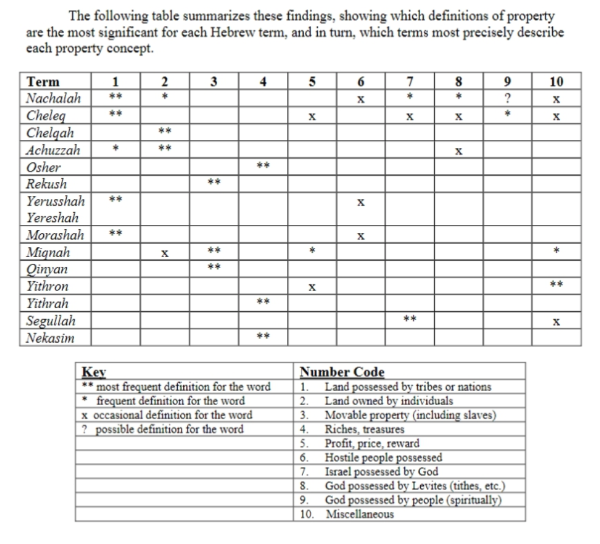
     

    A point can also be made about ‘adoption and manumission’: 

    Ancient Near East literature contains a wealth of rich source material regarding the legal process known as ‘adoption and manumission.’ One of the most explicit examples can be found in the story of Abraham’s foreign servant, ‘Eliezer,’ illustrating how an outsider of Israel could be adopted and become an integral part of a household for the master’s lifetime or until the jubilee lands. Notably, upon the master’s death, the adoptee would inherit the master’s house and possessions. William Dumbrell’s research outlines Eliezer’s adoption and birth into Abraham’s house, shedding light on this process. ANE scholarship provides context to the nature of slaves, revealing them as individuals bonded by debt (not necessarily financial) rather than mere chattel, often being born into the household. These slaves voluntarily chose to be adopted by a master through a legal process. It is evident that within their historical context, these practices were not inherently malevolent. It is true that “manumission” means ‘to release’ but remember that the verse doesn’t command the perpetual binding – it only presents it as an opportunity. Therefore, I don’t see a good reason why a similar practice could not in any sense be attributed to Leviticus 25:44-6. 

    Lastly, using dictionary.com, ‘Chattel Slavery’ is defined as: 

    • the enslaving and owning of human beings and their offspring as property, able to be bought, sold, and forced to work without wages, as distinguished from other systems of forced, unpaid, or low-wage labour also considered to be slavery. 

    The fact that this verse only permits the Israelites’ bequeathing to ‘sons’ tells us that these slaves belonged to the household of their masters, and as such, had a household affiliation – which would rule out the possibility of ‘trading’ these slaves in a chattel manner between households, provinces, states or more – and ‘selling’ is a crucial criteria for labelling this as chattel slavery (as the main point of chattel practice is to gain profit). I have alsoalready made the point that ruthless rule with starvation is irrational, so it’s not very clear how well ‘force’ can be applied in forcing these slaves to work. Again, in my section ‘Slave or Servant’ Laura Culbertson tells us that slaves in an Ancient Near Eastern society “could act to preserve or transform their quality of life… Slavery was thus not a unilaterally downward social sentence, with many slaves rising along with their owners”. For this reason, I think that, using modern definitions, this is race-based perpetual servanthood, rather than race-based chattel slavery (in which you would be able to not only do anything you want to these slaves, along with selling them to whatever households, states, and provinces you want to).  

    Deuteronomy 20-21: 

    The following section will deal with female war captives. Many misconceptions arise regarding Israel’s war practices and, right off the bat, we’re going to dismiss the first. 

    Misconception: “Israel practised sexual slavery!” 

    Response: No, they didn’t. Sexual slavery was not permitted during war for Israelites, because, similarly to how many Ancient Wars were fought (as Sumerian texts tell us), Israelite soldiers were consecrated before they fought. We see in Exodus 19:14-15 that when approaching Yahweh at Mount Sinai – the people are instructed to wash their clothes and abstain from all sexual intercourse. With God being present with the Israelites (with the Ark of the Covenant) during the war (Numbers 10:35-6, Joshua 6:7-13. 1 Samuel 4:3-11, 11:11), in a legislative sense, Israelite soldiers were not permitted to perform sexual acts during the war. Explicit evidence is seen for this in 1 Samuel 21:4, where the priest says to David “I don’t have any ordinary bread at my disposal. Only holy bread is available, and then only if your soldiers have abstained from sexual relations with women.”. 

    Israelites were certainly not allowed to perform any sexual acts within the temple as part of the worship of Yahweh (Lev 21:7, 9; Num 15:39; 25:1-4; Deut 23:17-18; 1 Kings 14:24; 15:12; 22:46; Hos 4:4; 2 Maccabees 6:4; see also Rev 2:14, 20). 

     Now for the actual ‘slavery’. Deuteronomy 20:10-11 reads: 

    “’ When you approach a city to wage war against it, offer it terms of peace. If it accepts your terms and submits to you, all the people found in it will become your slaves.’” 

    The rendering here isn’t very accurate, but the NET comments tell us that the verse in Hebrew was translated as “become as a vassal and will serve you”. If you have read the first post in this series, you would be familiar with the Suzerain-Vassal dynamic, and vassals were not slaves as defined in modern times but rather were obliged to pay royal taxes and perform public works. 

    John Currid, Chancellor’s Professor of Old Testament at Reformed Theological Seminary, tells us in his 2006 Study Commentary on Deuteronomy, that Deuteronomy 21:12-14 is the apodosis to the protasis of Deuteronomy 20:10-11 (i.e., it is the “then you can do this” following the prior “if this happens”): 

    “First, the woman is to be taken into the man’s house, and there she is to be treated kindly and with dignity. After she is taken into the home, she is to shave her head, pare her nails and remove her captive garb. These acts are to symbolize that she no longer has the status of captive slave. The Septuagint and the Dead Sea Scrolls (11QT6:3.12-13) both depict the Israelite man as performing these acts upon the woman as a declaration of her new status. Deut 21:14. ‘And it shall be that if you do not take pleasure in her, then you shall send her out according to her wishes. But you shall certainly not sell her for money. You shall not oppress her because you have humbled her.’ The protasis of this law begins with the word ‘if’ and it indicates that not all marriages with captive women will work out. Husbands may terminate such marriages if they so desire. This is a formal divorce proceeding, and the verb ‘send… out’ is often used of divorce (see 22:19,29). The apodosis, beginning with the word ‘then’, spells out the manner in which the woman is to be treated. First, when she is divorced she will remain a free woman, and she cannot be reduced to slavery. A rejected wife, foreign or not, cannot become a slave. The husband cannot make money out of her by selling her into slavery. She is free. The husband is not to ‘oppress’ her. The exact meaning of this verb is uncertain; it appears only here and in Deuteronomy 24:7 in the entire Bible. It has been translated in various ways: ‘deal tyrannically’, ‘enslave’ (Philo), ‘set aside’ or ‘disregard’ (Septuagint), and ‘trade’ (Targums).” 

    Criticism: A critic may contend that “the phrase used for “you have had your way with her” is used elsewhere in the Bible twelve times, and sometimes it DOES mean rape, and therefore that Deuteronomy is effectively legislating rape! GAME OVER!” This person would likely be referring to 2 Sam 13:12, 14, 22; Lam 5:11; Judg 19:24; 20:5. Twice does it refer to violating an unbetrothed girl (Gen 34:2; Deut 22:29), but it also refers to adulterous sex with a consenting woman (Deut 22:24); once to sexual intercourse with a woman on her menstrual period (Ez 22:10), and once to incest (Ez 22:11).

    The issue with this interpretation is the fact that all of these cases refer to cases of sexual immorality – i.e., they are, in some way illicit and are seen as debasing the woman. We have already seen that Deuteronomy 22:22+ legislates against rape in the previous post, and since this is a legal scenario, it follows that this act of taking a woman to be your wife, waiting the mourning period and then being permitted to sleep with her and casting her out (effectively reducing her to an object) is deemed as sexual immorality, instead of the misconception that rape is being legislated. We also note that Exodus 21:16-17 legislates against kidnapping an individual, telling us that the man was not allowed to “steal” this woman against her will for his desires, and further, the man being forced to wait a month, having seen the woman without her hair and beauty ornaments tell us that this law was intended to help ensure that her captor wanted to marry her for love rather than lust. Isaiah 3:18-24 attests to a high valuation of beauty ornaments.  

    Some more reasons why this is not referring to rape are as follows: 

    1. The Hebrew word ‘anah’ (humbled/humiliated) is multifaceted. The Targum Jonathan (an Aramaic translation of the prophets) employs the word “intercourse” suggesting that my theory about the contemporary understanding of the sexual relation between the man and the woman is true. 
    1. If the female captive was violated (and therefore ‘damaged goods’ as the ANE society would have seen it), the texts likely would have used “taw-may” as used in Genesis 34:27 (concerning Dinah being raped by Shechem). 
    1. Deuteronomy 8:2, 3 and 16 employ the verb ‘anah’ in the PIEL verbal stem (the most flexible stem formation in Biblical Hebrew), which clearly refers to God humiliating Israel and therefore humbling them, but we know that he didn’t impose Himself or rape Israel.  

    Rebuttal: “Then what is the shame? What does it mean to ‘humble’ her?” 

    Since divorce was considered rejection, the wife subjected to it would “lose face” in addition to the already humiliating event of having become a wife through conquest. 

    An extra line of defence of the fact that the woman’s consent was necessary to becoming an Israelite wife can also be seen in Numbers 30:9. This section talks about vows. We know that this woman would be both a widow and without a father (per the conquest), and as such, her vows would stand without the presence of a ‘head’ (father or husband). As such, the woman could not be forced into marriage if she didn’t want to be married. 

    Another line of progression?

    It can be argued that what we see in Deuteronomy 23:15-16 is another line of ‘monumentous’ progression (similarly to what I stated for Exodus 21:20-21). Again, nowhere in other ANE legal collections do we see this principle of ‘not returning a runaway slave’. This would provide another line of evidence for the idea of moral progression.
    One could argue that this sort of stipulation only holds for slaves who run away from specific regions, and is therefore effectively a command not to hold extradition treaties with other nations – which is a position which Dr Joshua Bowen, an Assyriologist holds. I am happy to grant that this is a possibility, but it still seems to me that the underlying principle of ‘not returning a foreigner’ (in a ‘hard’ society with a scarcity of resources) still provides a ‘sanctuary’ for runaway slaves – which was the opinion of Harry Hofner:

    “Deuteronomy 23:15-16 concerns slaves in neighboring countries (e.g., Tyre, Sidon, Aram, Ammon, Moab, Edom, Philistia, Egypt) who escaped and entered Israel seeking sanctuary. These instructions prohibited Israelites from extraditing them to their foreign masters. Ancient Near Eastern treaty documents that included clauses requiring the return of fugitives serve as the background to Deut 23:15-16. Escaped slaves and political rebels represented two different classes of fugitives. However, it seems that the purpose of this law was not only to discourage such treaties (undoubtedly any such treaty in the era of Moses would have included such a stipulation), but also to protect slaves who fled to God’s people for protection from oppressive treatment by brutal masters. Israel was to be a place where oppressed people from other lands could find refuge, just as God freed them from enslavement in Egypt.“
    Israel: Ancient Kingdom or Late Invention? – Daniel L. Block (p.154) 

    Corvée Labour:

    Despite all that has been said, you’d be unsurprised to hear that ‘online atheists’’ issues don’t stop here. Forced/conscripted labour is described in 1 Kings 7:1-12 for the new palace Solomon builds. Remember, we aren’t talking about the moral legitimacy of Solomon building the palace or slavery, we are just trying to understand, contextually, the nature of these agreements. We have already talked about the Suzerain treaty between Israel and God, but Israel also formed such treaties with other nations. The labour operated on a national level rather than a personal one, and these labour agreements were pre-arranged agreements between vassals and suzerains. It should also be noted that God punished Israel for breaching their treaty in 2 Samuel 21:1 and the King of Israel was required to compensate the Gibeonites for their loss (2 Samuel 21:2-9) – entailing a higher level of obligation on the Suzerain than the vassal. 

    “The distinctive emphasis of the treaty was on the superior party, the suzerain. In this arrangement the suzerain agrees to make certain provisions for the vassal. He agrees to defend the vassal in the case of attack, along with permitting the existence of the vassal nation. In addition, the suzerain has the right to take tribute from the vassal at any time. The vassal, for his part, agrees to a position of servanthood but not slavery. Vassals honor the suzerain with tribute and material goods“
    Longman, T. I. (2013). The Baker Illustrated Bible Dictionary. Baker Publishing Group

    “FYI: God does not allow the Israelites to empire build. People they come against typically attack, and/or raid Israel first. The “forced labor” is typically a lord/vassal treaty, which exists between countries and not slavery on a personal level.” 
    A New Believer’s Bible Commentary: Genesis-Deuteronomy. Barret, J (2013) (p.199) 

    A Miscellaneous Text – 2 Kings 4:1 

    Nothing needs to be said in an attempt to vindicate this scenario. The labour of people and households could be used as collateral to guard against debt as is seen in this verse. I’ll let the scholars handle this one, I’m getting tired. 

    “We already saw in Chapter 3 that in the cuneiform tradition debt-slaves were not to be regarded as the property of their creditors, since the creditor has only purchased the service capacity for work (Arbeitskraft) of the debt-slaves (This view is also advocated by Riesener, Der Stamm TIP, pp. 1, 130; cf. also Rashi, ad. Loc.).” 
    Chirichigno, G. C. (1993). Debt slavery in Israel and the Ancient Near East (p. 179). Bloomsbury Publishing Plc. 

    “Households in Israel were entitled to land grants. Although households held title to the land in perpetuity, it was often lost to creditors. Monarchs taxed households into crippling debt. Rich households made loans to poor households to pay their taxes, but secured these loans by taking their land and the labor of their members as collateral. When households defaulted, creditors foreclosed on the land and sold its men, women, and children as slaves (2 Kgs 4:1). Legally, creditors were not buying land or selling slaves, just holding the land as collateral and collecting the wages of its household to repay the debt (Lev 25:35-46; 2 Kgs 4:1; Neh 5:1-5).” 
    Strauss, M. L. (2011). How to Read the Bible in Changing Times: Understanding and Applying God’s Word Today (p. 121). Baker Publishing Group. 

    New Testament
    1 Peter 2:18, Ephesians 6:5-9, Titus 2:9 and Colossians 3:22: 

    You would think that the New Testament, arguably the moral guideline for western society today would be so clearly against slavery during the Roman rule of Judea, but according to our anti-Christian friends, Christians can’t even catch a break here! The first thing to point out is that the predominant viewpoint among New Testament commentators is that these texts aren’t referring to Jewish slavery, but rather Roman slavery. 

    “The view that these concisely formulated teachings have adapted a tradition whose real background can be assigned to a Greco-Roman environment has found almost unanimous acceptance among New Testament specialists. “ 
    Stuckenbruck, L. T (2013). Religions and Trade Religious Formation, Transformation and Cross-Cultural Exchange Between East and West (p.357) 
     

    The second point to be made is that Peter and Paul are being tactical and prudent. With slavery being the bedrock of the Roman economy, if early Christians had immediately clearly opposed it, they would have been spawn-killed. There was already hatred between the Jews and the Romans, and we already know that Nero had no issue blaming Christians for the Great Fire of Rome, you can only imagine the diabolical things that would have happened if Christians immediately went for the foundation of the military superpower ruling over them. 

    “The idea of slavery as the foundation of the Roman economy needs to be stressed, and this foundation may well lie at the heart of early Christian exhortation to remain submissive to masters. If it is true that slavery was the central labor force of the Roman economy, it follows that if Christians became known for opposing the institution, the Roman authorities would immediately, and perhaps even irreparably, damage the movement. Put differently, it was important to the survival of Christianity for its slaves to be good slaves. Since this was the case, one motive for Peter’s exhortation would have been the desire to survive as a movement. Peter’s exhortation to live under the order as slaves emerges, then, from this economic context. Herein finds them that they are to do this “with all respect,” or “with deepest respect.” He insists that they are to show the same “deep respect” even to “those who are harsh.” Peter wants the Christian slave community to manifest a kind of behavior that transcends the norm of society and demonstrates its supernatural origins. In so doing, the economy will not be threatened, and the Christians will be seen favorably.” 
    Guthrie, G.H,. Nystrom, D.P, McKnight, S,.Burge., M.,Keener – NIVAC Bundle 8: General Epistles, Revelation 

    Luke 12:47-8 (???):

    Yes. Some people stoop this low, but likely due to a lack of understanding.  

    “Slave managers and even cases of slaves owning slaves are known from the Roman period. In most of the parables of Jesus that involves slaves, a slave who fails in his task is demoted, exiled, beaten, or executed (Matt 18:23-35; 21:33-41; 25:14-30). Luke 12:47-48 displays a standard that any Roman master would have been familiar with: “The servant who knows the master’s will and does not get ready or does not do what the master wants will be beaten with many blows. But the one who does not know and does things deserving punishment will be beaten with few blows.” Slaves who were successful gained more responsibility rather than manumission (Matt 25:14-30). Jesus did not endorse slavery with these stories, but used their familiar context to teach about the kingdom of God” 
    Yamauchi, E. M., & Wilson, M. R. (2017). Dictionary of Daily Life in Biblical & Post-biblical Antiquity (p. 1519). Hendrickson Publishers. 

    Now for the counter-case. Judeo-Christian values are what effectively led to the abolition of slavery (per modern connotations), but how did the New Testament ethic accomplish this? 

    Romans 16:7-9: 

    ‘Andronicus’, ‘Amplias’ and ‘Urbanos’ were common slave names – and are the names of common workers with Paul. Considering Paul was Jewish, it follows that there was very reasonably no Jewish Christian slavery. 

    Galatians 3:28: 

    Slaves are, by definition, seen as inferior. However, Paul makes it abundantly clear that there is no inferiority/superiority in Christ. As the Christian message spreads – such an idea will render the slave/master hierarchy obsolete, as we have seen. 

    1 Corinthians 7:23: 

    The usage of the word ‘become’ here is significant. It implies consent and entails a previous ‘free’ status. Paul is, quite literally, telling the Corinthians to not become slaves. 

    Quite a strong case can be made using this verse, actually.
    The verse says ‘do not become slaves of humans’. Furthermore, verse 21 does implore slaves, if they can do so wisely, to seek their freedom. Luke 17:1-4 is a direct condemnation of the one who causes another to sin and 1 Corinthians 8:13, a chapter later, is an echoing that Paul held that same sentiment as Luke. If ‘becoming a slave’ is contravening Paul’s command, how much worse is it for those who force others into slavery? Further, if all are equal under Christ (Galatians 3:28), and even enemies are to be loved (Matthew 5:43-44) all are made in God’s image, then it seems very difficult for Christians to justify any sort of forceful enslavement that would have persisted in first-century Judea.
    My point here is not that the verse, alone, removed from context, stands a categorical declaration against slavery (i.e., “revolt against your masters and sow turmoil – immediately destroy the institution”, as Peter and Paul are quite adamant against that, for the survival of Christianity), but when read in the context of Christian principles, which can not be removed from it if you want to make a substantive point about the Christian Bible, Paul is instituting commands that thoroughly destabilise justification for any organic form of Christian slavery – i.e., it effectively becomes a direct command against taking and becoming slaves.

    Colossians 4:1: 

    Paul exhorts Hellenized Jewish-Christian masters to be just and fair – for those who want to quote Colossians 3:22, please quote this also.

    Rolling all the evidence together, we see that people are told not to become slaves, that they all hold equivalent value in Christ, that masters should treat their slaves fairly, and that Paul works at the same hierarchical level with people who can be reasonably concluded to be slaves. It’s therefore not surprising that these ideologies dissolved the Greco-Roman model of slavery. 


    So, does the Bible promote Slavery? No, that would be misreading its intention. 

    The Old Testament regulates/permits the Ancient Near Eastern practice of servanthood and redemption of those who have sold themselves into slavery while trying neither to immediately abolish it nor evaluate its moral status. Following the New Testament, Christianity led to the abolishment of slavery – which is the opinion of multiple historians, such as Tom Holland and Robert Fogel.

    For those who wonder why Christianity didn’t immediately put an end to slavery, such would have been deeply implausible considering the Greco-Roman environment it was operating in. Christianity acted like a ‘depth-charge’. As such, it took a while for its truth to penetrate through to the bottom of society. I do have a few contentions with John Walton’s framework for moral epistemology, but I think he does a good job with the analogy of God ‘baking a cake’ – illustrating the concept of necessity, and that it should not always be equated with something intrinsically good: 

    “Although we should understand God’s actions as purposeful (that is, working toward a goal), we should not imagine that God furthers that goal by producing progress. We should not imagine that God is constantly shaping humanity to ever-higher levels of goodness or morality that will eventually achieve the ideal. Neither should we imagine that we represent the society that has actually achieved the ideal. An alternative model to understanding a process toward achieving a goal is what we could call procedure, as opposed to progress. In a procedural model, every iteration serves a different purpose toward a common goal, which could not be achieved without the completion of every step. The metaphor for a procedural model is the process of baking a cake. There is a final, ideal cake at the end, and some of the steps will more closely resemble it in terms of their attributes than others, but the various stages in the recipe are evaluated not on the basis of how closely they resemble the ideal, final cake but of how necessary they are to produce the final product.” 
    The Lost World of the Israelite Conquest (p.24) – John Walton 

    Although John distinguishes between ‘progress’ and ‘procedure’ – I would say that these two models are not mutually exclusive – given that ‘procedure’ naturally ‘progresses’ toward something. 

    I hope you found this helpful. If you have any questions/points/objections, feel free to leave them down below and I’ll try to get to them! 

    Thanks for reading, 

    P.S: This is an excellent dialogue that, if you made it this far, you’d likely be interested in seeing. It covers both perspectives of this topic.

    Rookie


  • Flying Spaghetti Monster – 2: God is… not great?

    May 26th, 2024

    If you haven’t read the first post in this series, I recommend you do, as much that I write here will build off from there. This is the second instalment. The terminology might be getting a little more philosophical here, but bear with me!

    Shifting the goalposts?

    Thanks to MindShift – an agnostic-atheist who converted from fundementalist Christianity, I’ve got a great list of horrific acts that God committed in the Bible.

    MindShift, who is a moral relativist, says that morality is dependent on culture, yet keeps trying to hammer home that these things were just plain wrong, but his framework doesn’t allow him to do this. Many online Atheists frame this in a way that is analogous to making an argument that somebody else’s moral framework is atrocious, but openly admitting that your morality is objectively no better than theirs is practically a way to pull the rug out from under your own feet.  

    Our boy MindShift takes it a step further. Although ultimately, he can’t justify the objective superiority of his moral worldview, he instead tries to show that the Biblical God is inconsistent with what the Biblical God deems as ‘good’ – what one could call an ‘internal critique’. This is a valid strategy, but as you will see, it will require a huge burden of proof. If God, by his nature, isn’t what God, himself, calls good, then the Euthyphro dilemma rears its ugly head again, and it seems that within the Christian moral realm, God would be rendered obsolete. 

    There are a ton of verses here, and I’m going to go through all of them except for a couple I will tackle in the last post of this series (not this one). I’m quite thankful to MindShift for doing this video because I’ve wanted to go through all the tough verses in the Bible, but reading the whole thing takes ages, so I’m grateful that he condensed everything down for us. 
     
    I don’t really expect anyone to read this whole thing through. Christians, I’ve done this so you can use this as a repository for when people whip out a random Bible verse and say God is evil. Atheists/anti-theists, do what you want, I guess. Some of the stuff in here (I think) is quite thought-provoking, so you might enjoy reading it. 

    My Fundamental Claim

    A clear and, I think, uncontroversial statement that I’d like to make to preface this is: 

    “permitting someone to do something, is not necessarily making a claim or affirming that whatever the thing they are doing is intrinsically ‘good’” 

    • For example, if you let someone do something bad, it could be that you are allowing someone to see the natural consequence(s) of their actions (experience is a great teacher, you know), or it could be that the person who the thing is being done to, is receiving their due retribution (i.e., judgement/punishment). You will see me reference this idea multiple times in various forms throughout this post – so I will refer to it as statement ‘p’. 

    Note: I won’t be pasting in verses here as I normally do, because there are just too many and if I do, I won’t have the terabytes to post this. I encourage you to look at as many verses as you can in context as you read what I write here and verify for yourself the things that I am saying, rather than just taking my word for it. 

    I will also clarify that “good” in this document will mean “in accordance with God’s eternal moral law”, which is something I’ll clarify a little more in the next part. 

    Without further adieu, and with 19 charges against his name, I call to the stand, the God of the Christian religion! 

    God’s Hypocrisy: The Case Against Objective Morality – REFUTED 

    1. Lying. 
      The first bullet MindShift fires is an accusation that either (1) God is a liar or (2), he condones the act of lying itself as something good (remember that condone can either mean to affirm the intrinsic good nature of something or to simply permit it to be done. MindShift needs to affirm the first definition to make a substantive point) – both of which would be contrary to his nature (as per the ninth commandment in Exodus 20:16). He uses two verses to support this claim, and therefore, to prove his claim, either one needs to be true in at least one of the two verses. 
      1. Joshua 2:4-5. Here, two Israelite spies are sent by Joshua to scout the city of Jericho. They stay at the house of Rahab, a prostitute. When the king of Jericho learns of their presence, Rahab hides the spies and lies to the king’s men, saying the spies left the city. Rahab is also celebrated later in the Bible in Hebrews 11:31 and James 2:25, for “welcoming the spies” and “sending them out another way”. Initially, this looks tough to reconcile, right? I might say that God didn’t say Rahab’s lying was good, but it’s ambiguous as to whether Hebrews and James are saying that Rahab is justified only for welcoming and hiding the spies, or for doing those two things and lying to those who came looking. If I were MindShift here, I would say that the Bible has to be endorsing (in the greater sense) all of Rahab’s actions, but not only is that ambiguous, it’s fallacious, and falls prey to the fallacy of division (i.e., just because something (the praise) may be true for the whole act, it doesn’t follow that it is true for each constituent act that is part of the whole). Therefore, MindShift’s argument is effectively an argument from silence, because neither NT text says anything about how Rahab treated the king’s men – they only speak about the way she treated the men of Israel.
         
        So it is not necessarily the case that the act of lying itself is being condoned as intrinsically good – which is what needs to be proven for MindShift’s argument (2, above) to run. Let me show you an analogy to make this clearer. 
        • Imagine Tom, Betty, and God in 1500 B.C – this is the old covenant, so the Leviticus 24:19 justice still stands. Tom has done some really bad things, and Betty is tasked by God with bringing retribution. Tom is sentenced to five slaps on the wrist from Betty. Does it follow that slapping someone on the wrist is an objectively, case-independent good thing? No. However, if Tom is due judgment, should Betty relent? No, because that would be unjust, and it is morally unjust to withhold punishment where it is due. Therefore, judgement is a ‘good’ thing in the sense that it prevents greater evil, or brings things ‘back on track’, though lying is still objectively a bad thing.  
          Now, switch out Betty for Rahab, lying for the slap on the wrist, and Tom for Jericho (the king’s agents are conduits for the judgment here).  
          It can therefore be said that the overall justice is being affirmed as intrinsically good here rather than the universal act of lying – that is what Rahab is justified for in Hebrews and James, and this is in line with what we’d expect from a second-temple Jewish audience, who were all too familiar with crying out for God’s justice against their enemies. Rahab’s act of lying itself was still intrinsically disordered, but within the economy of justice, it was congratulated. It could be that Rahab’s choice to judge her city (and to be faitfhul to YHWH) is what is being congratulated in its entirety (and Joshua 2:9 attests to her and her people’s knowledge that they should have left the land) and a person to be congratulated for exacting judgment does not require such method of judgment to be intrinsically good, in fact, the whole point of judgment is that the means is supposed to be unpleasant. Also note that this would count as a passive/permissive judgment, since no Divine Command was given, so it’s not perfectly analogous to my brief analogy.
          A person might object that I am effectively saying that I am saying that the end justifies the means, but that wouldn’t be an accurate reading of my point. The full point I am making can be stated as that judgment is not necessarily a “good” thing in the sense that it is God’s perfect ideal, in God’s perfect world, but that it is “good” in the sense that it is necessary for restoring a necessary order and limiting further evil – in the same way that a court can be considered ‘righteous’ for putting a criminal behind bars – or even Jesus’ sacrifice can be considered something ‘good’ (in the sense that it makes us righteous) but ‘bad’ (in the suffering it necessitated).
      2. 1 Kings 22:21-23. Here, the prophet Micaiah describes a vision where a spirit volunteers to deceive King Ahab’s prophets, leading Ahab to his doom in battle. This occurs after Ahab, notorious for his wickedness, seeks assurances for war against Ramoth-Gilead. Despite other prophets predicting victory, Micaiah’s vision reveals a divine plan of judgment, where deception is used to ensure Ahab’s fall at Ramoth-Gilead. The main issue MindShift sees here is when a [satanic] spirit volunteers to be a deceiving force in the mouths of all Ahab’s prophets. The Lord agrees to this plan, indicating it will lead to Ahab’s downfall, but by now, you should be able to see why I went to great lengths in my comments on Joshua 2 to highlight a main idea that I’ll be using quite often to refute MindShift’s interpretations. Here, I refer to the statement ‘p’. 
    1. Killing Babies. 
      MindShift seems to have some issues with God killing babies (and fairly so! We both agree that we have a gut-twisting initial reaction to this!), especially considering that most Christians profess to be pro-life (or at least the Catholics dogmatically do). I guess he sees this as contradictory. I’ll add some pre-emptive comments before I go through these one by one. The first principle to be aware of is that your life is not your own. God, who owed us nothing, gifted us with existence and has the right to determine how much ‘existence’ we recieve on Earth. Of course, Christians believe that per his nature, he wouldn’t kill without some justified cause, but, remember, he doesn’t owe you that, in the same way, this post I’m writing now has no ultimate say as to whether I delete it or not. You and I both did nothing to deserve our lives before we came into existence, because there was no us, and therefore we aren’t ultimately owed anything by God. Therefore, even if God wanted to kill babies unjustifiably (which, obviously, I don’t think he did/does), there would be nothing ultimately “unjust” about it – because justice presumes ‘right’. Note, also, that MindShift must show that God condones killing babies as something good to make his case – a very strong claim. Further, with the prospect of an afterlife – it could also be proposed that a baby can end up with an assured salvation – although without the virtues gained through soul-building.
      1. Isaiah 13:11-16. This is one that MindShift brings up, but both verses 11 and my comments above reveal this to be a non-issue. 
      2. 2 Samuel 12. This one can be understood similarly to the one above. Here, King David had committed adultery with another man’s wife and killed her husband, because of what can be inferred is pure lust. Justifiably, God punishes David by killing the son that would be born. It should be obvious now that performing a judgment upon someone does not make the way that judgment is performed objectively, universally good. Rather, it can be said that it was a necessary action. 
      3. Genesis 7. This is the flood of Noah’s Ark, and I’m not even going to write the justification for it, you can go and check that one out yourself. If MindShift is willing to grant that the flood plausibly happened to pick at the Biblical narrative, he should also be willing to grant the narrative of Genesis 18:16-33. If you want to propose an internal critique, it’s not clear to me how it’s not arbitrary to pick one text of the Bible and grant it a literal interpretation, without granting another. 
      4. Exodus 7-11. A common theme is starting to show now, MindShift seems to enjoy picking at specific verses for this point without reading the surrounding context. In Exodus 11:4 and onwards, Moses delivers a final warning to Pharaoh regarding the tenth and most devastating plague, the death of the firstborn. Moses informs Pharaoh that at midnight, all the firstborns in Egypt, from the firstborn of Pharaoh to the firstborn of the lowest servant, will die. MindShift seems to forget what happened in Exodus 1:15, where Pharaoh commanded something very similar, but for the Israelites, however, God gave him ten chances to let the Israelites go before he delivered such a severe punishment. ‘Firstborn’ in Ancient Egypt (and in the rest of the ancient near east) had a different meaning. Due to high infant mortality rates, the term ‘firstborn’ could, and more often than not did, refer to older people who have yet to come into their inheritance.
      5. Numbers 31:13-18. This one is dense, and a lot of things can be said, and I will speak about it in more detail in a later subject. For now, I will only speak about it regarding baby killing, the leaving virgin women alive bit will be answered later. 
        1. This is Moses’ speaking, not God. God only said to “exact vengeance” in verse 2, nothing more. From that, we cannot infer that God told Moses to kill children. If anything, on further inspection I think it is very reasonable to believe that this was an overextension of Moses’ hand – it gives us some precedent as to how the Israelites saw/undertook war. Looking again at Numbers 31, we see that Moses sent the Israelites ‘to war’ against the Midianites. We have three options:  
          1. By ‘war’, Moses specifically told them to annihilate them – I think this is implausible, considering the Israelites didn’t initially do this. If Moses did say this, then I think the fact that the Israelites would have disobeyed and left the women AND the boys and livestock alive tells us about their intuitions about going to war/what ‘war’ entailed. 
          2. By ‘war’, Moses specifically told them to leave the non-virgin women and boys – I think this is very implausible, as it would contradict the order he gave later.
          3. Moses, as scripture says, simply told them to ‘execute the Lord’s vengeance’. I think the fact that the Israelites intuitively left the women and children alive tells us how they saw ‘war’ and vengeance/judgement.
        2. Moses, not God, tells his men to kill the children. Note that this was a period characterized by tribal warfare. It may have been Moses’ (not God’s) intention was likely to eliminate the possibility of tribal retribution happening at all. Not much else needs to be said here, as MindShift must show that God explicitly condones child killing as an intrinsically good, virtuous thing. 
      6. 1 Samuel 15:2. This is probably MindShift’s strongest point here, but it’s still weak. Here, God himself does command a genocide (or, at least, an Ancient Near East historical representation of one – which I speak about later – keep reading!), so MindShift is halfway to fulfilling his claim. However, the point dies when we realise that God doesn’t condone this genocide as an intrinsically good thing to do, as you’ve probably realised by now, he doesn’t do that anywhere. The most you can say here is that it was necessary, but we have already proven that necessary does not equal objective good. Furthermore, we see that the Amalekites are not innocent, for more details, read Exodus 17:8-16 and Deuteronomy 25:17-19.  
        1. It could even be said that since the attack by the Amalekites in Exodus 17 occurred during the time of Moses, which was estimated to be around the 13th century BCE and the events of 1 Samuel take place much later, likely around the 11th century BCE, the Amalekites had two hundred years to repent from their evil atrocity (Jonah gives us precedent that God accepted true repentance from nations that did), although note that I’m not sure this last point I’ve given is that strong, since I can’t be sure that a prophet was sent to the Amalekites to beg them to turn from their evil ways. 
    1. Jealousy. 
      1. In Exodus 20:5-6, God refers to himself as jealous. The simplest definition of jealousy that I found would be “a feeling of unhappiness and anger because someone has something or someone that you want”. I’m not sure that this is the best definition though. I don’t think it’s always a bad thing to be jealous. For example, if your significant other cheated on you, would you not initially feel jealous? If someone stole money that was yours, would you not be jealous as you saw them spend it? I think that we would all agree that if someone took something that rightfully belonged to us, we should be rightfully angry. What you do with that anger is important, but the indignation itself is a natural, just reaction. 
    1. Vindictive. 
      Who has a better right to enact vengeance than the arbiter of justice himself? As the Suzerain of Israel, God has every right, and need to exact vengeance for his people, or the Israelites would have been conquered and died out very quickly. 
      1. Psalm 94:1. You’ve got to be kidding me. 
      2. Leviticus 26:25. This vengeance is warranted here. Literally just read the previous five verses.
      3. Isaiah 59:17. See my pre-emptive comment above. 
      4. 2 Samuel 6:6-7. This one is stronger, and at first glance seems quite unfair. God smote this guy immediately simply as he was trying to stabilise the ark. I ask you, though, if God told you not to touch something, and you still touched it, knowing full well that the consequence was death, and that thing genuinely represented God’s presence with his people, what would you expect to happen? It could also be that had God not done this, the Israelites would have disrespected him even further than they ended up doing later. I suppose that this is God setting boundaries, and it should be known that it is also possible that this act of Uzzah does not necessarily determine his post-death fate. The Benson Commentary explains this verse much better but I’ll just add a little bit of it that helps to better frame my point – “[being] a Levite, he was guilty of a double error; first, in not carrying the ark upon his shoulders, together with his brethren; which their neglecting to do, on this solemn occasion, and consulting their ease more than their duty, was an offence of no small aggravation. Secondly, in touching it, which even the Levites were prohibited from doing, under the express penalty of death.” From this, it can also be said that Uzzah’s public execution would have served as a public confirmation to the Israelites of what, and who exactly they were dealing with. 
      5. Leviticus 10:1-2 – similar reasoning to that given for 2 Samuel 6:6-7 can be applied here. 
    1. Unforgiving. 
      1. Joshua 24:19 – this is Joshua speaking, not God. He claims that “[God] is a jealous God who will not forgive your rebellion or your sins.” God is a jealous God, as we have already ascertained, but it is false that he “will not forgive” as Jonah attests. It seems to me more likely that Joshua is making a threat, but Christians don’t believe that prophets are infallible unless prophesying, so there is no issue here. 
      2. 2 Kings 24:3-4 – this one is a little trickier than it seems at face value. Verse 4 seems to clearly state that “the Lord was unwilling to forgive them”. “Them” could refer to both Manasseh (the King) and Judah (the people) as a whole, or it could refer to Judah alone. However, we see that in 2 Chronicles 33, Manasseh is captured – during which he repents, and God forgives him. Do we have a contradiction here? I’m not so sure.  
        If “them” refers to the land of Judah, it seems that the author is implying that the people are still at least partly responsible for their actions even if they were misled – i.e., they should have known better. In “being unwilling to forgive”, it seems plausible that this is speaking consequentially. 2 Kings emphasizes the long-term, national repercussions of Manasseh’s actions. Despite his repentance and forgiveness, which is detailed in 2 Chronicles 33, the sins he committed during his reign had set in motion a series of events and patterns of behaviour among the people that ultimately led to Judah’s downfall. It’s possible that people in Judah, along with Manasseh repented, but sometimes some actions are irreversible. If I killed someone, whether I am forgiven or not for their murder doesn’t bring them back. I propose that the “non-forgiveness” spoken about here is a non-withdrawal of consequence. 
      3. Jeremiah 11:14 – here, Jeremiah is told by God, not to pray for the idolatrous people of Judah, whom he intends on casting judgement on. God says that “[he] will not listen to them when they call out to me for help when disaster strikes them.” Context helps, guys. God has repeatedly told these people to repent and has given them warnings. This isn’t something he can do forever, because the effect of sin on the human condition makes it such that continually defaulting on ones promises reduces the potential to be sincere – to a point where sincerety can become extremely difficult to act with. Also, the people can’t cry about the impending judgment when they’ve had warning after warning after warning. 
      4. Ezekiel 7:3-4 – a judge has to judge. Similar reasoning can be used here to that used for Jeremiah. 
      5. Proverbs 1:24-30 – brave move to go for Proverbs. A lot of the language used here isn’t literal, since it is a collection of wisdom sayings. I can just make the point that Proverbs is saying that once struggle truly strikes, wisdom will be far more difficult to find. The consequences of your actions will make it such that wisdom will effectively “evade” you.
    1. Murder. 
      Please reread my intro to section ‘2’. I refer again to statement ‘p’. God can act simply because it is the necessary course of action he needs to take to realize his will. 
      1. Numbers 25:1 – this specific verse doesn’t seem to be an issue, but I presume he’s referring to the following passage – I don’t know how many times I’m going to need to make the point that (a) – if God wishes to take a life, he can do it (although how he would do it would be perfectly just – in line with his nature), and (b) God punishing someone with action ‘x’ does not entail that action ‘x’ is a good action for all people to do at all times. Action ‘x’ is still a bad thing, which is why it is punishment. I get the idea that Brandon (MindShift) is smart enough to know this, but I guess it’s just a consequence of his fundamentalist worldview. 
      2. Joshua 11:20 – two points can be made: 
        1. Judgement 
        2. Unsurprisingly, MindShift doesn’t go into context to tell you what these people did that warranted death. Deuteronomy 9:4 tells us the reason that these nations are being driven out: “When the LORD your God has driven them out before you, do not say in your heart, ‘Because of my righteousness the LORD has brought me in to possess this land.’ Rather, the LORD is driving out these nations before you because of their wickedness” But what exactly do they do? Leviticus 18:21-5 tells us they were at the very least: 
          • Sacrificing young children to idols (18:21, burning them alive to Molech); 
          • Profane the name of your God (18:21); 
          • Lying with a male as one lies with a female is an abomination (18:22); 
          • Having intercourse with animals (18:23); 
          • Women having sex with animals (18:23); 
        3. Deuteronomy 18:9-12 tells us even more, but I don’t want to overdo the quotes. It’s clear that these nations were on a downward spiral, and had they survived any longer, you could only imagine how much worse it would have gotten. Sadly, a lot of these children could have likely followed in the footsteps of their parents – it may have been better for them to die before they reached the age of accountability than to grow up to copy their parents and go to Hell. 
          We see that God is very patient. In Genesis 15:13-16, God tells Abraham about the destiny of his descendants – specifically the Israelites and refers to the fact that “the sin of the Amorites has not yet reached its limit”. It is likely that these “Amorites” represent all of Canaan, based on the fact that they are claimed to be living in the promised land, but note that at least four hundred years were given for these Canaanites to repent, but did they? 
      3. 1 Samuel 15 – I already responded to this earlier. 
      4. 2 Samuel 8 – firstly, note that “David reigned over all Israel; he guaranteed justice for all his people.” according to 2 Samuel 8:15. I.e., David ensured that he got “justice” for his people. According to ChatGPT for this section: 
        1. Historical Context: The accounts of warfare in the Bible reflect the realities of the ancient Near East, a region and era characterized by constant conflict over territory, resources, and power. In this context, warfare was a common aspect of life and survival for ancient peoples, including the Israelites. 
        2. Theological Perspective: From a theological standpoint, the Bible often portrays God as acting within the historical realities of the time to achieve divine purposes. This includes protecting and leading the Israelites against other nations. In these narratives, such actions are not depicted as “murder” in the sense of unlawful killing without cause but are presented within the framework of divine judgment, fulfilment of promises, and the establishment of a people through whom God intends to reveal His purposes. 
      5. MindShift might contend that because God “protected David wherever he campaigned” (v.6, v.14), then God is confirming that warfare is perfectly good, but this isn’t necessarily true. It could be that God is protecting David out of favour for him and the Israelites because David “ensures justice” for his people – i.e., David is fair and wise in his exploits and does not wage war greedily, but rather ensures the security of his people. 
      6. Deuteronomy 22:20-21, 21:20-21, 13:6-9 
        Overall, we see that the only real issue that Brandon could be having here is the application of the death penalty, which isn’t a contravention of God’s law, depending on the context. If a person can be imprisoned for their crime and therefore kept away from civilization to prevent them from doing it again, then killing is the wrong option – otherwise, what are we to do? If God decides to punish someone, vengeance belongs to him (Romans 12:19-21), and as such, he is free to do it in whatever manner he chooses. I believe he would repay as is fair, but you should naturally expect an unpleasant punishment for an unpleasant crime, and the degree to which the judge evaluates a crime to be unpleasant will be reflected in the punishment. Here, I will try to explain the logic that went behind these laws. In explaining them, I am not endorsing them as perfectly good, as it is evident that God knew that the law of ancient Israel was imperfect (see my previous post) and was working within the existing ANE moral framework, and remember that this is descriptive (is) law, rather than prescriptive (ought) law.
        1. Deuteronomy 22:20-21. To many of us modern people, this may seem harsh. A woman is to be “stoned to death” if she is found to have not been a virgin by her husband at the time by which her husband has marital relations with her. In our oversexualized culture, this seems abhorrent. However, this reflects the reality of how highly ancient Israel valued virginity. 
          God is working within the time to regulate and prevent Israel from engaging in the adulterous (see my response to Joshua 11:20) and hyper-sexual activity of their neighbouring nations, and it is clear that to do this, he needs to reinforce the idea that virginity is very highly valued. A woman who lost her virginity to a man was obligated to marry him, or rather, the man was obligated to marry her (which would include paying the bride price), as Exodus 22:16-7 tells us. A woman who didn’t claim this price would be devaluating herself and her virginity in this culture, so it can therefore be said that this is a way of exhorting women to value themselves and “not give themselves away for free”, and direct them away from prostitution. If women continually did this, it could have led to severe exploitation, which much of Deuteronomy 22 tries to guard against. One may ask why the same standard is not applied to men. It should be noted that in ancient Israel, men paid the bride price for women and not the other way around. Therefore, it seems like in ancient Israel, female virginity was valued higher, and deeply cherished. Therefore, its misuse or disregard was not taken lightly at all. We also see in the same chapter that: 
          1. If the man turned out to be wrong with his accusation, he had to pay a severe fine of 100 shekels of silver (v.19), and he would not be allowed to divorce her as long as he lived. One might question why he wouldn’t instead give the money to the woman and then divorce her, but it’s easy to see how the man could have exploited the woman by stealing the money back. Further, the claim would have already done damage – similar to how false rape accusations end up with defamation lawsuits today, rather than both parties simply walking away from the ordeal. 
          2. Adultery for either sex is punishable by death for both (v.22) 
          3. If a man and an engaged woman are in a city (where other people would be able to hear) and he rapes her and she says nothing/does not cry out, both are to die (v.23-4), however, if they are in the countryside (where there are few/no people to hear) and he rapes her then he alone receives the death penalty (v.25+, the logic is explained here also). 
            The reasoning behind these two laws seems to be “if you are in a place where you can be heard, and you are not heard, then we will assume that you intended to commit adultery, however, if you are in a place where no one could have heard you, only the perpetrator will be killed”.
            It should be remembered, though, that (1) this is descriptive “is” justice – it is not supposed to be a perfect model, but is a description of how Israel handed such cases at its time, and (2), courts are told to “inquire diligently” a few chapters previously (Deuteronomy 19:18-21). The intention of such a stipulation is to thoroughly investigate such cases.
          4. Verses 28-9 tell us that if a man rapes a woman who is not betrothed, then he is obligated to marry her, and may not divorce her as long as he lives. I agree that this is quite sad for the woman, but upon further inspection, it is making the best of this dire situation in this culture. The alternative is that this woman has been violated, and because of the high value of virginity in ancient Israel, not many people would be lining up to marry her. To ensure that she is at least looked after by someone, the man is obligated to marry her. Here are some good questions I thought of whilst trying to understand these verses:  
            1. “Why not just pay the woman the money and have the man die, that seems like better justice, right?” – We see that the man is allowed to die in other passages where the woman is betrothed, i.e., there is someone designated to marry and take care of her, so that part isn’t an issue. In this case, if the man were to die, realistically, no man would be stepping up to take care of her because, as we’ve said, due to the high valuation of virginity in ancient Israel. 
            2. “Why can’t he just pay her the money instead of her father?” – Firstly, he is obligated to marry her, which means he and his household should not be able to keep the money. The household finances were very unified at that time. Secondly, if the man were only to pay a fine for rape (and not marry), we can imagine that vile men would see rape as something that is just expensive, rather than morally wrong – you can imagine how that would turn out. 
            3. “Couldn’t a rich enough man just pay the price anyways if he liked a non-betrothed virgin who didn’t like him?” – theoretically, maybe, but any man with that amount of money wouldn’t have had much issue finding a wife without resorting to such vile means, not even taking into account the social suicide such an act would force him to commit. Such an act would make no logical sense at all. Know that fifty shekels of silver was a substantial amount of money. 
        2. 21:20-21 – I think that this is harsh, but I think that’s exactly the point (considering verse 21). It should have served as a strong aversion to disobeying and disrespecting your parents. Further, this doesn’t break any law, considering that the sixth commandment is far more likely a prohibition against murder, instead of killing. MindShift has not proven his point. 
        3. 13:6-9 – idolatry was a very real problem in the Israelite’s world. Time and time again, we see that they are tempted to idolatry (in Numbers 25, King Solomon etc.). Eventually, it makes sense that God has to put his foot down and pose strong consequences to make the Israelites fear doing this evil (see verse 11). It’s sad, I agree, but no clear explicit or implicit moral contradiction is found in here or chapter 21, so MindShift is unsuccessful. 
    2. Genocide. 
      At a high level, I don’t see how this is an issue, and I’ll explain why. I guess MindShift may have a problem with the idea that God said “Thou shalt not murder”. If so, then I’m getting a little tired of writing the same apologetic over and over again. Please read my intro to section ‘2’. A lot of Atheists nowadays seem to think it highly implausible that older civilizations could have been so wicked and immoral, but if we take the Roman empire circa AD.0 for example, Historian Tom Holland tells us that these were the kinds of people that would be happy to leave their newborn children out on the streets. It was very possible that if they weren’t recruited into slavery or prostitution, they would be eaten by stray dogs due to economic hardship, birth defects, being born out of wedlock, or simply because they didn’t want them. It’s thanks to the early Christians saving these children that this abominable practice was stopped. My point here is not to say that the Canaanites did this specific practice, but to illustrate that in many ancient civilizations, actions that are considered morally reprehensible by our standards, were the norm. With what Leviticus 18:21-5 has told us, it is not unreasonable to believe that the Canaanites that lived one to two thousand years before were at least capable of doing similar or worse. A question I’d like to pose to the atheist, is “Is it better to allow these people to carry on living, knowing (note ‘knowing’, not ‘thinking’) that it’s only going to go downhill and that they will not listen to correction, knowing that if these people intermingle with the ‘morally superior’ Israelites, that their sinful activity will infect them too (Deuteronomy 20:18)?” This is a theme we see elsewhere in the bible, where the Israelites are misled by other people groups e.g., Numbers 25. Even if you do not agree, I think you can see my point. 
      1. Genesis 7: Responded to in section 2c.  
      2. Numbers 21:2-3: see the introduction to this section. 
      3. Deuteronomy 20:10-19:  
        1. Concerning verses 10-15 (rules for the non-Canaanite nations) Note that this section opens with “when you approach a city to wage war against it”, not “go to every city to wage war against it”. This is giving a general rule to first offer peace in war – otherwise to respond in kind. Concerning the ‘slavery’ here, that’s for my next post. It warrants a longer response. If these people do not respond well, then, yeah. A normal war is waged. I agree that it’s not pretty.  
        2. Regarding verses 16-18, please read my intro to this section. Note that there is no affirmation that “genocide” is a universal moral obligation that everyone is bound by – which is what MindShift needs to prove for his argument to work, please also see section 2c., about being arbitrary about which verses you consider when doing an internal critique. 
          However, it would be good to share my view on how to understand the clear barbarism in this text. My model is as follows: 
          1. “Herem” is the Hebrew term that is constantly used to describe what the Israelites are supposed to do to these Canaanite nations. For example, in Joshua 6:17, 1 Samuel 15:3, Deuteronomy 7:2, Leviticus 27:28 and here also. John Walton tells us, in the 15th proposition of his book “The Lost World of the Israelite Conquest” that ‘Herem does not mean utterly destroy’, but rather to remove from human use. 
          2. Although there was a historical reality to the wars, per modern scholarly consensus, the texts of the Pentateuch were written at a time by which the Israelites could not ‘annihilate’ the Canaanites, because they were virtually unrecognizable. It can be argued that the point of the text here is rather to tell the Israelites ‘to have nothing to do with the Canaanites’ – to not intermarry with them (as the previous section (10-15) permitted for other nations, which is an opinion accepted by the scholars of the Pontifical Biblical Commission. 
          3. Therefore, this specific text, like many ANE war texts, is likely exaggerated. We see similar (if not heavier) exaggeration in contemporary Egyptian war accounts, in fact, the Egyptians “never lost” (I’m sure you can figure out why).  
            1. Firstly, the Hivites (also called Gibeonites) become vassals after deceiving Joshua. 
            2. In Judges 1:27-36, it is mentioned that various Canaanite tribes continued to inhabit certain regions despite Israelite efforts to displace them. Additionally, throughout the historical books of the Old Testament, there are references to ongoing conflicts with Canaanite peoples and the failure of Israel to completely remove them from the land.  
            3. Also, archaeological evidence also supports the idea that Canaanite culture persisted in the region even after the Israelite conquest. Excavations have revealed continuity in material culture, settlements, and population groups telling us that not all Canaanites were wiped out or displaced. 
            4. For those that say that ‘it doesn’t matter if not all the Canaanites were dead, it just means that Joshua failed!’, here’s why this is an untenable position. Joshua 11:15 indicates clearly that Joshua thought he had done “…as he was told. He did not ignore any of the commands the Lord had given Moses”. If the point was to show that Joshua ought to have utterly exterminated the Canaanites, then it seems extremely implausible that the attentive scribes would clearly note that (as (b) says) not all the Canaanites had died. Plausibly, the message is, “insofar as God had intended Joshua to do, he had done it” – which was not complete extermination.
      4. Judges 18:1-28: to be honest, I’m quite happy that MindShift quoted this chapter because I think it serves as a strong “argumentum ad consequentiam” (argument from consequence) against moral relativism. For those that are unaware, the book of Judges “depicts a period of instability and moral ambiguity in the history of Israel, characterized by the repeated cycle of sin, oppression, repentance, and deliverance.” – thanks GPT. Quite often you see the phrase “In those days Israel had no king. Each man did what he considered to be right.” – which is effectively a tenet of moral subjectivism – MindShift’s ideology. The whole book was quite hard for me to get through, and you should read it yourself – you’ll see what would happen if humanity were left to its own devices without any higher moral instruction. Back on topic, it’s important that we read Chapter 17, which is something that I doubt MindShift did because it nullifies his entire point here. In this chapter, Micah creates his religion – which involves the creation of a carved image and a cast idol, and his establishment of a private shrine. Micah then consecrates one of his sons to become his priest, later replacing him with a Levite. This Levite becomes the priest of the shrine, which contains the idols. It is this Levite which, in chapter 18 tells the tribe of Dan that “God is handing it over to you – a place that lacks nothing on earth!”. The tribe then goes on to raid the ‘peaceful’ city, killing its inhabitants and burning it down. This, ladies and gentlemen, is the consequence of idolatry – or rather, the consequence of moral subjectivism in the world of the ancient Israelites. 
      5. 1 Samuel 15:2-3, 7-8 – responded to in section 2f. 
      6. Numbers 31 – this verse is notorious. Muslims and Atheists love quoting it against Christians, and I’ve already responded to the ‘baby killing’ in 2e, along with making the point that God did not tell Moses to kill the children here, but rather to ‘exact vengeance’, therefore, MindShift cannot make his point here. The point that many critics bring up here is Moses’ response to his officers when he finds out that they ‘went easy’. I’ll just assign a score of “necessary” which has a ‘moral score’ of “<=0, but greater than any other metaphysically possible outcome”. Critics’ points can be summarized as this: 
        1. Why kill the non-virgin women? Why leave the virgins for the taking? 
          • Someone who makes this claim either isn’t aware of the surrounding context or doesn’t care. I direct you to Numbers 25. Here we see that the Israelite men are seduced into idolatry and sexual immorality by the women of Moab and Midian. Initially, we see that this is with the Moabite women, but the chapter goes on to tell us that this happens with Midianite women also. Exodus 34:12-16 also tells us that the Israelites were warned against this kind of activity due to the consequences it could, and did, lead to. It follows, therefore, that Moses is likely trying to exterminate the women who enticed the Israelite men into idolatry – the worship of Baal Peor, along with the men that were enticed into it, but leaving the virgin women (who therefore did not take part) alone who, let’s face it, would not have been involved in military planning (if they were not willing to engage in what the non-virgin women did). To reinforce this point, we see that Revelation 2:14 tells us that Balaam instructed Balak to put a stumbling block before Israel, and we also see that Numbers 31:16 references the role of the Midianite women, who acted on Balaam’s advice, as a part of the cause for the Israelites’ sin at Peor. This verse implies that Balaam, after failing to curse Israel directly, suggested an indirect method to bring about their downfall. Following on from 2.e., this is likely Moses’ attempt at justice – he is trying to eliminate the chance of an inner rebellion by the children, whilst being merciful toward the virgin women who, without husbands, wouldn’t have been able to take care of themselves and were uninvolved, and almost certainly wouldn’t have been safe if any other nation knew that the Midianite women were now defenceless. This isn’t my endorsement of Moses’ actions; I’m just trying to communicate what I think was his thought process. 
        2. How were they even supposed to differentiate between the two? 
          • The text isn’t clear on this, but it’s possible that this was done through physical examination or based on cultural practice. In some cultures, for example in South America, virgin women dress distinctly to those who are not. 
      7. Joshua 10:28-40 – this is another text about Joshua annihilating a Canaanite nation. I think I have effectively made points about this in my introduction and in 7c. 
      8. Joshua 6:21 – this is another text about Joshua annihilating a Canaanite nation. I think I have effectively made points about this in my introduction and in 7c. 
      9. Jeremiah 50:21 – this is later on in the Biblical narrative and isn’t specifically related to the destruction of the Canaanite nations. Instead, Jeremiah 50 is a prophecy of judgment. The necessary context is that these people destroyed Jerusalem and the Temple in the 6th century BCE, whilst exiling a significant portion of the population. Idolatry, along with Babylon’s oppression of the Israelites are also criticised (e.g., v.33) and are given as reasons for this punishment. It should also be noted that God ‘used’ i.e., allowed the Babylonians to be an instrument of judgement against Judah, but it does not follow that the Babylonians are morally exempt. Take, for example, police officer G who has told person A multiple times not to do action ‘x’, because it is inherently destructive, and yet they continue to do it. Also, presume that you have also agreed with ‘A’ that you will only provide them protection as long as they keep your statutes. If person ‘A’ breaks those statutes, you no longer provide them with protection, but from nowhere does it follow that person ‘B’ should have attacked the now vulnerable person ‘A’. I think we are starting to get an idea of how ancient civilisations operated, and how lucky we are that we (arguably) no longer live in a world dominated by the ‘conquest’ mindset. 
      10. Joshua 7: I don’t think MindShift brought this verse up, but I watched another video where someone raised a compelling argument against it. The context here is that the Israelites face a surprising defeat at Ai due to Achan’s (an Israelite) disobedience. After the victory at Jericho, Achan secretly took some of the spoils, violating God’s command not to take anything. As a result, Israel is defeated at Ai, leading Joshua to seek God’s guidance. God reveals the cause of their defeat is sin within the camp. Through a process of elimination, Achan is identified as the culprit. He confesses to taking a robe, silver, and gold from Jericho. As punishment, Achan, along with his family and possessions, is stoned to death by the community. This act removes the sin from Israel, restoring God’s favour. 
        The main problem brought up is the idea of the ‘collective punishment’ here with Achan’s family, but I think Jewish commentaries shed enough light on this to make it reasonable to believe that Achan’s family were culpable too. 
        • Achan’s Age and Family Structure: Given the genealogical details provided, Achan could have been an older individual with a mature family. His status suggests he would have had a household potentially including adult children, spouses, and possibly grandchildren. In such a family structure, the concealment of stolen items within the tent would likely not have gone unnoticed, especially considering the communal nature of ancient Israelite living spaces and family dynamics.  
        • Communal Living and Shared Knowledge: In the closely knit, familial units of ancient Israel, activities within the household would have been visible or known to its members. The act of hiding contraband, especially items of significant value and size such as a Babylonian garment, silver, and gold, would feasibly attract attention or require complicity to conceal. This context supports the possibility that Achan’s family, or at least some members, were aware of or involved in hiding the accursed items. 
        • Lastly, one may say that this idea of collective punishment would enforce an idea of collective responsibility among the Israelites 
    3. Divorce.
      I found this point quite funny, but also sad. It just showed me that MindShift is, quite simply, uneducated on this specific topic. I think by now I have hammered home that there lies a distinction between the Old Testament Law and God’s eternal law (which Christians would refer to as the objective moral law that we can know through Jesus), but I’ll just quote Jesus to respond to this: 
      1. Matthew 19:8-9 tells us – “Moses permitted you to divorce your wives because of your hard hearts, but from the beginning it was not this way. Now I say to you that whoever divorces his wife, except for immorality, and marries another commits adultery.” We have continually noted that ‘permission’ is not a blanket affirmation that something is objectively morally good. Jesus tells us here that the Israelites at the time were not nearly ‘morally advanced’ enough to hold to how things had been ‘from the beginning’. 
    4. Child Sacrifice.  
      1. Genesis 22:1-2. I think MindShift raised some striking points here. I already made a partial response to Abraham’s test of faith here, but it won’t hurt to address MindShift’s criticisms directly. I’ll summarize them: 
        1. “Just because God didn’t let him go through with it doesn’t mean that God placed a high value of importance in making sure that one of his followers was willing to kill his child for his belief in God.” 
        2. “It set up a necessary hierarchy of ‘God first – over children’. Many children have died due to neglect over this very reason. He shouldn’t have said that Abraham was justified by his faith for this very act (being willing to kill his child)” 
           
          Brandon more or less concedes the point here. We’ve both said that it therefore does not follow that God universally approves of ‘child sacrifice’ or thinks that it is a good thing, but we see that MindShift takes issue with the hierarchy it sets up. Some points can be made. I’ll respond to the second part first because it’ll help me respond to the first properly. 
          1. When MindShift says that Abraham was justified by faith, he’s referring to James 2:21-23. The Bible also tells us why Abraham was willing to do this in Hebrews 11:19 – which effectively says that Abraham was willing to do this because he believed God could bring Isaac back from the dead (where else do we see this?) – not because he believed God was a monster. We see that Abraham’s motivation for following this command was not what you’d expect to hear about it. As for children dying due to neglect – this is true, but it doesn’t follow that parents should not take care of their children and divert all their resources to God – it heavily implies the opposite in 1 Timothy 5:8 and Psalm 127:3. 
          2. Regarding the second point, I contend that this was a specific command for a certain circumstance to convey a specific theological truth and prophecy, where God would sacrifice his son – the ‘lamb’ for our sins. Some people may find it hard to hear, but as I said at the end of this post – “It would be a sin for us to love creatures more than the creator”. God does come first, so MindShift is correct, but following God entails that you are to love your children properly as per (1 Timothy 5:8 and Psalm 127:3). I would say that MindShift is creating a false dichotomy based on flawed behaviour – it is not loving your children or love God, it is both love your children and love God. 
        3. Two contentions arose in my head when I was writing the above: 
          1. “How can it be said that Abraham loved his child, but he was willing to kill him? Isn’t that the point of contention?” – I stress, again, that this is a false dichotomy. I would say that it is rare, but I do not think that Abraham being willing to kill Isaac entails that he did not love him. I will add some more colour to the picture. Jewish tradition makes the case that Isaac could have been a young man up to the age of 37, since at the very beginning of the next chapter – Sarah is said to die at the age of 127. Isaac was born when Sarah was 90 (Genesis 17:17). As much as we aren’t certain of how much time passed between the end of Genesis 22 and Genesis 23, anyone of this age would be young to someone of Abraham’s age – which would explain the term ‘na-ar’ that is used to refer to Isaac. This is a Hebrew word that can mean “boy”, “youth”, or “servant”. We also note that Isaac is intelligent enough to note the absence of a lamb present for the sacrifice – which implies he was above the age of reason and was aware of his role. Isaac is bound by his very old Father after having noticed this would mean that he ought to have escaped if he was smart enough to figure out that he was the sacrifice. The fact that he didn’t may suggest willingness, and further, this interpretation lines up better theologically – with Jesus being about thirty when he was sacrificed, and with Jesus himself also consenting to his crucifixion as Jesus tells us that only he can “No one takes [his life] away from [him], but [he lays] it down of my own free will. [he has] the authority to lay it down, and [he has] the authority to take it back again”. From this, I propose that Isaac knew he was to be sacrificed, and accepted it.  
          2. “By your logic, if God told me to kill my child, would it be right or wrong to do it? How could you, or anyone, be certain that he didn’t tell me to do it? Can’t anyone say that they are killing their child in the name of the Lord?” Theoretically, they could, however, the narrative does not give us indication before this point that Abraham had any sort of mental impairment. It tells us that God ‘appeared’ (possibly physically) to Abraham multiple times: 
            1. Genesis 12:7 
            2. Genesis 17:1 
            3. Genesis 18:1 
              We can therefore reasonably propose that Abraham personally knew God and had seen him (at least in a Christian worldview – you are free to believe or not believe whether this happened yourself). If this is the case, then Abraham was acting with the sensory knowledge that God is real and was not acting on hallucination. Therefore, if an individual claimed that they intended to kill their child because God said so – they would have to present the same evidence that God did say so. God also performed miracles for Abraham before he did this too – with Isaac’s birth when Sarah was ninety (which he told Abraham that he was going to do). If God wanted this to happen – he should be happy to show his presence and perform miracles for us to see to confirm it as he did with Abraham. This would be the litmus test I propose. 
      2.  Judges 11:29-35: Unlike the above, I don’t think this was a good point at all. Here’s a summary – Jephthah, filled with the Spirit of the Lord, vows to God that if he is victorious in battle, he will offer as a burnt offering the first thing that comes out of his house to greet him upon his return. Unfortunately, his victory leads to a tragic outcome when his daughter, being the first to come out to greet him, becomes the subject of his vow. Jephthah is distraught, but he and his daughter agree to fulfil the vow.  
        MindShift seems to take this as an endorsement for child sacrifice, but before I respond to that, I’ll steelman his argument. In verse 29, it says that “the Lord’s Spirit empowered Jepthah” and in verse 30 it says Jepthah made the vow, so doesn’t that mean that God caused Jepthah to make the vow? 
        I highly doubt it. 
        Right after Judges tells us that the Lord’s Spirit empowered Jephthah, the narrative tells us that “He passed through Gilead and Manasseh and went to Mizpah in Gilead. From there he approached the Ammonites”. Jepthah makes the vow on the condition that he beats the Ammonites, so I see no way you can make the inference that the Lord’s Spirit “empowering” Jepthah makes him make this vow. It seems much more like the vow was unnecessary if he had been empowered, and more like it was a rash course of action from Jephthah. I think, therefore that the narrative of the story is effectively God’s way of saying “Don’t make foolish vows with me” – and it is also a signal to the rest of Israel to not do the same. Similar to Abel, Jephthah could have dedicated food, but no. He made a rash, and quite frankly, stupid, vow. 
      3. John 3:16 – wow. This was a ballsy claim. As we have seen as a common theme throughout this post – God allowing a unique event or performing an action of judgment does not entail that God approves of all instances of that said event or action used within that judgment. Technically, yes, Jesus is the Son of God (by person), but he is also God (by nature) – and I am not here to explain the Trinity – that is for another post. I can contend that not only was this a willing sacrifice (as seen in Luke 22:42), but self-sacrifice is the greatest form of love (John 15:13) – trying to turn Jesus’ self-sacrifice against Christians is a BOLD thing to do. 
        1. Possible criticism – “but doesn’t Jesus say ‘not my will but your will be done’ – how is that a willing self-sacrifice? Doesn’t it mean that Jesus didn’t want to die?” This is where having good Christology comes in handy. Under orthodox Christian belief – Jesus is said to have had two wills – one stemming from his human nature, the other stemming from his divine nature (this one is equivalent to the Father’s). Christians understand that in Jesus’ human nature, he was very averse to his impending crucifixion – as is evident by the hematidrosis it is said that he experienced (Luke 22:42). However, Christians also believe that the divine persons share the same will, and therefore, in Jesus saying, ‘not my will, but your will be done’, he is rejecting the human will to avoid his impending death and accepting his (and the Father’s) divine desire for him to die on the cross.   
    5. Other Forms of Marriage.
      I try to be quite charitable, but these points were just straight garbage. I’ve watched enough of MindShift’s content to know that he is smart enough to not make incompetent errors like this, and as much as I try not to attribute malice to what can be attributed to incompetence, there’s not much I can do in this section. 
      1. Deuteronomy 21:10-25. Nowhere here do we find an endorsement of polygamy. We find restrictions and regulations in the case that it happens instead. I highly doubt MindShift read Deuteronomy 17:17 before making this point because I think it was quite poor. If a King cannot marry many wives, how much more does the restriction apply to the popular folk? 
      2. 2 Samuel 5:13 – …yes, and David broke God’s law. What God said would happen if you marry multiple wives, is exactly what happened to David, and his son Solomon, who did this exact thing. 
      3. 1 Kings 11:3 – following on from the previous point, read verses 4-11. 
    6. Rape. 
      MindShift seems to make a brief point that the rapist and the raped do not have free will by God saying the woman is going to be raped. This is not necessarily the case, since knowledge has no causal power. From God knowing a person will do something, it does not follow that his knowledge caused that person to do it. It can simply be that the man who is going to do this already has this tendency, and God is not going to protect David from it in any shape or form. MindShift again also makes the fallacious argument that God is ‘ok with rape’ because he used it to punish David, but as we have seen time and time again, how God punishes someone does not change the intrinsic moral value of that action – that is exactly why it is a punishment. 
      1. 2 Samuel 12:11-12 – MindShift makes a weird point – “where is the free will for the woman who is now getting raped?” Following on from above, the woman is the victim of this, so it’s not clear how her free will is breached other than in the way that she has been violated. It doesn’t seem to follow that she does not have free will.   
        However, what this judgement does, is that it humiliates David, and causes the King of Israel to suffer intense emotional anguish. As he has taken the life of his wife’s ex-husband, he will now lose his child. As he has committed adultery with his wife’s ex-husband, so now shall another man commit adultery with his wives (as it happened in 2 Samuel 16:21-22). That pride that he had built in taking all of these wives and concubines would now be completely shattered – publicly. It is a ‘tit for tat’ sense of justice, which was the standard of Old Testament Law as we have seen multiple times by now. 
        Secondly, we also notice that nowhere does the text say that these women were raped. It just says that these women had sex. MindShift is presuming that these women were raped, presumably because he can’t see that they would have wanted to have sex with Absalom (David’s son) – however, given that these women were part of David’s innumerable count of concubines, I do have some speculations as to their character. Notice that they weren’t even wives (which David had tons of) and so their actual allegiance to David can be questioned – especially since it was this polyamory that caused David to commit idolatry – it’s quite plausible that these women did not at all have David’s best interests at heart, and therefore, were willingly disloyal to him. Further, the pagan cultures many of them came from may not have had similar prohibitions against sexual immorality. I will instead steelman his argument into something more potent. At first glance, it seems like the concubines are not responsible at all, and I agree that they have less responsibility than David. The reason I think they suffered also, was because, as per Deuteronomy 17:17, a man is not to marry multiple women and per the Ten Commandments, a man is not to commit adultery. David’s concubines would have known that David was sinning with his polyamory, and they joined into it (therefore helping his sin along). Given David’s abundance of women also, it is quite implausible that he forced any of these women to become his concubine. It is more likely that per his riches and status, they willingly did so of their own accord. They, therefore, likely could have said ‘no’, and David would have moved on to the next woman. Therefore, the concubines are guilty of contributing to David’s adulterous sin but, again, the text does not even say that these women were raped. 
      2. Deuteronomy 28:30 – “You will be engaged to a woman and another man will rape her.” Nasty, I know. This text comes from God warning the people what will happen if they do not keep his commandments. Again, I don’t need to contend that judgment is an intrinsically good thing, just necessary. I also don’t have to contend that how judgment is exercised is morally good, either. Read the rest of this passage, as it details the utter destruction and suffering of everyone. Ultimately, you will likely see that this whole passage is God’s way of saying he will give the Israelites up to the desires and actions of the conquest-driven world around them. He will not protect them from it. 
      3. Deuteronomy 22:23-24, Deuteronomy 22:28-29 – I clarified these verses in section 6f. 
    7. Incest.
      It’s not clear to me what the point of this section was. I think MindShift’s rote point is basically that ‘If God lets something happen, then he necessarily approves of it’, but that is fallacious for several already given reasons which I am not going to robotically repeat (statement ‘p’). 
      1. Genesis 19:33-35: I don’t need nor intend to ‘justify’ anything here. Lot was raped by his daughters. They intentionally got him drunk so they could have relations with him to preserve their family lineage. I guess this could be seen as part of the nuclear fallout of Sodom. 
      2. Noah – this is an allusion to the Ark. I.e., “if God removed all life from Earth in Genesis 6, did Noah not reproduce through incest? Does that not mean that God affirmed that incest is good?” We have already systematically shown that the jump from silence to approval is fallacious, so I won’t waste my time on that. I will have more to say on the Ark in a later post. I think MindShift’s fundamentalist background is starting to show – and I sort of feel bad for him. No disrespect, but when you are raised to read the Bible in such a literalist way, it’s no wonder that he’s managed to misconstrue so many verses. 
      3. Leviticus 18 (outlawed, not “objective”): it’s not clear that God has used ‘necessary incest’ at all. I will grant that I have not yet spoken about Biblical human origins or the story of Noah’s Ark in detail, so I haven’t yet justified this claim, but I intend to in later posts. Because of this, for the sake of argument, I will grant MindShift’s point here that God did use ‘necessary incest’ for reproduction. Even if I do, time and time again I have already explained that necessary actions are not necessarily intrinsically good – they can be relatively good when compared to a possible alternative (i.e., a numerical moral score of –2 versus a moral score of –9, the former is relatively good in comparison to the latter, but –2 is still a negative number). 
    8. Adultery. 
      “It’s not adultery unless he blesses you with multiple wives” – I wonder if MindShift could give the Bible verse for that one (spoiler alert – he can’t). Funnily enough, the vast majority of biblical characters that had multiple wives and/or concubines suffered for this exact reason – so I wonder where MindShift pulled this ‘blessing’ from.  
      I will just paste in what he said “I can prove to you that this was approved by God because when Hagar got pregnant from that and ran away because Sarah had been so upset that she was mistreating her what did God do he sent an angel to go and retrieve Hagar and bring her back to her master Abraham and he continued to bless Abraham which by the way we see God removing covenants and blessings left and right in the Old Testament when people disobey him and yet supposedly every single promise that God made Abraham came to fruition but adultery is always wrong unless God needs it for the fulfilment of his plans” 
      1. If you read what he said, nothing in there indicated approval. If anything, Abram’s sleeping with Hagar led to Sarah (who told him to do it) being even more jealous and mistreating her. Yes, God did later bless Abraham, but the children of promise came through Isaac, whose mother was Sarah. Therefore, God did not at all need Sarah to coerce her husband and, if anything, (1) Sarah and Abraham then had to wait 13 more years before Isaac would be born – it can be posited that this was part of the punishment given for this, and (2), the whole situation became a mess – as 16:4 tells us that once she became pregnant, Hagar herself despised Sarah, and I can only imagine the terror the two put each other through if Hagar ran away. Concerning sending Hagar back, I mean, God could have allowed Hagar and her unborn child to die in the wilderness, but he specifically intervened so that wouldn’t happen.  
        If anything, MindShift has a large burden of proof here to prove that God ‘[needed this adultery] for the fulfilment of his plans’, because it’s not clear to me that this is the case at all.  
        It could be said that Hagar is the mother of the Arab people – the Muslims. If it were not for this adultery, maybe the Muslims and Christians would be one people, united under one faith in God. 
    9. Animal Cruelty (basically animal suffering). 
      I did a response to the problem of animal suffering over a year ago now – it’s here if you’re interested.   
      1. Proverbs 12:10 – God says we should care for animals. Correct, no problems here. 
      2. Exodus 29:10-14 – ultimately, this is a contention against the Old Testament blood sacrifice ritual. I don’t have to contend that this is an intrinsically good thing because its entire purpose was to cleanse from sin. If there was no sin, there would be no need for a sacrifice. Intrinsically, it could be said this is a punishment, which I would contend necessitates a ‘negative’ action but is aimed at a positive end, which is a similar point to that which I raised early on in this post – see 1a. 
      3. Exodus 9:6 – this was one of the ten attacks God mounted against Egypt. It wasn’t supposed to be an intrinsically good thing. It would have led to famine and severe hunger in Egypt. 
      4. Numbers 11:31-35 – yes, God gave the people quails as food… Ultimately, the problem of the natural ecosystem is something I briefly covered in my animal suffering response. Again, though, I see no universal moral claim where God says it is “intrinsically morally good” to eat animals. I think he could reach with Genesis 9:3, but as we have noted, saying ‘you may’ do something is not equivalent to saying that that ‘something’ is an objective moral good. This is simply the burden of proof that MindShift has undertaken. 
    10. Keeping the Sabbath. 
      1. Matthew 5:17 – Jesus came to fulfil the Law. MindShift is correct, but I don’t think he understands what ‘fulfil’ actually means here. From a basic Google search, fulfil is defined as ‘achieve or realize something desired’. I briefly touched on this in the first part of this series, so if you’ve read that, you already know what I am going to say. 
      2. Matthew 12:1-2. Noting the context here, Jesus is said by the Pharisees to break the Jewish law about the Sabbath. Jesus tells us that in fulfilling the law, he was showing them the true intention of the Law – its Spirit. Acts of healing and helping others are in line with the true Spirit of the Sabbath. John Walton says this much better than me: 
        “Since OT Law was didactic, note that the death penalty was the maximal punishment that could be applied rather than the due punishment always. Exodus 35:2 expresses the moral importance of the Sabbath and describes justice, and it describes how important the Sabbath should be treated by the Israelites in covenant with God. Notice that the word for “obey” in Hebrew can better be translated as “hear and take heed” 
      3. Numbers 15:32-36 – here, we see that the man was gathering wood on the Sabbath – which is a non-urgent action. If the man was really in need of wood to kindle a fire, he ought to have done this on a previous day, or asked a neighbour who would have understood his situation. His actions were not in line with the Spirit of the Law as Jesus’ were. Furthermore, if this specific action had not been punished, the law likely would have been broken in greater ways. 
      4. Nehemiah 13 – there isn’t a contradiction here, based on what I said. If those here still acted this way after knowing about Numbers 15 then death wouldn’t do much more, no? 
    11. Generational Punishment. 
      I would argue that it is more accurate to view original sin as a passive consequence rather than an active punishment – especially as God has given himself to us in Jesus to remediate it, and since this remediation was planned from the beginning (Genesis 3:15). About the difference between the verses that MindShift gives from the Pentateuch (Exodus 20:5, Exodus 34:7, Numbers 14:18, Deuteronomy 5:9) and Ezekiel 18:19-20, interestingly enough, adding in verse 19 helps my case. I have already proposed that the Old Testament law was not optimal, and reflective of God’s ultimate moral law, and instead was very reflective of ANE Law, and was simply a way for the Israelites to maintain covenant order in an ANE system. With that in mind and seeing Ezekiel 18:19, we notice that the Israelite reaction to the children not being punished for the crimes of the parents was confusion “’ “Yet you say, ‘Why should the son not suffer for his father’s iniquity?’”. We see similar confusion from verses 25-9, which gives us precedence that this sort of justice was common in ANE systems, and Ezekiel 18:19-20 is God slowly navigating Israel through moral progress. Our supposition is found to be correct when we see that in the Code of Hammurabi when a builder’s negligence leads to a death, the builder’s son could be put to death (a principle of reciprocal justice). Similarly, Hittite laws included provisions where if a free person committed a crime, their family could be seized or enslaved if they were unable to pay the fine or compensation. 
    12. Misogyny. 
      I haven’t put every single verse here because some I have already responded to in earlier sections. I thought this section would be a lot stronger, but some of these quotations, to be blunt, made me laugh. Especially the part where he claims that if you are a woman and you think God loves you, that you are a fool, and you ‘haven’t read your Bible’. This was a very arrogant, and presumptuous thing to say, but hey, what else have we grown to expect from our ex-fundamentalist atheist 😊. I’m going to go through these very quickly. 
      1. Men and Women are equal (according to the NT – Galatians 3) – correct. In terms of intrinsic value, men and women are equal. 
      2. Leviticus 27:3-4 – I don’t have to defend this – considering I’ve already claimed that the ‘laws’ of the Old Testament were flawed. This is likely in line with ANE value systems. If anything, a lower price for females here (considering it is talking about the redemption price for vowed people) would mean that it is easier to redeem a woman than a man, which goes against MindShift’s initial polemic. I would propose that it is more likely that the higher price is more likely due to the financial value that a man would generate as a worker as opposed to a woman. 
      3. Ephesians 5:22 – yes. A man is the head of his house, but no, go ahead and leave out verse 25, where a man is to love his wife as Christ loved the Church – sacrificially. A house is not a democracy, and a car with two steering wheels cannot function correctly. I will write more on this in another post, with heavy inspiration from St John Chrysostom. 
      4. 1 Timothy 2:12 – this verse is tired. Many scholars have come up with plausible explanations for it. Here are three: 
        1. Interlude – 1 Corinthians 14:34-5 – In first-century Judea, women did not have similar educational rights to men, because of this, women may have been chatting amongst themselves during the service, asking each other for clarity. This verse may just be a command to stay silent during the service and to wait until they were able to ask their husbands at home. MindShift didn’t bring up this verse specifically, but it helps to give context as to what the early church was going through. 
        2. Timothy was living in Ephesus when this letter was written, and there were significant problems: 
          • In Ephesus, the main religion was the worship of the goddess Artemis, and many women were leaving the worship of her to come to Christianity. The Temple of Artemis (who the Romans called Diana) was an all-female religion, where worship included sexual rites, including prostitution. Naturally, you wouldn’t want these women teaching anything to do with Christianity, considering their backgrounds – as they thought sexual rites were the way to worship a god. – Dan Kimball – How (not) to read the Bible. 
        3. We see that Paul does not mean here that a woman should stay completely silent because, in 1 Corinthians 12:7-30, we see him acknowledging (with no distinction between men and women) that people prophesied and prayed aloud in the Church. 
      5. Genesis 2:20-23 – this one just made me laugh. The being that was created first was a combination of man and woman (in a sense) because it was this man that God split in half into man and woman. 
      6. Genesis 5: “Why is lineage important only because of the man you came from?” – possibly because men were polygamous, but more likely due to patriarchal society structures and political reasons. God never condoned it, but it makes more sense (and would be easier to write) the paternal lineage. 
      7. Numbers 1:1-2 – read verses 3 and 4. Preferably in the NET. Last time I checked women in ANE civilisations weren’t conscripted for war. 
      8. Genesis 17:9-14 – allegedly this meant that God’s covenant was with men only, but the text never says this. I think we’re starting to see a theme with MindShift’s thinking pattern here. This was a covenant kept with a nation, and therefore women were counted as bearing the covenant sign through the representation of the covenant males. 
      9. Leviticus 6:14-18 – only males can be Priests. Is this man so upset that men and women have different roles in society? 
      10. Genesis 6:1-2 – “God has sons, never daughters”. The verse doesn’t say this. The ‘if it isn’t in the text, it’s not true’ manner of epistemology is, as is evident, very dangerous. 
      11. Leviticus 21:9 – “says nothing about a priest’s son?” If you read this chapter and come away with the idea that priests were allowed to engage in prostitution, I cannot help you. 
      12. Exodus 20:17 – “Women considered property” – ah yes, of course. Because obviously, a woman was allowed to covet another woman’s husband, no? 
      13. Jeremiah 8:9-10 – after everything I have said, I don’t see how you can realistically make an argument from this verse. 
      14. Exodus 21:7-9 – I’ll cover this in more detail elsewhere. 
      15. Exodus 22:18 – “only female witches killed” – this conclusion doesn’t follow. Further, Deuteronomy 18:9-14 is very egalitarian. 
      16. Leviticus 12:1-5 – “woman is doubly unclean”. I’ll admit, this one, on the surface, doesn’t seem to make much sense, but the NET commentary helps: 
        • “a male child must be circumcised on the eighth day, so the impurity of the mother could not last beyond the first seven days lest it interfere with the circumcision rite. A female child, of course, was not circumcised, so the impurity of the mother would not interfere, and the length of the impure time could be extended further.” 
      17. Leviticus 15:19, 29-30 – “menstruation requires a sin penance” – true, but so do male bodily discharges (see verses 13-18). If anything, if women went ‘uncharged’ for their bodily fluid discharges and men didn’t, I’m sure MindShift would have a similar problem. 
      18. Numbers 5:15-31 – “only applies to women” that are unfaithful. Again, I’m not trying to defend this ANE system as if it were the gospel, considering that it is common knowledge that it is flawed (as I have said time, and time again). 
      19. Numbers 27:8-11 – “Inheritance only goes to men” – I covered this in my previous post. 
      20. Genesis 4:19 – “God allows polygamy only for men” – there are so many things wrong with this type of reasoning that it’s ridiculous. If someone can tell me how to make the jump from “person A did X” to “God said only those of type 0 (which A is a part of) who did thing X is allowed to do X, and no one of any other type was allowed to do X, and X is an intrinsically good action”, I’d love to hear it. 
    13. Cannibalism. 
      1. Leviticus 26:29 – “forced cannibalism of your sons and daughters” – it’s not clear that God is forcing these people to do this at all: 
        1. This is a judgement, and very clearly not a good thing. 
        2. Is it not more plausible that something like this comes from famine/madness (see verse 26)? 
      2. Jeremiah 19:7 – if you made it here, and you’ve read this whole post, you should be sensible enough to read this chapter from the first verse and come to a rational conclusion. Secondly – “I will make their dead bodies food for the birds and wild beasts to eat” – I didn’t know that people were “birds” and “wild beasts”. 
    14. Racism. 
      1. Nehemiah 13:23-30 – Nehemiah is addressing a violation of Exodus 34:16 and Deuteronomy 7:3-4 which prohibits Israelites from marrying those from pagan nations to prevent them from being led to worship other gods. Nehemiah rightly comments in verse 26 that it was for these specific reasons that put King Solomon in trouble. I suppose MindShift may have a problem with inclusion, but I have already affirmed the inferiority of this covenant. It was only intended to act as a Suzerain-Vassal treaty to introduce Yahweh to foreign nations, and it foreshadowed the new covenant that accepts people from every background. 
      2. Genesis 9:24-27 – Ham was seeking to humiliate his father and paid the price for it. One’s lineage was something very valuable (similarly to your father’s modesty), and so Ham was punished for this. There isn’t an issue here. 
      3. Exodus 23:23 – it’s good to know the overall context before looking at this verse. This event was prophesied at least four hundred years prior in Genesis 15:16 – see section 6.b.iii. 
      4. Nehemiah 13:3 – this is simply a consequence of Deuteronomy 23:3-6, which was a law restricted up to the tenth generation of the Ammonites and Moabites due to their treatment of the Israelites on their way from Egypt. There was likely a customary expectation of hospitality towards travellers, especially those passing through or near one’s territory. In ancient times, providing such necessities was a common practice and seen as a basic act of kindness and respect between different peoples. 
      5. Judges 12:4-6 – we have already spoken about Judges in this (see section 7d). This is a terrible reading. The man’s accent gave him away – that’s all. 
      6. Leviticus 25:44 – this will be covered properly elsewhere, but it’s important to read the rest of the chapter before coming to such a conclusion. 
      7. Numbers 25 – read my introduction to section 7, along with 7f. 

    A Christian Framework of Moral Epistemology 

    After all of this, one may wonder “How can we even begin to know the actual moral law?” I would propose that it is as simple as following Jesus and his commandments, as he said in Matthes 19:18-21. The Sermon on the Mount (Matthew 5-7), I think, is a strong typological parallel to Moses’ reception of the 10 Commandments from God on Mount Sinai. However, Jesus is not only a moral teacher, but he is also a saviour, and he asks you to follow him (see Matthew 19:21, John 14), the choice is yours. 


    Conclusion 

    If you managed to make it to the end of this, then a big congrats. If you managed to read this whole thing, then no, you didn’t. This took months to write and study for, so if you’re wondering why I ghosted for a couple of months, this post is why. I hope now you’ll be able to read the Bible with a clearer mind as to the intentions of the books and the author. If you aren’t convinced by any of my points, that’s perfectly fine! Just drop a comment or email me at rookieapologist@gmail.com. 
    You may also have noticed that a glaring subject is missing from here, but I think it should be properly dealt with in its post, so what’s coming next! 

    Thanks for reading. Let me know your thoughts down below. 

     
    Sources referenced/used (forgive my garbage referencing skills, I’m not THAT academic): 

    • The Benson Commentary 
    • The Enduring Word Commentary 
    • How (not) to read the Bible – Dan Kimball 
    • Christianity StackExchange 
    • Tom Holland: Dominion 
    • NET Commentary 
    • John Walton – the Lost World of the Torah 
    • John Walton – the Lost World of the Israelite Conquest 
    • MindShift’s original video
    • A conversation between Suan Sonna and Jimmy Akin


  • Flying Spaghetti Monster – 1: erase your memory

    May 5th, 2024

    Another reason that non-Christians have a lot of trouble swallowing the idea that the God of the Bible at least possibly exists, is due to a malformed understanding of who he is. For a lot of these non-Christians, the reason for this misunderstanding is because of an, understandably, bad reading of multiple passages of the Old Testament, which is constantly perpetuated in atheist circles on reddit and other platforms. This miniseries is quite exhaustive, so I’ve split it into three – this is the first. 

    I also apologize for going silent for a couple of months. This series took AGES to research, I watched LOADS of videos, read lots of books, all with the intention of being as honest and neutral (at least as much as one can be) as possible in this series, so I think I can confidently say that whoever you are, you can get something of value out of this series, even if it’s just a sentence.


    Rethinking The Torah*

    *For clarity, you should know that ‘Torah’ does not actually mean ‘the whole Old Testament’. It is synonymous for “Pentateuch” and refers to the ‘first five books of the Bible’ – Genesis, Exodus, Leviticus, Deuteronomy and Numbers.

    A convincing argument can be made that the laws in the Torah were not Israel’s complete constitution. Rather they were a selection of the laws at times and places to help paint a picture of what God’s people were supposed to be like (and ultimately highlights their eventual failure to keep them). 

    Let’s take a brief detour…

    Firstly, let’s look at a similar ‘legal’ text – the Code of Hamurabbi, which was an ancient code of law from ancient Babylon in Mesopotamia. It’ll help to give us some precedent as to how to understand the Torah: 

    • Christine Hayes, Professor of Religious Studies at Yale University, tells us that
      • “we would do better to understand [Old Testament Laws] as legal collections and not codes. I know the word ‘code’ gets thrown around a lot [for example] “Code of Hammurabi” and so on but they really aren’t codes. Codes are generally systematic and exhaustive, and they tend to be used by courts. We have no evidence about how these texts were used. In fact, we think it’s not likely that they were really used by courts, but they were part of a learned tradition, and scribes copied them over and over and so on – they are also certainly not systematic and exhaustive. So, for example, in the Code of Hammurabi – we don’t even have a case of intentional homicide, we only have a case of accidental homicide so we really don’t even know what the law would be in a case of intentional homicide – we can’t really make that comparison with the biblical law.” 
    • More scholarly support is found from John Walton, Old Testament scholar and Professor Emeritus at Wheaton College tells us in regard to Ancient Near Eastern legal collections that
      • “these are not laws that have been enacted, nor necessarily rulings that have been actually given. They are treatises on judicial wisdom”. 

    So, the Code of Hamurrabi (“COH”) – was not universal – it was just a means to establishing an end – order, which was reckoned the highest good in the Ancient Near Eastern society. This is backwards from today. The Code was a self-glorification of the king and, arguably, subjects would have read it as descriptive (is) justice, not prescriptive (ought), i.e., “this is how I do x, I’m so great!”. The COH was a manner of teaching justice, like a justice model. It was a treatise, with casuistic (case-by-case) examples, on the exercise of judicial powers. In this regard, it is very similar to how the Torah is supposed to operate, and it sets the stage for us to look at the Torah. 

    The point is, that these are more didactic (written with intent to teach) than prescriptive (“you ought do these exact things”). They are trying to teach judicial lessons or express the importance of order and justice. There is no indication that these ANE legal collections were prescriptive or understood as national legislation. As Delbert R. Hillers notes in Covenant, these laws “left considerable latitude to local courts for determining the right in individual suits. They aided local courts without controlling them.” 

    …and now you get it better.

    The Torah defines instructions, or directional teaching on the path of life. These are more like guidelines than actual rules. The Torah is like Proverbs (another collection of wisdom sayings later in the Bible, except it is more like culturally-situated wisdom). The ‘laws’ found in the Torah, therefore, are very similar when comparing them to their Hittite or Babylonian counterparts. 

    This helps us out, as contradictions are not an issue if the Torah is not prescriptive but didactic. Take for example, Leviticus 23:22:

    ‘ When you gather in the harvest of your land, you must not completely harvest the corner of your field, and you must not gather up the gleanings of your harvest. You must leave them for the poor and the foreigner. I am the Lord your God.’” ‘

    vs Deuteronomy 24:19, which mentions the widow also:

    ‘ Whenever you reap your harvest in your field and leave some unraked grain there, you must not return to get it; it should go to the resident foreigner, orphan, and widow so that the Lord your God may bless all the work you do. ‘

    Another point may be made in that we see the author of 2 Samuel 12:6…

    ‘ Because he committed this cold-hearted crime, he must pay for the lamb four times over!”’

    …was aware of the Torah (Exodus 22:1)…

    ‘ (21:37) “If a man steals an ox or a sheep and kills it or sells it, he must pay back five head of cattle for the ox, and four sheep for the one sheep.’

    but when we see David’s punishment in 2 Samuel 12 for adultery with Uriah’s wife, Bathsheba, and murdering Uriah, we see that David was not killed.

    We note from this that the Israelites did not see the law as universally prescriptive. Jesus affirms this, contrary to the Pharisees, that saw the Torah as perfectly universal. If you look at Matthew 12 – gathering grain fields on the Sabbath, and see Jesus’ response, quoting what David DID, not what the law said ‘word-for-word’. Matthew 12:3-4,7 reads:

    ‘ He said to them, “Haven’t you read what David did when he and his companions were hungry – how he entered the house of God and they ate the sacred bread, which was against the law for him or his companions to eat, but only for the priests?…If you had known what this means: ‘ I want mercy and not sacrifice ,’ you would not have condemned the innocent. ‘

    …so is there ANYTHING prescriptive in the Torah?

    Yes, specifically in each book post-Genesis:

    • Exodus:
      • Beyond the Ten Commandments (Exodus 20), there are various laws in chapters 21-23 (known as the Covenant Code) that have didactic elements, teaching about justice, fairness, and the treatment of others in the community.  
      • The Ten Commandments here are objective and are kept by Christians, due to Matthew 19:18, John 14:15, and Malachi 4:4-6 telling us how the Jews/Israelites understood this law. Chapters 21-23 are didactic, as they are casuistic and dependent on the cultural situation of those who are receiving the law. 
    • Leviticus:
      • Leviticus is known for its detailed ritual laws, especially in chapters 1-7 (laws about sacrifices) and 11-15 (dietary laws and purity laws). These can be seen as didactic in teaching the concepts of holiness, purity, and the distinction between the sacred and the profane.  
      • The sacrificial Levitical laws of cleanliness are obsolete now, as we no longer have the need for ritual sacrifice in the New Covenant. 
    • Numbers:
      • Numbers contains a mix of narrative and law. The chapters concerning the organization of the camp (chapters 1-4), the laws of the Nazirite vow (chapter 6), and the laws for the community (chapters 15, 19) can be interpreted as didactic, emphasizing the need for order, dedication, and community responsibility.  
      • Pretty much all of the laws in Numbers are given for this specific people and place, they are therefore obsolete. 
    • Deuteronomy:
      • Much of Deuteronomy (especially chapters 12-26, often referred to as the Deuteronomic Code) can be seen as didactic. These chapters reiterate and expand upon earlier laws, emphasizing the need for Israel to follow God’s commands as a way of life and teaching principles of justice, compassion, and societal organization. 
      • Similar reasoning for Deuteronomy and Numbers. There are some laws that can be said to still stand, for example Deuteronomy 18:9-13, but it’s clear that most ‘laws’ here are given directly to Israel per circumstance. 

    My main point is that the Torah expresses the moral importance of something, so that Israel would understand how important it was to God, however, this is working within the guidelines of ANE society. They are “Covenant Stipulations” and are therefore dependent on the presence of the Covenant – not rules for all people at all times and all places.

    The Suzerain-Vassal Treaty

    The Law was what we call a ‘Suzerain Treaty’ – which was when the King of one nation took on another nation as a vassal (a person, or nation, who received protection and land from a lord in return for loyalty and service). See Isaiah 42:6 and Ezekiel 36:22 for evidence. The Torah was not given as a time-independent ideal system. It is a culturally situated system it was meant to bring enhancement to the reputation of the Lord among the nations of the Ancient Near East, and therefore there wasn’t much God could do if he wanted to protect his people in this environment dominated by the idea conquest, power and expansion.  

    Imperfection

    The Torah was meant to teach Israel how to enhance the character of the Lord within the cultural world of their day – not our modern culture. I.e., what could they do so the other nations would see how great the Lord was? The Torah doesn’t address issues like if slavery is wrong because it’s not attempting to create the perfect moral code and it was not written to our modern sensibilities. It is “working within the culture”. The Torah teaches importance of certain things in relation to others, but was used to give instruction, or aid local courts in judgement with regard to certain issues. You may have realised that I am repeating similar ideas, but I think it’s necessary considering how drastic of a change of understanding I am asking for most readers. 

    Evidence for this ‘’imperfect law” understanding is seen when a change was introduced in Numbers 27 – God, again, admits that the Mosaic law was imperfect in verses 6-7, because he admits a change – why would you change a perfect law? Deuteronomy 15:12-18 also improves on Exodus 21:2-11, providing evidence that the law slowly progresses.  

    Some Objections:

    1. Some might object with Psalm 19:7, which states that the Law of God is perfect, however, when the Hebrew word ‘tamim’ is used elsewhere like in Genesis 6:9, with regards to Noah, it doesn’t necessarily mean that Noah was perfect. Also, it’s a Psalm, so literal interpretations need to be taken with a pinch of salt – expressive, idealistic writing is extremely common in this book, and you’d be hard-pressed if you take it literally. A better translation would be “The Law of the Lord is sound, consistent, unimpaired, and genuine”, this would be a much better understanding of what the writer was attempting to convey. 
    2. Another group might object, saying ‘Why not just force them to be better?’ I worry that this would obstruct free-will, and it might not be beneficial for them in light of this. There would also be a ripple effect, in also having to effect changes in the surrounding nations. If a people like us were swapped with the Israelites living in 1500BC, our moral code likely wouldn’t get us very far. Again, the Torah doesn’t address issues such as “is slavery good”, “are women greater than men”, “is democracy better”, etc. God was trying to work within the bounds that these people had. It is effectively like working with a child – sometimes, you just can’t force them to do what you want them to do. 
    3. A further objection might be raised in Matthew 5:17, but J.Daniel Hays tells us that “the antithesis is not between ‘abolish’ and ‘observe’, but between ‘abolish’ and ‘fulfil’. I.e., Jesus is not saying that he has come to observe the law, but to fulfil it, meaning that (according to how the Aramaic word is used elsewhere) Jesus came to “bring the Law to its intended meaning”. Jesus was not stating that the law is eternally binding on New Testament believers – basically, the Pharisees had misunderstood the Torah and its purpose (see John 5:39). Matthew 5:21-22 echoes the intent of the Torah, with Jesus telling us that righteousness goes beyond following certain ‘laws’, and that that is not where true righteousness is found. 
      • Also, see Matthew 5:18. Once everything was finished (John 19:28-30), the Torah would pass away (for clarification of this verse, see Hebrews 8:13).
    4. On a less related note, some might argue that some punishments in the Torah seem harsher for specific crimes, but these seem to be crimes that are direct offenses to God, or because the Torah places a higher value on human life and less on property. For evidence, check out how the Middle Assyrian Law, the Code of Hamurrabi and the Hittite Law handle things like theft and murder. Compare your findings to those in the Torah! 

    Some improvements?

    In some respects, the Torah can be seen improving upon some of the prevailing laws of the ANE.

    • Christine Hayes tells us that Middle Assyrian Laws legalize violence against wives and “destrainees” (debt-servants). She also tells us that the Bible improves upon the idea of punishment depending on class hierarchy, something found in the Code of Hamurrabi.
    • Michael Walzer tells us that
      • “it has often been said that Israelite law the three codes taken together is more advanced that is more humanitarian liberal and so on than that of other ancient peoples”.
    • Furthermore, we see that the Torah transitions the justification for morality to be the character and person of God, not the eyes of the state – which could also be considered an improvement, as it provided an incentive for the Israelites to be good. It was common in the ANE back then for your social worth/culpability to be dependent on whether you were caught in the act or not, and so your socio-ethical standing was dependent on how you appeared, not who you truly were before the court law. We see that God, multiple times, tends to justify the reason for following the law in his being, especially when regarding certain laws that may be hard to enforce on a court-level – see Leviticus 18:4, 20:7, 24:22, 25:17. 

    This concludes part 1! If you liked it, you should check out this video series by Inspiring Philosophy. That’s where I got most of the information for this post, and it’s a lot easier to watch than read :).  

    Apologies if this felt like drinking from a fire hose! There’s a lot to cover here, and I tried my best to condense it into something that wouldn’t take too long to digest, however, my next two posts are nowhere near as short, and reasonably so, but there’s a lot of good information here that anyone can benefit from reading.

    Thanks for reading, and until the next part,

    Rookie


  • pain, pleasure, and everything in between – pt.2 

    Jan 7th, 2024

    For a lot of people, a schmackdown objection they have to Christianity is the issue that, post-our horrible struggles here on Earth, the supposedly omnibenevolent, so-called all-loving God of Christianity gleefully sends people to their demise in a fiery afterlife just for not believing in him. This post is aimed, as you guessed it, at vindicating the God of the Christians, and to help you to really understand the concept of hell, and why it actually makes good sense. I’ll be using the NET translation, with NRSV where unapplicable. 

    There are a couple stages we need to go through before we get to Hell – by now, everyone and their dog knows the story of Adam and Eve, but only a select few nerds know the story of Satan himself. There are two interpretations I have found of his story. The first one is more clearlty supported by scripture and more popular, but I think the second one actually makes great sense. Either way, the one you decide to run with won’t really matter since the cause of the fall is practically the same for both. 

    Stage 1: Where it all began, the story of Satan 

    As we know, the angels and the heavens were created before the Earth. What were they doing? It’s not very clear, but we do know that at some point all the angels, including Lucifer/Satan, existed together in harmony, given that for there to be a ‘fall’ there needs to have first been peace. 

    Ezekiel 28:12-19 starts by addressing the King of Tyre, but as the text progresses it shifts to a more symbolic language that theologians intepret to refer not just to the human King, but the spiritual forces (Satan) behind him. It reads: 

    ““Son of man, sing a lament for the king of Tyre, and say to him, ‘This is what the sovereign Lord says: “‘You were the sealer of perfection, full of wisdom, and perfect in beauty. You were in Eden, the garden of God. Every precious stone was your covering, the ruby, topaz, and emerald, the chrysolite, onyx, and jasper, the sapphire, turquoise, and beryl; your settings and mounts were made of gold. On the day you were created they were prepared. I placed you there with an anointed guardian cherub; you were on the holy mountain of God; you walked about amidst fiery stones. You were blameless in your behaviour from the day you were created, until sin was discovered in you. In the abundance of your trade you were filled with violence, and you sinned; so I defiled you and banished you from the mountain of God – the guardian cherub expelled you from the midst of the stones of fire. Your heart was proud because of your beauty; you corrupted your wisdom on account of your splendor. I threw you down to the ground; I placed you before kings, that they might see you. By the multitude of your iniquities, through the sinfulness of your trade, you desecrated your sanctuaries. So I drew fire out from within you; it consumed you, and I turned you to ashes on the earth before the eyes of all who saw you. All who know you among the peoples are shocked at you; you have become terrified and will be no more.’”” 

    Using similar reasoning, Isaiah 14:12-15 (NET) backs this interpretation up: 

    “Look how you have fallen from the sky, O shining one, son of the dawn [Lucifer]! You have been cut down to the ground, O conqueror of the nations! You said to yourself, “I will climb up to the sky. Above the stars of El I will set up my throne. I will rule on the mountain of assembly on the remote slopes of Zaphon. I will climb up to the tops of the clouds; I will make myself like the Most High!” But you were brought down to Sheol, to the remote slopes of the pit.” 

    Along with Revelation 12:7-9: 

    “Then war broke out in heaven: Michael and his angels fought against the dragon [Satan], and the dragon and his angels fought back. But the dragon was not strong enough to prevail, so there was no longer any place left in heaven for him and his angels. So that huge dragon – the ancient serpent, the one called the devil and Satan, who deceives the whole world – was thrown down to the earth, and his angels along with him.” 

    And lastly, Wisdom 2:24 (NRSV): 

    “But through the devil’s envy death entered the world, and those who belong to his party experience it.” 

    These verses give us great insight as to what happened, and why it happened. Note that the name ‘Lucifer’ is a Latin name, traditionally understood to mean “morning star”.  

    Interpretation 1: 

    Ezekiel tells us that the ‘morning star’ was the ‘signet of perfection, full of wisdom and perfect in beauty’. Isaiah tells us that Satan gave in to this pride and decided he wanted to become, not just like God, but God himself. According to Revelation, Satan managed to convince a third of angels (clarified in Revelation 12:4) to rebel with him, but they were defeated by Archangel Michael and his angels and, according to Luke 10:18, Satan fell ‘like lightning’ to the Earth.  

    Interpretation 2: 

    Provided the same verses, some speculate that the devil was not directly envious of God, but rather, was envious of humanity. I found a video of a Priest who said that: 

    “God showed the Angels some semblance of his plan for the world and that the destiny of the human person is to be elevated and glorified in a remarkable way above the Angels. Satan won’t stand for that so he rebels and goes to war, not against God (the devil knows he’s a creature he knows he can’t beat God), he goes to war against us. His conflict is against us. Why us? We’re the creatures God loves the most so he can’t accept the plan that God has for us because in all reality you and I are rather puny and weak in comparison to the Angels.” 

    I actually think this interpretation, although not the most obvious, makes the most sense. Angels are defined as spiritual, created intellects with intelligence and will. They are also personal and immortal. If Angels possess intelligence, why would they go to war with God? They know they can’t win. It makes much more sense for them to attack something they think they have a chance of beating (i.e., us). I also struggle to see how Satan was able to convince a whole THIRD of the angels to fight God but, hey, what do I know?

    In either sense, both great sins have the same source – pride. 

    From pride stemmed the desire for self-deification – the desire to be God, either in entirety or to have his will supersede God’s. From pride, envy formed – either Satan was jealous of God’s position and thought he rightfully deserved his place, or he was angry at the joy of man, and decided he wanted to ruin it. I would argue that pride is probably the greatest sin, because with it comes at least envy, wrath, and selfishness. It also paints Satan in a direct parallel opposite to the character of God. Revelation 12:12 tells us that Satan knows that ‘his time is short’ and effectively plans to drag all of God’s creation down with him.  

    But to where? 

    Stage 2: What is hell, and why does it exist? 

    The next step is to understand what exactly hell is.  
    First, like we did before, let’s look at the verses referring to Hell, explicitly, in the Bible. 

    1. Matthew 25:41: 

    “Then he will say to those on his left, ‘Depart from me, you accursed, into the eternal fire that has been prepared for the devil and his angels!’” 

    1. Matthew 13:50: 

    “and throw them into the fiery furnace, where there will be weeping and gnashing of teeth.” 

    1. Mark 9:43: 

    “If your hand causes you to sin, cut it off! It is better for you to enter into life crippled than to have two hands and go into hell, to the unquenchable fire.” 

    1. Revelation 20:14-15: 

    “Then Death and Hades were thrown into the lake of fire. This is the second death—the lake of fire. If anyone’s name was not found written in the book of life, that person was thrown into the lake of fire.” 

    1. 2 Thessalonians 1:9: 

    “They will undergo the penalty of eternal destruction, away from the presence of the Lord and from the glory of his strength.” 

    1. Matthew 5:22: 

    “But I say to you that anyone who is angry with a brother will be subjected to judgment. And whoever insults a brother will be brought before the council, and whoever says ‘Fool’ will be sent to fiery hell.” 

    1. Matthew 10:28: 

    “Do not be afraid of those who kill the body but cannot kill the soul. Instead, fear the one who is able to destroy both soul and body in hell.” 

    1. Matthew 18:9: 

    “And if your eye causes you to sin, tear it out and throw it away. It is better for you to enter into life with one eye than to have two eyes and be thrown into fiery hell.” 

    1. Luke 10:12-14: 

    “I tell you, it will be more bearable on that day for Sodom than for that town! “Woe to you, Chorazin! Woe to you, Bethsaida! For if the miracles done in you had been done in Tyre and Sidon, they would have repented long ago, sitting in sackcloth and ashes. But it will be more bearable for Tyre and Sidon in the judgment than for you!” 

    From all these verses, we might draw a couple of conclusions. 

    1. Hell is a sentence, a judgement. 
    1. Hell might contain some sort of ‘fire’. We aren’t certain what kind of fire this is though, since fire as we know it is at least a merely physical phenomenon. The Bible isn’t one hundred per-cent clear on the metaphysical state of the damned post judgement. We should also note that verses 3, 6, 7, 8 use ‘Gehenna’ in their original language.  
      • Gehenna, or the valley of Hinnom, is an actual valley in the city of Jerusalem. In Israel’s past, it was used as a place of child sacrifice. From the reign of Josiah onward, it was used as a garbage dump where the fires burned the refuse continuously. Jesus used it as an illustration of the final judgment of the wicked. 
      • Further, provided that the first two verses are taken from passages where Jesus is speaking in parable, and so maybe metaphorically, it could be said that the fire might not be literal, although the experience in Hell may be analogous to it. 
    1. Hell is intended for the Devil and his angels. Satan does not rule hell, he is to be punished inside it with the rest of his subjects. 
    1. In whatever way Hell will ‘materialize’, it will be inherently destructive for its inhabitants. 
    1. Whatever this ‘fire’ is, it will not preclude the target’s ability to think, as there will be ‘weeping and gnashing of teeth’. 
    1. Hell is a place where God is not. Of course, he knows what’s going in there, but its inhabitants remain separated from his presence. 
    1. Based on Luke 10:12-14, there may be levels of judgement/“punishment” in Hell, given that ‘more’ implies a relative scale. 
      • Dante’s Inferno illustrates this concept in a fascinating way, check it out! 

    Pretty morbid, eh? 

    Well yeah, it would be – and here’s why. 

    It is within the human nature to search for good.
    We look for things we enjoy, that make us feel nice, laugh, smile and more. In fact, even when you do something wrong, I’d argue that you did it because it, or something related to it, felt right to you at the time, although you may have known it was wrong.  
    If this is true, it is clear to see that in attempting to do ‘wrong’ things, we are going about looking for something ‘good’ in an incorrect way. i.e., we are looking for some perversion of something good. For example, serial killers do objective evils, however to them, they find some sort of enjoyment in these evils. They do not do evil for the sake of evil itself, but in search of some sort of perverted good (enjoyment, but through murder) or perverted route to good.
    From this, we can note that good can exist without evil, but evil cannot exist without good, given that evil is, by nature, a perversion of what is good. 

    Now, think for a second, what would you get if the source of infinite goodness removed himself from the presence of humans who, by nature, desire good? 

    Hell – fire or not – a truly torturous existence. 

    Hell is a place in which good does not exist. The ‘concept’ is still there in the memory of its inhabitants, but there is no sort of material ‘source’ from which good can be drawn.  

    Everything that makes someone good comes from God. Every expression of goodness is by necessity an expression of his nature (as we are made in his image), and so in Hell, due to an absence of God, there is nothing left of you that makes you good. 

    In saying no to God, we are saying no to the infinite good, and therefore to the only thing that could make us truly happy – since it is common knowledge that materialism only brings finite, temporal joy. 

    I’ll speculate here, but all this could mean that one can still sin in hell, since Jesus affirmed ‘weeping and gnashing of teeth’ and therefore some level of consciousness in Hell. Therefore, Hell is not necessarily a punishment, it’s a self-inflicted state. 

    To summarize, the experience of “eternal separation” from God is pretty much hell. Fire or not, removing God creates Hell for a creature that is ordered toward searching for good. Hell is for people who desire to put themselves on an equal level, or above, God. God is a gentleman, and he gives those people exactly what they want insomuch as it is possible. Hell may be a way of him saying “fine, as you rejected my love for your eternity [your whole life], I will also reject you for mine” or CS Lewis put it much better in ‘The Great Divide’: 

    “There are only two kinds of people in the end: those who say to God, ‘Thy will be done,’ and those to whom God says, in the end, ‘Thy will be done.’” 

    Stage 3: Common Objections 

    I think I’ve answered the majority already, but these are some that I’ve missed out: 

    1. How can God give an infinite punishment for a finite crime? 

    I’ve already made an argument that it’s not accurate to say that Hell is a God-inflicted punishment, but rather a self-inflicted one. The infinite/finite issue is a fair question, but a few points can be made. 

    • The length of time it takes to commit a crime is not necessarily equal to the period of time one would be punished for. This is quite clear even in our judicial systems. You could kill a person in five seconds, but in most countries, you’d be put behind bars for much longer than that. 
    • As already stated, Matthew 13:50 alludes to some level of consciousness in Hell, which may provide evidence that sinning may continue in Hell and, as a result, ‘continually lengthen’ the period of one’s stay. 
    • It can also be proposed that rejecting God may be the ultimate sin. If you reject the infinite, ultimate source of good, what are you left with? What more can he give you, if not himself? 
    1. Christians believe you have to believe in Jesus to get to heaven, right? What about all the indigenous people that have never heard of Jesus? Are they automatically condemned? 

    This, funnily enough, was the exact question that made me become an atheist in sixth form. Surely, not every person has heard the Gospel, right? Mark 16:15-16 is pretty clear that you need to believe in Jesus to go to heaven, right? What about everyone else who, through no fault of their own, are effectively condemned to hell just because they happened to be born in the wrong place at the wrong time? That’s horrible! 

    Time to read again: 

    1. Exhibit A – Old Testament Evidence: Job 

    Most people have probably heard of Job and his tale, but I’m not here to talk about that today. The point I’ll make is quite simple. Job wasn’t a Jew, he wasn’t a Christian, but God proudly spoke about him to Satan in Job 1:8: 

    “Then the Lord said to Satan, ‘Have you considered my servant Job? There is no one like him on the earth, a pure and upright man, one who fears God and turns away from evil.’” 

    God is clearly proud of Job, and if Job had died at the moment God was speaking, it’s hard to make a case that he would have gone to hell. Note that God says that ‘there is no one like him on the earth’, implying that the point of this story is not to tell us that we can be like Job without God since God concedes that Job is literally one of a kind, given that it is a story about trusting God in the midst of suffering. The Historicity of Job and the Old Testament is a topic for another time. 

    1. Exhibit B – Gospel Evidence: Luke 12:48, John 9:41, and John 15:22 

    Luke 12:48 reads: 

    “But the one who did not know his master’s will and did things worthy of punishment will receive a light beating. From everyone who has been given much, much will be required, and from the one who has been entrusted with much, even more will be asked.” 

    John 9:41 reads: 

    “Jesus replied, “If you were blind, you would not be guilty of sin, but now because you claim that you can see, your guilt remains.”” 

    John 15:22 reads: 

    “If I had not come and spoken to them, they would not be guilty of sin; but now they have no excuse for their sin.” 

    I think these quite heavily imply that those that lack knowledge cannot be fully blamed. The more you are blessed with, the more that will be demanded from you. Common sense, right? 

    1. Exhibit C – Pauline Evidence: Acts 17:26-28 

    “From one man he made every nation of the human race to inhabit the entire earth, determining their set times and the fixed limits of the places where they would live, so that they would search for God and perhaps grope around for him and find him, though he is not far from each one of us.” 

    From this verse and God’s nature, it can be argued that God has providentially ordered it such that those who would hear the gospel are those who would have the best chance of responding to it, and those who never hear it are those who had the ‘lesser’ chance of accepting it. 

    1. Exhibit D – Pauline Evidence: Romans 2:12-15 

    “For all who have sinned apart from the law will also perish apart from the law, and all who have sinned under the law will be judged by the law. For it is not those who hear the law who are righteous before God, but those who do the law will be declared righteous. For whenever the Gentiles, who do not have the law, do by nature the things required by the law, these who do not have the law are a law to themselves. They show that the work of the law is written in their hearts, as their conscience bears witness and their conflicting thoughts accuse or else defend them…” 

    This is more or less a mic drop. Paul tells us that the law is ‘written in [our] hearts’, implying that we all have some sort of instinct telling us right from wrong, societal conditioning or not. Those who ‘perish apart from the law’ will be judged according to their response to that conscience and knowledge. 

    There could be more passages, but I think these were the clearest. 

    However, 

    This does not provide you with an excuse, or a ‘way to heaven without God’. Under Christian teaching, the only reason why anyone can make it to heaven is precisely because of Jesus’ sacrifice and reconciliation. Should a person be declared righteous at judgement and allowed into heaven without hearing the gospel, the debt of their sins have been paid by Jesus on the cross, and his grace ‘covers’ them. The reason, I think, that the Bible or Jesus don’t explicitly tell us what happens to those who haven’t the chance to hear the gospel, is precisely because we might become complacent. It might swing the other way, and we would effectively render Jesus’ sacrifice as useless.  

    I should also point out that my intention with this post is not to reduce Jesus’ sacrifice to a ticket to heaven. Although that is included for the faithful who remain faithful, Jesus can very literally change your life if you give your life to him! 

    I watched a podcast episode featuring Joe Heschmeyer and Matt Fradd, and Joe said something that stuck out to me. I’ll summarize: 

    “The reason hell doesn’t make sense to modern man is because he has no idea he is anything less than great [or at the very least, good] …do you deserve to be the President? [I don’t think so.] Well, do you deserve to go to heaven, a place of perfect, eternal bliss? [Does anyone?]” 

    Special Stage: Does Heaven = Hell? 

    I was debating whether to actually include this section. I watched a discourse between an Atheist and a Catholic about a month ago on the Christian concept of heaven, and I thought that the Atheist brought up some interesting objections that most people don’t actually think about, and so I decided to basically dump the objections here along with a mix of some of my, and the Catholic’s responses. The last one is really good! 

    Objection 1: Might Heaven not become boring? If we have finite minds, might we not just get bored of the experience, or run out of things to do? 

    Not necessarily. Provided there could be activities provided by an infinitely creative mind, is it not possible that we may never run out of things to do? In the case that there is repetition, that might not necessarily be a bad thing. Some people enjoy some repetitive, simplistic things. 

    Objection 2: Ok, but what about the idea that you can’t leave? Can’t that be characterised as slavery? If not the idea that you can’t leave, what about the idea that you are induced with surroundings that you would never want to leave? 

    I don’t think that’s necessarily a form of slavery. For example, if we use an analogy of a person who wants to commit suicide, oftentimes, we would say that they are making the wrong decision, although it may seem right to them. Even in the horrific case that the decision may seem like the correct one to some (i.e., euthanasia), who are we to say that? We aren’t God, we don’t know the future, and a person in heaven isn’t suffering, like one in a critical state of health. 

    Objection 3: Sure, but what about free will, the Christian concept of free will means that we can do anything we want to, right? Regardless of if it’s right or wrong, if you can’t sin in heaven, doesn’t that mean you don’t have free will? Isn’t that some form of slavery? 

    No. Free will isn’t being able to do whatever you want – it’s just having the power of acting without the constraint of necessity or fate; the ability to act at one’s own discretion.
    It doesn’t necessarily follow from that that I can do anything I want to. No matter how hard I want to, I couldn’t breathe in Space without a source of oxygen, or I couldn’t fly, it’s contrary to my nature. Free will is therefore dependent upon the nature of the agent that is exerting it. A person in heaven wouldn’t be able to sin because it would be contrary to their nature – i.e., they would never want to, and the reason they would never want to is because they would have a complete conception of good and evil. [As said earlier,] a person who commits evil does it not out of a desire for the evil itself, it’s out of a desire for some malformed good. Now, pleasure is a good thing, but it can become a bad thing depending on whether or not it is exploited, and how it is achieved. Therefore, in heaven, we would be able to clearly see and understand evil for evil, and therefore never choose it – similarly to how God doesn’t do evil. It doesn’t mean God doesn’t have free will – it’s just contrary to his nature. He understands evil for exactly what it is. 

    Objection 4: Right, but doesn’t that directly contradict the idea of Adam and Eve, along with the biblical idea of Angels? If Adam and Eve didn’t understand evil for what it truly is, how can they be blamed? Also, how could they sin if you say we were created perfect? Doesn’t sin require some sort of internal temptation? Further, if Lucifer knew exactly what evil was in heaven, how on earth (pun intended) did he sin? 

    I would say that Satan, Adam and Eve had enough understanding to be culpable for their actions because I would say that sin incorporates two or three components: an intellect, nature and maybe but not necessarily external source of temptation. Purity does not entail an impossibility of sin, it just means a lack of a predisposition/tendency toward it. So…

    1. A person with intellect, and a non-tainted nature can sin if they understand evil well enough, and still choose it. For example, if we take Satan’s example, no one tempted him, and he had a pure nature with intellect. He had a choice between serving God and serving himself. He chose himself, and the necessary consequence of his actions was to suffer. Whether he regrets it or not, I don’t know, but considering (under Christian theology) he’s still working, I doubt it. 
    2. In the case of Adam and Eve, these had an intellect, and a pure nature, but also had an external source of temptation. If you look at the Hebrew used in Genesis 2:7, the word ‘nÿshamah’ is used to describe the breath of life that is infused into man. When this word is used in Job 32:8, it is said that ‘there is a spirit in man and the [nÿshamah] of the almighty gives them understanding’ implying that the ‘breath of life’ that was infused into man at the beginning carried with it some level of intellect. They understood sufficiently to choose well, and they chose wrong, and the necessary consequence of their action was heavy. 
    3. If we take Jesus’ example when he was tempted in the desert, Jesus was pure and saw evil clearly for what it truly was, and knew exactly what evil was in its essence. He wasn’t deceived by appearance, which was why he never chose it. 
    4. If we take ourselves in heaven, we will know exactly what evil is (like Jesus did), and therefore will never choose it. In heaven will know evil better than Satan did, seeing that we might know God better than the angels did. We will have a better reference point. Those who are in heaven will have resisted evil well enough down here, won’t they be able to do it in heaven? 

    Objection 5: Even if that’s the case, how will fairness be adjudicated? If other people get better things, it’s weird to say that everyone will be equally, supremely happy? 

    Sure, but this may presuppose some level of envy in heaven. Heaven is a gift, not something earned. You shouldn’t feel envious if you receive something you don’t deserve and someone receives better, considering you’ve been treated fairly. See Matthew 20. If you consider what we’ll receive like a wage, where I get paid £5/hour (that I haven’t earned), and the next guy gets £50/hour (that he hasn’t earned). I will still eventually get the same things he does, just at a delayed rate. 

    Objection 6: All that taken into consideration, if there’s no suffering in heaven, how will we feel we think about people that we care about who ended up in hell? Won’t we feel bad? Doesn’t that contradict the idea of no suffering? 

    Not necessarily. [As I said earlier in this post, there will be nothing ‘good’ left of those in Hell to miss or to feel sorry for]. We might not necessarily be rejoicing in people’s suffering as they are sent to and suffer in Hell, rather, we will be grateful to God for his justice. It would be a sin for us to love creatures more than the creator, and love is to will the good for another. We would be effectively hating justice if we did that and it’s actually a disordered compassion to not want justice for criminals. There do exist some people who actually don’t want criminals to be punished for their actions! 

    To be honest, the answer to most of these objections are founded on a presumption that heaven can be accurately concieved with a normal human mind. Although the following may sound like a cop-out, it’s difficult to project our current selves, ideas, and complications onto something that we, by nature, can’t fully comprehend. However, it’s good to flesh these things out in discourse. 

    All in all,

    Since we also struggle to comprehend Hell, pretty much exactly because we are continually decieved by ourselves and Satan about the nature of sin, it’s easy to be convinced that no one deserves to go there. I completely understand that the traditional societal perception of Hell seems irrationally barbaric, but hopefully this post has helped to show how you can understand it in light of the Christian message and history, and how it actually makes good sense if it and verses about it are interpreted properly and in good context.

    If you made it here, you’re an absolute nerd, but thank you for reading, and God bless! Let me know what you thought in the comments!


←Previous Page
1 … 3 4 5 6
Next Page→

Create a free website or blog at WordPress.com.

Privacy & Cookies: This site uses cookies. By continuing to use this website, you agree to their use.
To find out more, including how to control cookies, see here: Cookie Policy
 

Loading Comments...
 

    • Subscribe Subscribed
      • RookieApologises
      • Already have a WordPress.com account? Log in now.
      • RookieApologises
      • Subscribe Subscribed
      • Sign up
      • Log in
      • Report this content
      • View site in Reader
      • Manage subscriptions
      • Collapse this bar