emphasis on sort of Below are some helpful considerations to keep in mind when evaluating ‘evidence’.
What is evidence?
I’m not interested in debating definitions of evidence, so I’ll just rely on a rather neutral source to give me a definition – the Stanford Encyclopaedia of Philosophy should do:
“Evidence, whatever else it is, is the kind of thing which can make a difference to what one is justified in believing or (what is often, but not always, taken to be the same thing) what it is reasonable for one to believe.”
(Kelly, 2016)
Along this vein, evidence essentially confers justification – it makes something reasonable to believe, and it sort of functions as a physical or objective reason.
Does testimony count as evidence?
The following are snippets of a really good video put out by Emerson Green. No use reinventing the wheel. I think he makes good points. All credit for the points in this ‘Does testimony count as evidence’ section goes to him.
“First, what is testimony? It’s very simple: testimony is when other people tell you things – that’s it...Testimony can be unreliable. People make honest mistakes, they’re subject to biases, their faculties can mislead them – not to mention, people sometimes people lie. Even setting that possibility aside, we have hard evidence that eyewitness testimony, for example, is unreliable.
Of course, none of these people actually conducted those experiments themselves. They hear about that hard evidence on podcasts, YouTube channels, articles, and so on. Then they believe that you can’t trust testimony on the basis of the testimony they received about its untrustworthiness.
No one thinks testimonial evidence is the top-shelf gold standard of evidence, that it’s irrefutable proof, or that it couldn’t possibly be misleading. So why do skeptics think it’s so damning to point out that testimony is not an infallible guide to truth? There’s a gap between “X is fallible” and “X provides no justification for anything.”
Testimony does provide some justification, and it’s fallible. It’s not unique in that way.Our senses are fallible—does that mean that our senses can’t provide evidential support for anything? Of course not. They’re fallible, and they confer justification. Scientific instruments are also fallible—does that mean we should toss out results produced by scientific instruments? The experts in a given field are also fallible, and so on.The fact that testimony is fallible is not enough to justify the idea that testimony provides no justification for a given belief…To quote Michael Huemer: “Almost all my interesting knowledge about the world is based on testimony. I know, for example, that the Earth is about 4.5 billion years old, that Japan is a country…I didn’t figure out any of that myself; I learned all of it from other people. Without testimony, practically none of my current beliefs would be justified.”
Without testimony, how would we learn about most history? How would we learn about scientific findings that we didn’t discover personally? Really, how would we know about much of anything outside our immediate field of awareness? Some philosophers argue that you’re justified in trusting testimonial evidence by default—that’s our starting point. The default is to trust it, to assume that what people are saying is by and large true or at least reasonable to think given the evidence they have available to them. That’s the beginning assumption, and we’d need specific grounds to doubt a piece of testimonial evidence, not to trust it.
Just to reiterate the point that’s going to preclude 90% of the skeptical objections to this. You’re justified in trusting testimony by default as long as you have no specific grounds for doubt about a given piece of testimony.
But why would you think it’s definitely true? Well, I didn’t say that. I said you are justified in trusting testimony by default. I didn’t say it was definitely true. But what if they have an extensive history of lying about the subject? That would be a good reason for doubt. Their testimony claimed to have built a perpetual motion machine that contradicts the laws of thermodynamics? Yeah, that sounds like a pretty good reason to doubt their testimony. Again, you’re justified in trusting testimony by default as long as you have no specific grounds for doubt….
Another reason we might be entitled to trust testimony by default is the principle of charity in interpretation, which holds that one must try to interpret other people’s words in a way that makes their statements by and large correct or at least reasonable. Ordinary communication would be nearly impossible without this presumption. When someone makes a claim, we assume, all else equal, that they’re telling the truth. We also assume they’re using words in a normal way—in the same way that we assume that you’re using words in a standard, mutually understood way until given reason to think otherwise. We also assume that you’re telling us how the world seems to you until we have reason to think otherwise. Both are built into our ability to interpret what anyone else is saying. If we start by taking no one’s word for anything and not believing that your testimony correlates at all with how the world seems to you, then communication and understanding would break down entirely.”
(Green, 2023)
I think we can give a resounding ‘yes’. Testimony does count as evidence, given that it can confer justification. Of course, the quality of the testimony, the nature of the claim, and some other things need to be considered, but yes, although fallible, testimony does in fact count as evidence for a claim. Of course, a given testimony can support multiple claims, as a result of which the final matter may remain underdetermined if it does not support one claim any more so than another.
Do extraordinary claims require extraordinary evidence?
Remember the little bit of maths that I introduced in the last post – Bayes theorem? It went a little like this:
P(A|B) =
The point to be made is quite simple – if you drop P(A) – i.e., if an event becomes more improbable (and more along the lines of extraordinary), to maintain the same posterior probability (P(A|B)) – that is, the probability given the evidence, one must provide evidence that strongly supports A (i.e., increase P(B|A) by the same proportion). That’s about it – it’s quite intuitive.
The problem with a lot of presentations of this argument is that they implicitly claim that the nature of the evidence itself should also be ‘miraculous’ to some extent – but the issue with this approach is that it can quite easily create an insurmountable epistemic barrier. It’s a problem encountered as a consequence of many sceptical worldviews – if you drop P(A) low enough, then the quality of evidence required to maintain P(A|B) must be increased by the same proportion.
More simply, if one asserts that the evidence itself for a miracle (B) should be extraordinary, then it’s not hard to close yourself off to potential truths – e.g., if you dogmatically claim that we should have 4k HD pictures of Jesus walking out of the tomb. Ultimately, whether this is something one wants to do is up to them. Still, it’s counterintuitive to anyone that values rational inquiry – you should want to maintain an epistemological system that doesn’t close you off to potential truths at all. To reiterate a point stated earlier – it’s also sufficient to show that alternative naturalistic explanations are less expected given the evidence to justify the Christian position. It could be the case that P(A|B) = 0.05 – but if P(A’|B) is 0.01, then the Christian argument should be favoured.
Next will be to show that the God that causes miracles, is the same God that rose from the dead, but that’s gonna take a while 😊
Good question. Now would be a good point to summarise what we’ve confirmed so far, but doing so would cut out necessary detail to the point that the argument presented wouldn’t have much force. If you’re just joining here, you can skim through the numbered points of the previous post and get a general gist of how we got here.
Stage 2: Concluding on stuff
In points 6-8 of the previous post, we proved that whatever this subsistent existence is, there can only, in principle, be one of them. Thus far, we know that this cause is unique and uncaused, but can we know anything else?
Well, we know that since there can only be one of these subsistent existences, that everything that is not this subsistent existence, must have a real distinction between its essence and existence, but that also means that at any point in time, everything that is not this subsistent existence is dependent on it for its existence. We also know from previous reflection that this subsistent existence is necessarily existing as (1) it is uncaused, and (2) its essence is its existence – its “definition” genuinely is existence – it could not fail to exist. Let’s scribble this down:
Since there cannot, in principle, be more than one thing the essence of which is identical to its existence, this cause (which is subsistent existence itself) is unique.
Since it is unique, anything other than it that exists must be something the essence of which is distinct from its existence.
Anything the essence of which is distinct from its existence will, either directly or indirectly, have its existence imparted to it by a cause which is subsistent existence itself.
So, this unique cause which is subsistent existence itself is the cause of everything other than itself.
Since whatever lacks a real distinction between its essence and existence would exist in a necessary way rather than a contingent way, this unique cause which is subsistent existence itself exists in a necessary way.
Whatever is subsistent existence itself need not and could not have a cause of its own.
So, this unique cause, which is subsistent existence itself, is uncaused.
Now, consider this – the things of our experience whose essence is distinct from their existence are related by actuality and potentiality.
What on earth does that mean, you ask?
These are terms coined by Aristotle. To summarise:
Actuality describes how something is at a given instant. For example, a coffee cup you hold in your hand might be hot.
Potentiality describes how something could be. The same coffee cup could be warm, cold, frozen, etc – but for obvious reasons, it can’t be cold and hot at the same time. It’s only when something that is actually cold (such as ice) actualizes, the mug’s potential to be cold, that it becomes cold (albeit slowly).[1]
Brace yourself, because I’m about to use the words “potential” and “actual” about a thousand times from here on out.
Similarly, essence and existence are related by potentiality and actuality. Something’s essence (at least, when it is really distinct to its existence) only really amounts to a potential thing – it could or could not be. It’s only when something actualizes its potential to exist (gives it existence) that it actually exists. We could then just say that existence is a kind of actuality, right?
If that’s the case, then something that is subsistent existence itself can be similarly considered to be pure actuality with no potentiality. This makes sense, because whatever this thing is, it is uncaused and could have no cause (as we have already noted) – it has no potentiality for existence. Formally:
If that which is subsistent existence itself had some potentiality for existence which needed to be actualised, the existence would have to be imparted to it by some other cause.
So, that which is subsistent existence itself has no potential for existence which needs actualisation but rather exists in a purely actual way.
So, if this purely actual being has no potential for existence, and its essence is identical to its existence, it can’t change – i.e., it’s immutable. Since existing strictly within time entails changeability, an immutable cause must also be eternal. It doesn’t “come to be” or “pass away”. It simply is. Furthermore, since being material (physical) also entails changeability (in size, shape, temperature, any material factor), this cause must also be immaterial, or incorporeal.
Onto the next big question. What is perfection?
Probably a year ago now I wrote an analysis of Slavery in the Old Testament, in which I also gave a definition of goodness. Part of this definition said goodness can be characterised as “the true actualisation of a subject’s potential – how well a subject reflects its ordained purpose”. You might not agree with this completely, but I think you’d agree that it’s at least reasonable. If someone doesn’t do what they’re supposed to do in some respect, then (depending on the matter of course), this is often considered a bad thing. Similarly, with objects (such as a phone with a broken screen), if they don’t work as they are intended, they are often considered defective, or imperfect. A defect like this is called a privation – the absence of some feature a thing would naturally require to be “complete”. It involves the failure to realise some potential inherent in something.
On the flip side, if something were to be perfect, it wouldn’t have any privations or potential to fulfil and would possess maximal perfection. Since this cause is purely actual, it is maximally perfect, and fully good (as long as you consider goodness a perfection). Let’s summarize:
For this purely actual cause to be capable of change, it would have to have potentials capable of actualisation.
However, it is purely actual, so it lacks such potentials.
So, it is immutable.
If this purely actual cause existed in time, then it would be capable of change, which it is not.
So, it is immaterial.
If this purely actual cause were corporeal, then it would be material, which it is not.
So, the purely actual cause is not corporeal.
If the purely actual cause were imperfect in any way, it would have some unactualized potential, which being purely actual it does not have.
So, the purely actual cause is perfect, or maximally perfect.
For something to be less than fully good is for it to have a privation – that is, to fail to actualise some feature proper to it.
The purely actual cause has no privation (which is an unactualized potential)
So, the purely actual cause is fully good.
Moving onto power.
I think it’s reasonable to say that power is the ability to make something happen, or more formally, the ability to actualise some potential – to make something potential, actually the case. If the purely actual cause is the source of all existence except itself, and therefore (in some form) the source of all actualising power, it is omnipotent.
To have power entails being able to actualise potential.
Change is the actualisation of a potential, and actualises something’s potential to exist in a certain way.
Any potential, including a potential for existence, that is actualised is either actualised by the purely actual cause or a series of actual causes which terminates in the purely actual cause.
So, all power derives from the purely actual cause
But to be that from which all power derives is to be omnipotent.
So, the purely actual cause is omnipotent.
But, what on earth is this thing? Is it personal? Or is it just like the Sun, providing heat but pretty silent? There’s actually good reason to attribute intelligence to this cause, but first, we need to have some notion, or idea of that intelligence even is.
Traditionally (in the philosophical setting), intelligence involves:
The ability to grasp concepts (e.g., the concept man – but not just a particular man, what it is to be a man in general – the universal idea that applies to all men, such as certain biological characteristics)
The ability to merge concepts (e.g., the ability to combine man and mortal into the thought all men are mortal)
The ability to infer one thought from the others (e.g., all men are mortal -> Socrates is a man -> Socrates is mortal)
Clearly, (1) is the most important, since (2) and (3) are dependent on it. It’s no use trying to merge concepts that you can’t grasp, or infer conclusions.
Continuing, it seems quite clear that concepts can be considered to be some kind of pattern, or form, that we are able to memorise and apply to multiple individuals.
Naturally, when these forms/patterns come to exist in material things, the results are those exact material objects, but when we think more generally about these forms or patterns, we are able to abstract away from all the different particular men we know and focus on the general pattern common to all men. This is the essence of strictly intellectual activity – the ability to have the universal or abstract form or pattern of a thing without being that kind of thing.
Hold that thought for a minute – we need to delve a little more into cause and effect to see where I’m going with this.
We briefly noted earlier that when something changes or caused to exist, a potential is actualised, and that something already actual must have actualised it – this principle can be referred to as the principle of causality. The principle of proportionate causality extends upon this quite logically, saying that a cause cannot give something that it does not have to an effect (even if it’s not present in the cause in the exact same way). A basic example might be that, I can’t give you a calculator if I myself do not have one, but there are three ways an effect can be present in its cause before it ends up in the effect. Let’s use the example of me giving you £20 (don’t get excited):
Formally – Quite straightforward. I have a £20 note and give it to you, or two £10 notes, or four £5 notes (etcetera). I pass an instance of the form/pattern of £20 to you.
Virtually – Here, I might not have £20 physically, but I might be able to Bank Transfer it – i.e., I don’t have the money on hand, but I have the power to get a hold of it.
Eminently – Because of my glorious industry connections, I convince the Bank of England to let me manufacture my own £20 notes and give one to you. Here, not only do I have the ability to acquire already existing £20 notes, but I have the power to cause these to exist in the first place.
I’d contend that with regard to any effect, whatever is in it must have been in the cause in any of these three ways – going back to our purely actual cause, since everything that exists is going to trace its existence back to it (as it is the cause of everything other than itself), it would also need to be the cause (in some way) of all of the patterns, forms, or essences that everything materialises as, but not just what they are actually, what they are potentially – it doesn’t matter what a given thing materialises as, it must first be present (in some form) in this purely actual cause lying at the other end of the causal chain. To pause and summarize:
Whatever is in an effect is in its cause in some way, whether formally, virtually, or eminently (according to the principle of proportionate causality).
So, the purely actual cause is the cause of all things.
So, the forms or patterns manifest in all the things it causes must in some way be in the purely actual actualizer.
I think it’s quite clear that the forms/patterns of things must exist in the purely actual cause in a universal, or abstract way – similarly to how we are able to extract universal ideas about objects as stated before. If the purely actual cause is able to do this, then it’s obvious how they can cause every possible pattern or form to actually exist, since they have the general pattern of everything that exists (somehow).
If you’re have a good memory, you’ll notice that this is exactly that capacity that is fundamental to intelligence – the ability to grasp concepts. Not just that, but it’s also the case that this purely actual cause must cause the relations between things – i.e., it doesn’t just cause men, but it also causes the fact that all men are mortal, or a cat being on that mat. But doesn’t this sound like something – like a thought? This would mean that everything that actually exists, exists in the purely actual cause in the same way a thought or plan might exist in our mind before we do it – at least eminently or virtually if not formally (since God is not a man, or a cat, as he is not material).
This sounds a lot like another divine attribute – omniscience. And that’s what it is! Every possible pattern, or form, or essence exists in this purely actual cause in some way analogous to the way a thought exists in us.
The forms or patterns can exist either in the concrete way in which they exist in particular things, or in an abstract way (intellectual).
They cannot exist in the purely actual way in the same way they exist in individual things (formally), as something would cause itself otherwise.
So, they must exist in an abstract (intellectual) way.
So, the purely actual actualizer has intellect/intelligence.
Since it is the forms/patterns of all things that are in the thought of this intellect, there is nothing that is outside the range of those thoughts.
For nothing to be outside of those thoughts is for that thing to be omniscient.
So the purely actual cause is omniscient.
So each of the things of our experience has its existence imparted to it at every moment by a cause which is subsistent existence itself, one, necessarily existing, an (or better said, “the”) uncaused cause of everything other than itself, purely actual, immutable, eternal immaterial, incorporeal, perfect, omnipotent, fully good, intelligent, and omniscient.
But for there to be such a cause is for God to exist.
So, God exists. 😊
There are quite a few objections (quantum mechanics, questions about actuality etc.) that can be launched against parts of this argument, however, this isn’t the place to address them. I already overreached by including this section, but it’s kind of a lay-up to 5.2 and there was merit to including it. I’ll address the more common objections much later on, but if anyone is itching to see those objections for themselves, they can read Ed Feser’s book themselves. The above is a summarized (as much as I could) form of the argument, and he does explain things better there than I did here.
Regardless, I hope you enjoyed reading, and I hope this made you think.
I feel like I speedran this section here, but I’m trying my best not to overwhelm people with technical terminology whilst trying to maintain some semblance of the original argument. If you want a better treatment of these ideas you’ll want to read the first argument in Dr. Feser’s Five Proofs. For an even more detailed exposition, you’ll find that in Chapter 1 – Scholastic Metaphysics: A Contemporary Introduction – Dr. Ed Feser
I debated whether to include this here since it’s marginally off-topic, but considering 5.2.1, I thought it made sense to lay the foundation of the reasoning here before I got there. Here, I present a summarised form of Dr. Ed Feser’s “Thomistic Proof” for God’s existence, aiming to show why everything, right here, right now, ultimately depends on God for its existence.
It’s not my favourite proof, but I think it has its merits and ultimately does the trick. For a better and more in-depth analysis of the argument – you’ll want to go to Chapter 4. The Thomistic Proof – Five Proofs of the Existence of God (Ed Feser).
also im kinda tired of saying i have good arguments for God but not actually showing them
Warning: It’s quite technical, but I like to view metaphysics like mathematics. It’s hard, but the merits of some metaphysical investigations can heavily outweigh the costs.
A brief note – I’ll often use the words ‘essence’, ‘definition’ and ‘nature’ interchangeably. More often than not they can be used as such, but if there’s a need to use one specifically then I’ll say so.
Stage 1: Analysing Stuff
We experience stuff in reality, which really is stuff. We know that things such as trees, stones, and other humans really exist as things outside of our minds, and we know what they are – i.e., their “essence”. For example, a brief Google search defines a tree as “a perennial woody plant having a main trunk and usually a distinct crown”. Now, whether you agree with this exact definition isn’t the main point. The main point is that certain things have certain characteristics that distinguish themselves from others, such that we know one thing from another.
However, we also know that merely knowing what something is, doesn’t mean we also know that it is – i.e., that it exists. It’s not in the definition of a tree for it to also exist – they aren’t necessary. Therefore, we can say:
For any of the things we know from experience (stones, trees, etc.) there is a distinction to be drawn between its essence and its existence.
But what type of distinction is it? For example, the morning star and the evening star (the planet Venus) are the same thing outside of the mind, or extramentally. Those two names refer to the same real thing. However, merely by using different words to refer to it, we must be distinguishing between something, right? Otherwise, we wouldn’t notice a difference between the two phrases. This kind of distinction can be called a logical distinction, where the phrases refer to the same thing in reality, but the only distinction is mind-dependent, or intramental.
Is the essence-existence distinction also a logical distinction? No, for reasons stated earlier. Merely knowing what a thing is (its essence, or nature) doesn’t mean you know that it also exists. This type of distinction can be called a real distinction, where there is an extramental distinction. We can say:
If this were not a real distinction (a distinction in extramental reality) we could know whether a thing exists simply by knowing its essence.
But we cannot know whether or not a thing exists by knowing its essence.
Repeating what I said earlier – we know that if something’s essence and existence were the same thing in reality, then it would exist necessarily. It would be literally in its definition (or essence) for it to exist:
If it were not a real distinction, then the things we know from experience would exist in a necessary way rather than a merely contingent (non-necessary) way.
But in fact they exist in a merely contingent way and not in a necessary way.
Another reason as to why there must be a real distinction between something’s essence and its existence (at least for each of the things we know through experience) would be that if this were not the case, then there cannot be in principle more than one such thing.
Here’s why:
Remember how the morning star and the evening star (in not being really distinct) refer to the same thing in reality? The same would go for essence and existence. If they are not really distinct, then that something’s essence literally is its existence.
Now, let’s say there are two such things, A and B, where this is the case. How would you differentiate them? You might say A has the essence of [whatever A is], and it exists, while B has the essence of [whatever B is], and it also exists. However, remember that in this case, the essence and existence would have to be the same thing, and so the essence (or definition) of A, is simply that it exists. The same thing goes B, but notice that there’s no longer anything left to differentiate the two of them, and so they’re actually just identical!
So, if there exists something that has its essence identical to its existence, there can only be one such thing:
If there could be more than one thing the essence of which is identical to its existence, then two or more such things would be distinguishable in the way that species of the same genus are distinguished, or members of the same species are distinguished.[1]
But they cannot be distinguished in any of these ways
So, there could not, in principle, be more than one thing the essence of which is identical to its existence.
And, just for formality, we’ll restate the things we’ve already considered more clearly.
So, for any of the things we know from experience, if the distinction between its essence and existence were not a real distinction, then there could not be, in principle, more than one of them.
But for each of the things we know from experience, there is, or could be more than one of them.
So, for each of the things we know from experience, the distinction between its essence and existence is a real distinction.
Before we continue, it might be good to clarify one (rather crucial) thing. Just because two things are really distinct from one another, doesn’t mean that they can be separated.
One such example might be a circle’s radius and its circumference – these two things are not the same thing (since C = 2πr), however (quite obviously) you can’t have one without having the other – they’re quite literally dependent on each other.
Following on from that, in extramental reality, there’s no such thing as something’s essence existing apart from its existence – that doesn’t really make any sense whatsoever. You can’t separate the essence of a stone or human from its existence, right?
But if this is the case – how do things “get” their existence? We’ve concluded, quite obviously, that the things of our experience do not exist necessarily – but how is it that something’s essence is combined with its existence?
One possible answer is a brute assertion – just like with a circle’s radius and its circumference, the things of our experience are simply inseparable and are simply never apart.
The problem is, this doesn’t really answer the question, because it’s natural to just ask why it is the case that these things aren’t separable. In the case of a circle, its radius and circumference are mathematically related, but that doesn’t seem to be the case for a stone, does it?
We can also note that the things of our experience cannot impart, or give, existence to themselves. In that case, they would have to already exist – but we’ve already noted that things that have their existence really distinct from their essence can’t give existence to anything unless they already exist. They would have to exist before it exists, and I think it’s quite clear that such a possibility isn’t coherent – nothing can be the cause of its own existence. Let’s write this more clearly:
For anything the essence of which is really distinct from its existence, the existence must be imparted to it either by itself or by some cause distinct from it.
But if it imparted existence to itself, it would be the cause of itself.
Nothing can be the cause of itself.
So, it cannot impart existence to itself.
Therefore, for anything in which there is a real distinction between its essence and its existence, its cause of existence must be from outside of it – let’s call this thing being caused, thing A. One thing to note though, is that whatever causes this thing to exist, let’s call it, the causer, thing B, mustn’t just exist before thing A comes into existence, it has to exist while thing A is in existence. We’ve already determined that thing A cannot cause its own existence, so at any point in time that something exists – i.e., here and now, thing A must have a cause of its existence (B) which isn’t thing A but is imparting existence to A’s essence.
The same thing might be said for B, its cause at a given time, or simultaneous cause, might be C, and so on. Let’s pause and write this more formally first:
So, for anything the essence of which is really distinct from its existence, the existence must be imparted to it by some cause distinct from it.
Since its essence and existence remain really distinct at every moment at which it exists, including here and now, its existence must be imparted to it by some cause distinct from it at every moment at which it exists, including here and now.
So, for each of the things we know from experience, its existence must be imparted to it by some cause distinct from it at every moment at which it exists, including here and now.
But can this series go on forever – no, I don’t think this so, and here’s why. I think we can distinguish between two types of causal series.
A per accidens series – this would be a series in which each member is not simultaneously dependent on a previous member’s existence at a given time for its causal power. One such example might be a family tree – if your great-great-grandparent passes away, it doesn’t remove your ability to reproduce.
Interestingly enough, the original proponent of this argument (St. Thomas Aquinas) thought that time might be a per accidens series – so he probably wasn’t very convinced by the popular Kalam Cosmological argument.
A per se series – this would be a series in which each member is simultaneously dependent on a previous member’s existence for its causal power. An analogy might be a coat which is hung on a hanger, which is hung on a rack etc. If any member of this structure is not supported by another structure (i.e., a foundation or something), the structure as a whole is not supported.
I think, and with good reason, that existence is a per se series. If at any given moment, something of our experience is not supported, or concurrently caused by another thing, then we can easily start to wonder why, or how, the series as a whole actually exists.
Now, the reason that a per se series cannot continue infinitely is based on pretty much what I just said. It doesn’t matter how many more “supporters” you add to make the coat hang – if there is nothing that supports the whole structure at a given time (whether it’s some magnetic force or whatever), it falls. The per se series, therefore, must end with a primary cause, something uncaused.
We’ve already noted that whatever this thing is, its essence cannot be really distinct from its existence (as therefore it would not be primary and would itself require a concurrent cause) and so its essence must be really identical with its existence or, as more fancily said by St. Thomas Aquinas, subsistentexistence itself.
Essentially, right here and now, all the things of our experience, with a real distinction between their essence and existence can trace their existence back to this cause, and this cause…is God. The next post will show why we can make that leap, but just to clarify:
Either this cause is itself something the essence of which is distinct from its existence, or it is something whose essence and existence are identical (something that just is subsistent existence itself)
If this cause is something the essence of which is distinct from its existence, then its own existence too must be imparted to it by some cause distinct from it at every moment at which it exists including here and now.
The causal series this would generate would be a hierarchical (per se) one, which cannot regress infinitely, but must have a first member.
The first member could only be something whose essence and existence are identical, something that just is subsistent existence itself.
So, either directly or indirectly, each of the things we know from experience has its existence imparted to it at every moment at which it exists, including here and now, by some cause whose essence and existence are identical, something that just is subsistent existence itself.
That’s part 1, part 2 should show us how to get to something like the classical conception of God.
1. To fully understand this fancy terminology, and for a more in-depth analysis of why this is the case you’ll want to check out Ed Feser’s explanation on pages 108-110 of his book. I’m trying to keep the word count minimal here 😊. I think the unemboldened part of the premise is decently justified based on what I’ve already said.
If you’ve been paying good attention to my writings throughout this series, you may have noticed me consistently affirming that ‘there are things I do not think naturalism can explain’ – along with bits and pieces of reasons throughout. Of course, I have purely philosophical reasons, in addition to historical arguments for the resurrection and a testimony of personal experience to rationally justify my Christian belief. Aside from my last point, this specific post is largely aimed at providing mostly scientific (though largely philosophical at the end) reasons for which I do not hold to a Strong Naturalistic view of Evolution, but rather a model of Evolutionary Creation.
My reasons can be summarised as follows:
Cellular Functional Information and Abiogenesis
The Emergence of Sexual Reproduction
The Mind
Dominance
To be fair, point 1 could support a Deistic model, but when adding 2, 3, and 4 I think that, overall, my reasons are more expected from a more strictly judeo-Christian God.
#1: Cellular Functional Information and Abiogenesis
Quite uncontroversially, information can be defined as ‘a sequence of characters that produces some specific effect’. According to information theory, information and probability are inversely correlated. Although the longer a sequence of characters is, the more information-carrying capacity it has, it would also mean that it is less likely to convey meaningful content because it is more likely that it would contain useless characters.
For example, the sequence ‘mp’ doesn’t contain any useful information (at least, in the context of the formal English language), but all you need to do is switch the ‘p’ for an ‘e’ and all of a sudden the sequence not only carries information but meaning.
There are 262 two-letter, alphabetical sequences, and only a small fraction of these are actual formal English words. If you lengthen the word to something like ‘messy’, you do get something longer. However, presuming random selection, you also reduce the probability of landing on a formal English word (as there are now 265 possible combinations), showing the inverse proportionality.
Why is this relevant? I’m glad you asked.
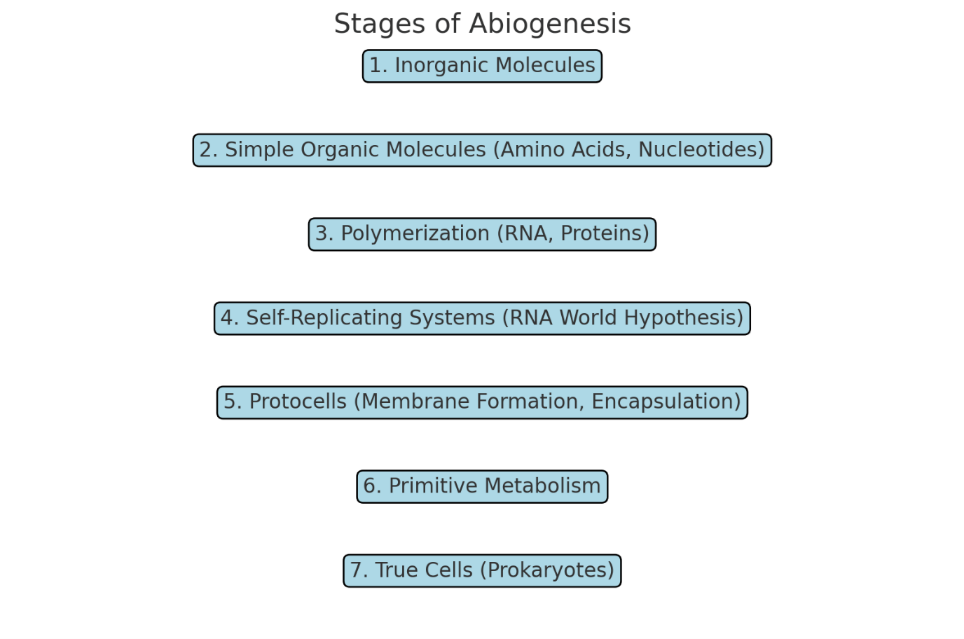
It is quite well known that DNA is the information storage centre of the cell, but not many have stopped to think what exactly it means to be ‘information’. Abiogenesis, simply put, is the idea that life arose from non-life about 3.5 billion years ago on Earth. It tries to propose a natural explanation for the origin of such information, and Strong Naturalistic Evolutionists would essentially have to prove that the following stages are reproducible under prebiotic conditions:
The stages are explained as follows:
Inorganic Molecules: The starting point involves simple inorganic compounds like water (H₂O), carbon dioxide (CO₂), methane (CH₄), and ammonia (NH₃).
Simple Organic Molecules: These inorganic compounds combine under the right conditions (e.g., lightning, UV radiation) to form basic organic molecules like amino acids and nucleotides.
Polymerization: These organic molecules must link together to form more complex structures like RNA strands and proteins. This stage involves creating long chains from simpler building blocks.
Self-Replicating Systems: The emergence of molecules capable of self-replication (like RNA) marks a critical step. The “RNA World Hypothesis” suggests that RNA could store information and catalyze its own replication.
Protocells: Self-replicating molecules must become encapsulated within membrane-like structures, forming protocells that maintain an internal environment distinct from the outside.
Primitive Metabolism: These protocells need basic metabolic pathways to harness energy and sustain themselves, possibly involving simple redox reactions.
True Cells: Finally, these primitive systems evolve into the first simple cells, resembling prokaryotes, capable of growth, division, and evolution.
Proteins (stage 3) are large, complex molecules that are made up of amino acids that are joined up in a specific sequence, and this sequence determines the protein’s structure and function. These amino acids that constitute them are smaller organic molecules, and they are determined by a corresponding sequence of things called ‘codons’ in something else called messenger-RNA (mRNA) – more simply, you get a specific amino acid because of a specific sequence of mRNA, and this mRNA is formed by a transcription of DNA. DNA, specifically, depends on certain sequences of nucleotide bases – these are adenine [A], thymine [T], cytosine [C], and guanine [G]. The picture should be starting to clear up a little now, but essentially, our genome can be seen as one very long ‘word’ that specifies extremely complex behaviour within our bodies.
But wait, that’s not all.
Proteins aren’t two-dimensional. Their three-dimensional shapes exhibit complex shapes, irregular arrangements, and most importantly, specificity. This is to say, some features must either be exactly what they are or within very fine boundaries for the overall protein to function. But, remember, these things are all determined by a sequence of nucleotide base pairs in a given DNA sequence.
Hypothesis 1:Chance
Now, take all this dizzying complexity, and plug it into a ‘chance theory’ of abiogenesis, which is one of the two (or maybe three) real options open to the Strong Naturalistic evolutionist, we start to see some glaring problems.
Firstly, specificity requires the correct letter-by-letter creation of a protein, however, this seems very improbable presuming you are going with some form of primordial soup starting point – i.e., the idea that these organic molecules had somehow formed and ‘knocked into each other until something happened’.
Secondly, such formation also requires solely peptide bonds, which roughly halves the probability because non-peptide bonds also form. Another thing to note is that the subset of proteins that are functional among all the combinations of amino acids is extremely low.
Thirdly, well, let’s actually run the numbers:
Most functional proteins are made of hundreds of amino acids, with an average size of about 300 amino acids2 – but presuming amino acids in a prebiotic soup may be simpler – let’s take a number on the smaller side – 150.
As stated, peptide bonds between amino acids form with a probability of about ½, so the probability of an amino acid forming by chance is about 1 x (½)150 = 1 chance in 1045.
Next, in nature every amino acid found in proteins (with one exception) has a distinct mirror-image of itself. There is one left-handed version (L-form) and one right-handed version (D-form), called optical isomers. Functional proteins only tolerate left-handed amino acids, so we need to square the previous probability – to get 1 chance in 1090
Maxwell Professor of Molecular Biology at Biola University, Douglas Axe shared in 2007 his calculation of the ratio of (a) the number of 150 amino acid sequences that produce any functional proteins whatsoever to (b) the number of possible amino acid sequences of 150 amino acids to be 1 chance in 1074.
All we have to do is multiply these independent probabilities together – 1090 + 74 = 164. This is the probability of getting even one functional protein of modest length, from prebiotic soup.
With all of these charges, one could raise the point – “Surely given all the possibilities and chances in the universe, such things could happen?” It’s a fair question, so let’s look at what probabilistic ‘resources’ the universe has to offer.
We can do this by calculating the number of possible events that could have happened since the beginning of the universe. By doing this, we can establish an upper boundary for how many ‘event resources’ the observable universe could possibly work with:
There are about 1080elementary particles in the observable universe, and because there is an upper limit on the speed of light, only those parts of the universe that are observable (i.e., could have affected events on Earth) are relevant to this calculation – as otherwise would be presuming that some events can break lightspeed.
There are also about 1017 seconds that have passed since the Big Bang.
Due to the properties of gravity, matter, and electromagnetic radiation, physicists have determined that there is a limit on the number of physical transitions that can occur from one state to another within a given unit of time. According to physicists, a physical transition from one state to another cannot take place faster than light can traverse the smallest significant unit of distance – the Planck length (10-33 cm), which takes light 10-43 seconds to travel.
This would put an upper bound of 1080 + 17 + 43 = 140possible atomic events/collisions in the observable universe since the origin of the universe. Other calculations have been made, and this is a higher bound, but it won’t help the naturalists’ case.
Using these generous numbers that we have found, we notice that, by chance, the universe does not have enough opportunities (10140) to even compensate for functional proteins forming by chance alone (1 chance in 10164). This does not mean that this would be impossible, but it would mean that if it did happen, doing some simple statistical hypothesis testing would show that almost certainly there would have been some other cause ‘helping it out’.
Hypothesis 2:Necessity
A second hypothesis put forward is the ‘necessity’ hypothesis – i.e., that there are some biochemical laws that exert themselves upon matter to make it such that the first cell was physically ‘predestined’. It also claims that chemical processes are deterministic (i.e., always produce the same outputs given the same inputs), and it must prove a couple of things:
Reproducibility in Laboratory Conditions
That there are multiple pathways to life
One may ask – isn’t it sufficient to show just one pathway? In a sense, yes, however, this single pathway may just easily be dismissed as a fluke, rather than an inevitable result. If there are multiple pathways – even with different starting points or slightly different conditions – it supports the idea that life will emerge as long as basic biochemical/environmental criteria are met.
Predictive models: The hypothesis should produce models that predict the environmental conditions under which life is likely to arise
Universality of principles: The hypothesis would need to show that the principles leading to life are universal, applying not just to Earth, but any environment with similar conditions
Multiple models have been put forward to try to propose some form of necessity. Dean Kenyon and Gary Steinman co-authored Biochemical Predestination in 1969, proposing a deterministic model and theorizing that the specific properties of amino acids and other biomolecules drive them to self-organize into complex structures, but Kenyon later retracted his support for this idea, moving toward intelligent design.
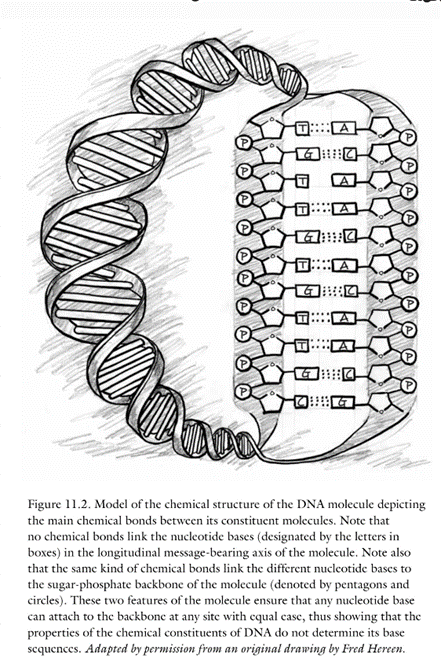
Michael Polanyi, a philosopher and scientist, critiqued purely materialistic and deterministic models of life’s origin, arguing that life and biological information cannot be reduced solely to chemistry and physics – for example, the bonding properties of each nucleotide are specified below – the image is taken from Stephen Meyer’s book – Signature in the Cell:
Just as the properties of building blocks do not determine a building, the bases do not determine DNA, and indeterminacy is actually necessary for complexity, because determinism leads to repetitiveness, not specificity.
Another model proposed is by Stuart Kaufmann, who has proposed models based on the idea of self-organization, but Meyer says that Kaufmann’s model doesn’t properly answer the specificity of sequencing itself, but rather presupposes specificity (which is begging the question).
Therefore, necessitarian models do not sufficiently explain the data we have at hand, so the most popular approach nowadays is to merge hypotheses 1 and 2.
Hypothesis 3:Chance and Necessity
The most popular hypothesis today is what is known as the RNA world hypothesis. This hypothesis states that RNA molecules were the first to both store genetic information and catalyse chemical reactions.
Without getting too much into the weeds of things, the RNA world hypothesis needs to show five things:
The plausible prebiotic formation of nucleotides and their assembly into RNA.
The emergence of functional, self-replicating RNA molecules.
The stability and persistence of RNA in prebiotic environments.
The formation of protocells that could contain and protect RNA.
The transition from RNA-based life to the DNA-protein world.
However, the hypothesis faces significant challenges:
RNA molecules are hard to synthesize and easy to destroy, especially in aqueous environments, where it can easily degrade through hydrolysis – which means that it is very difficult to replicate such processes as would be expected in prebiotic scenarios.
RNA-based replication systems are also ridiculously hard and maybe even impossible to create. While some ribozymes have been shown to catalyze RNA replication in lab settings, fully self-sustaining RNA replication with high fidelity is far from being realized.
The hypothesis also doesn’t explain the origin of biological information. Remember that RNA already has functional information contained inside of it in its nucleotides. So, such models basically presuppose a mix of a random and necessitarian formation of such nucleotides and sequences.
In essence, even the RNA world hypothesis begs the question. If RNA itself needs functional information to form, then this model is almost certainly inherently incapable of explaining the origin of functional information without deferring to random natural processes – which, although necessary for complexity as we have seen, is incredibly improbable on its own.
Ultimately, whether “Chance and Necessity” is able to explain the emergence of life on Earth isn’t really a problem for my model at all. Since I am taking a more abductive approach, all I need to really show in this section is that even if it does, or somehow will in the future – the sheer improbability of these circumstances coming to be on their own is almost certainly enough to rationally justify, or lend credence to a conscious external source of information – especially since information almost always comes from such source. However low a probability someone would like to assign to such source is up to them – and whether they think this source is a super-intelligent alien is not really my concern, but I don’t think it can be reasonably driven as low as probabilities required by some form of chance hypothesis necessitated by naturalism’s view that the universe operates solely according to natural laws and forces. I think this is sufficient evidence to justify a belief in, at least, one supernatural initial miracle to get evolution started (if it even did) for my model.
#2: The Emergence of Sexual Reproduction
This point is something I’ve thought about and haven’t got a real source for, and not much will really be said here. The problem is as follows:
Naturalistic hypotheses almost always propose the formation of initial organisms that will reproduce via asexual means because sexual reproduction necessitates the existence of multiple organisms that ‘know’ about each other (to reproduce) – therefore needing them to account for at least two reproductively compatible species or organisms. Even if this is not the case, such processes must account for species that, at some point in the past, had some common ancestor that just ‘decided’ (in some way, either through chemical randomness or necessity) to start reproducing via sexual means.
One could propose that two separate ancestor species started copulating with each other and that the organisms on Earth that reproduce this way are descended from this species, but one also needs to account for the probability of such an occurrence given naturalism, given Earth’s conditions, given reproductive compatibility, given probability of ‘meeting’ (i.e., being in the same place at the same time) and other concerns such as survivability of offspring. At the very least, it seems like such an occurrence is much more probable under Theism (“it is not good for the man to be alone”).
There do exist proposed solutions to this problem, but it is certainly not yet solved. For example, the ‘gradual transition’ hypothesis and the belief that early eukaryotes are believed to have first reproduced sexually still suffer from questions relating to the origin of DNA, and specifically the DNA for such a process, which I have proposed above. Although the ‘Red Queen Hypothesis’ suggests that sexual reproduction likely helps species ‘keep up’ in the evolutionary arms race against rapidly evolving parasites and pathogens, the question being asked here is not whether this process is beneficial, but rather how it, presupposing only natural forces and laws, came to be at all. Gradual processes involving incremental steps toward full sexual reproduction such as gene transfer might provide some sort of explanation, but surely anyone can see that this seems to get dangerously close to the teleology and purposiveness of such biological processes which, again, seems vastly more probable under Theism.
#3: The Mind
Firstly, it should be noted that not all naturalists are ‘physicalists’. When it comes to predominantly Atheist viewpoints, there are ‘hierarchies’ of permissiveness when it comes to how ‘material’ people are about reality.
I’ll lean on a very smart Atheist philosopher, Graham Oppy, to define Naturalism for me:
“…there are two bits to naturalism…all of the causal entities that there are natural entities, and all the causal properties that there are natural properties…and the natural entities are just—the properties and entities that are amenable to study by the sciences, very broadly construed, right? So by “sciences,” I don’t just mean the formal sciences and the physical sciences, I mean the social sciences as well.”
For the sake of this post, we can limit the type of naturalism we are investigating to physicalists – those who believe that all that exists is the physical world. The distinction between physicalism and naturalism is this:
Physicalism states that reality is entirely physical, and therefore entails that reality can be explained by some ‘proper understanding’ of physics.
Reductive physicalists believe that everything can be ultimately reduced to physics and physical reality is all that exists.
Non-reductive physicalists believe that not everything cannot be ultimately reduced to physics, such as mental states or social phenomena – these phenomena are said to ‘emerge’ from physical processes.
Naturalism states that the only explanations are explanations afforded by the natural sciences, which could be biology, chemistry, or any other social sciences – not just limiting explanations to physics.
Now, it’s not for me to defend either of these positions, but the reason it is relevant this post is that there are a couple of things that naturalism needs to account for:
Intentionality: this would be the ‘directness’ or the ‘aboutness’ of thought toward some object/objective
Qualia: this would be the raw, qualitative, phenomenal ‘feel’ associated with experiences and other conscious mental states
Privacy: this is first person, privileged, subjective access to one’s own conscious states
Rationality: the ability to intellectually grasp abstract and universal concepts and propositions, and apply formal rules of inference
Now, we have already seen that, quite plausibly, the laws of biology cannot be reduced to pure physical phenomena (due to functional information), so it seems that mental properties, which are at least at that level, cannot be reduced to purely physical phenomena also. Therefore, I don’t really have much more to say directly to reductive physicalists.
Moving on to non-reductive physicalists, again, it seems like we don’t really have very good empirical evidence to verify at what point the mental phenomena above really begin to ‘emerge’ – what the dividing line is such that functional information simply ‘emerges’ from a structure or becomes irreducible (at least, presupposing a purely physical reality).
Furthermore, briefly, a physicalist view also seems to struggle empirically with distinguishing what parts of a causal process are actually relevant to an entire causal series. For example, presume that the mind is purely physical and every thought you have either (1) emerges from some neurons firing or (2) is directly caused by it. To what extent can we really say that these neurons were the sole relevant cause of the thought? Can we not say that the wind that blew, causing your eyes to look somewhere else caused a chain reaction that eventually led to the neurons firing is also equally relevant? In that case, to what extent can we really say that that which is ‘you’ is really just a biological substance – is it wrong to add the wind too? Why?
This seems to conflict with the reality of intentionality and qualia – the truly subjective feel of one’s experience and the directedness that we all experience. Worst of all, it seems to directly challenge the persistence of identity through time. In this case, how exactly would we be able to directly point at something essential that remains with you and makes you “you”, at any point in your life?
There are also difficulties in verifying the relationship between brain activity and mental activity, in that brain scans seem to necessarily struggle with accounting for mental processes. At most, brain scans might be just said to be able to explain the correlation between some phenomenological property and some given brain activity – but it is a large leap to claim that this is a causal relationship. For if it were, the Neuroscience community would likely be screaming ‘victory’ by now.
The points raised are similar to the ‘philosophical zombie’ argument that is popular in the field of the philosophy of Mind, which entertains the metaphysical possibility of beings that are physically identical to humans, yet do not experience consciousness. i.e.,
Premise 1: If it is conceivable that zombies could exist, then it is metaphysically possible that they exist.
Premise 2: If it is metaphysically possible for zombies to exist, then consciousness is not identical to or reducible to physical properties.
Conclusion: Therefore, physicalism is false because it cannot account for consciousness.
Now, one may doubt that conceivability entails metaphysical possibility – and I would actually agree with this person. I think imagination (which is like forming a material mental representation based on sensory information) entails metaphysical possibility, but not conception (which is just forming a notion or idea of something). However, simply the fact that my brain is not numerically identical (i.e., exactly the same as) to my mother’s, yet we both (arguably) experience mental phenomena shows that there is something common between human brains that likely allows for mental phenomena that likely can’t be reduced to physics, or purely emerges from physics. I suppose that the physicalist would need to show (at some point in the far future maybe) what such commonality is that entails such experiences. Now, whether the Zombie argument works isn’t really my point here – rather, I simply want to show the sheer difficulty the natural sciences have when it comes to explaining mental properties through physics or natural sciences alone – Theism seems to have much fewer problems.
As for Naturalism as a whole, well, I think the whole of point 1 can be devoted to providing an evidential argument against it. As I said in that section, if you wish to credit the beginning of humanity’s existence to a hyper-intelligent alien, that is up to you. However, I think later blog posts will help us to zero in on what kind of cause best explains other data.
The Naturalist could always object that ‘we don’t know enough yet’. Of course, but what we do know is that information does arise from conscious agents. Therefore, it seems to make sense that an agent that can impart information in another seems to be a better explanation for the origin of information than some non-conscious agent – especially since information generally degrades over time in a purely natural system – as stated by the idea of entropy in information theory:
As entropy increases, the system becomes less organized and more random, leading to the degradation of information content.
Lastly, a Naturalist also needs to explain our ability to grasp non-physical phenomena such as numbers, propositions, moral values, meaningful symbols and probably most interestingly, beauty – such as artistic beauty or music.
It seems quite evident that the pure probability of our dominance over other much-stronger and faster species presuming Strong Naturalistic Evolution and natural selection is very unlikely. When considering dangers, alongside natural disasters – it seems quite interesting that such a resilient, yet feeble species would eventually possess such a strong command over the natural world. Although intelligence is a very powerful trait, I suppose it is dubitable that intelligence alone (1) could have emerged naturally and (2) could have coupled itself so nicely with our other biological qualities to have us reign so supremely.
Ultimately, I think I have given good reason to support why a theistic model of evolutionary creation is preferable to a naturalist version. My argument has not been deductive, but rather abductive. I am not saying that naturalists will never be able to explain these things, but rather, that Theism will likely always provide a much better explanation for things such as the origin of DNA, the origin of sexual reproduction, mental phenomena, and our intellectual dominance.
If you’ve got any thoughts or objections, go ahead and leave them below!
Thanks,
Rookie
Sources:
Point 1 relies heavily on material taken from Signature in the Cell by Stephen C. Meyer
The 300 Amino Acid average is taken from Alberts, B., et al. “Molecular Biology of the Cell.” 6th edition. Garland Science, 2014


 RookieApologises