I wasn’t certain whether this fourth post was even necessary, given that I think I have provided adequate justification for my position in parts one and two. Still, I suppose that there’s nothing wrong with me providing reasons for my not falling into either of these camps. Hopefully, this post won’t be nearly as long as either of the first two, and most of my justification will be aimed against Young-Earth Creationism (as I have already stated that I am not dogmatically averse to Old Earth models).
Broadly, my reasons are as follows:
Unreasonable presuppositions
Novelty
Empirical evidence
Arbitrary stopping points
Unreasonable Presuppositions
The first, and most important reason that I do not fall into either camp is the presuppositions that they impose on scripture and exegesis, especially through their literalism. Young Earth Creationism specifically holds to both a chronological and literal viewing of Genesis 1. The Bible is very much more a book detailing the story between God and mankind, than it is a book of science. Now, although I do not believe that it is metaphysically impossible for God to create the world as is literally described in Genesis 1, we also need to be wary of presuming that the Spirit’s inspiration intended to convey that Genesis 1 was literal. This is something I caution against in my first post, explaining the reasoning for my methodology.
Novelty
The following will be a summary of points raised in another excellent video by Inspiring Philosophy and will be directed specifically at Young Earth Creationists. I encourage you to watch his video yourself because the following is a summary.
Secondly, and surprisingly to most, a non-literal interpretative method is not at all foreign to Christianity. Multiple Christians throughout the ages have interpreted Genesis allegorically or figuratively, such as St. Irenaeus of Lyons in the 2nd Century AD (Against Heresies 5.23.2, 5.28.3), St. Clement of Alexandria (Stromata (Miscellanies) 6.16), St. Augustine (The Literal Meaning of Genesis 4.27).
Of course, the views of the aforementioned Church Fathers do vary, one holding to instantaneous creation (St. Clement), one holding to ‘thousand-year’ days (St. Irenaeus), and one holding to ‘God divided days’ (St. Augustine). Multiple other influential figures in the Church held to allegorical, or figurative interpretations, but the point to be made here is simply that non-literal interpretations of creation are not new within the Church.
There have existed other individuals, such as Isaac Newton, Bishop Ussher, and Johannes Kepler who have agreed that the date of creation was around 4000 BC, however, at the time, the scientific research was very limited regarding the age of the Earth. Thus, these individuals held to this belief because the contemporary evidence supported it, and that was because there had not been research against it.
Around the late Middle Ages, many Christians promoted something similar to what is called the ‘gap interpretation’ of Genesis 1:2. The text says that the Earth was ‘without form and void’ (or, ‘without shape and empty’ in the NET), such interpretation says that this could have been during an unspecified amount of time, during which there was only chaos that was later ‘reworked’ into creation. Some people even thought that this could have been millions of years.
In 1865, Reverend Richard Main wrote:
“Some school-books still teach to the ignorant that the Earth is 6000 years old.… No well-educated person of the present day shares that delusion”
As a matter of fact, in a publication of the Geological Society called ‘Myth and Geology’, Historian Michael B. Roberts writes on pages 47-48:
“Christian thinkers were open to a slightly longer time-scale long before geological evidence was apparent, as may be evidenced by Grotius, Mersenne, Burnett, Bishop Patrick and myriad others in the seventeenth century, who accepted a long duration of chaos and thus ‘deepish’ time, before there was any geological evidence for a great duration of time. And that is without going further back to the broader interpretations of Genesis of the Church Fathers such as Augustine…. Despite the date of 4004 BC being found in many English bibles a strict six-day creation was never the dominant view and was the official position of no church in Europe or America (until the late twentieth century)”
Regarding evolution specifically, multiple Christians, even around the time of Darwin, were supportive and/or saw no conflict between the theory of evolution and Genesis. Examples of such are Botanist Asa Grey, Philosopher James McCosh and Geologist and Mineralogist James Dwight Dana. Palaeontologist Richard Owen and Zoologist St. George Jackson Mivart both promoted their own models of theistic evolution. Historian Ronald Numbers writes in his book ‘The Creationists, Expanded Edition’, writes:
“Even in the conservative south, dominated culturally by Bible-believing Baptists, a number of Church-related colleges had been teaching the theory of evolution for decades.”
This is not to say that there was no Christian resistance to the Theory of Evolution, but it is certainly overinflated by people who are uneducated on the history of this topic. The Christians who left writings behind were largely accommodating to the research that was available at the time.
The ‘Young Earth’ movement, on the other hand, is quite modern.
Within the period of 1900-1950, there was one group that was mostly comprised of Young-Earth creationists – the heretical Seventh Day Adventist movement, who elevated the visions of their ‘prophet’, Ellen G. White, to be on par with scripture. Ellen had a vision that God took her back to the time of creation and revealed to her that everything was created in six, literal, twenty-four-hour days.
Among these Seventh-Day Adventists, was someone called George McCready Price – an ‘armchair’ geologist (as some have referred to him). He wrote several papers and books, arguing that the geological record had been formed as a result of Noah’s flood (which was what God had allegedly showed Ellen after the six days of creation), and he referred to this as ‘flood geology’, and taught that the Earth, and life on it, was 6000 years old, and was created in only six days. As a result, many arguments that Young-Earth Creationists use today date back to Price – not actual geological specialists.
People didn’t really support Price initially. Some years later, Bernard Ramm, in 1954, exaggerated Price’s influence and criticised Price’s ‘flood Geology’ in his book ‘The Christian View of Science and Scripture’. However, this book instead inspired a young theologian – John Whitcomb JR., to write his doctoral dissertation defending Price and his Young Earth views. He tried to get his work published as a book with some backing from Geologists, but they were quite clear that the geological record could not be used to support his interpretation.
Whitcomb decided to contact Henry Morris, who was not a Geologist, but rather, had a PhD in hydraulic engineering. Morris agreed to co-author the book, but since Price’s arguments had been rejected for decades by now, they had to add a ‘spin’ to his work. So, while recycling some of his arguments, they argued that in addition to the Earth being young, that the Universe was young also (Price only argued that the Earth, and life on it, was young, but had nothing to say on the age of the Universe). No Geologist endorsed the book, but in 1961, they had the book published – “The Genesis Flood: The Biblical Record and its Scientific Implications”.
Although scientists themselves saw the obvious rehashing of previous arguments and rejected it as such, the populace wasn’t so well informed, and within about 25 years, the book had sold 200,000 copies. The writers became celebrities, and before long – the word ‘creationist’ quite quickly became synonymous with ‘young-earth creationist’.
Quite simply, Christianity had never dogmatically affirmed Young Earth Creationism, and had been largely welcoming to the contemporary empirical research. Therefore, with this theory drawing much of its influence from a heretical ‘prophetess’, I think I have sufficient reason to reject it.
Empirical Evidence
I have already provided the results of empirical methods in part two to support my belief in the presence of macroevolution in creation, but multiple other lines of evidence can be used to rebut a 10000-year limit on the age of creation. Such are:
Cosmic Background Radiation:
This is light that is the oldest and most distant light in the universe. The blackbody spectrum that we can measure with it, with a peak temperature of about 2.7K, is exactly what you would expect from radiation that had been ‘stretched’ or red-shifted over billions of years.
Carbon Dating methods:
These methods are used to measure the ratio of Carbon-14 (which decays over time) to Carbon-12 in once-living materials. It is most reliable for samples up to 50,000 years old, but this is sufficient to press charges on a Young-Earth view.
The Geological record:
As stated earlier, the geological record does not support a young-earth view. For example:
Radiometric dating: Similarly to carbon dating, this technique measures isotope decay, but it measures it in rocks. The oldest rocks on Earth, found in western Greenland, have been dated to be 3.7-3.8 billion years old. Some zircon minerals in Australia have been dated to being around 4.4 billion years old.
Geological processes such as Erosion, Sedimentation and Plate Tectonics: These processes are slow. The formation of mountains, canyons and sedimentary rock layers through gradual processes like erosion and deposition takes millions to hundreds of millions of years – as evidenced through direct measurement (of erosion and sedimentation rates) and radiometric dating of geological layers.
Stratigraphy and the Fossil Record: The geological principle of superposition states that in undisturbed layers of rock, older layers lie beneath younger ones (which makes sense, right?). By studying these layers, the fossil record has shown a clear progression from simpler life forms in older strata to more complex organisms in recent layers, spanning billions of years.
Many more lines of evidence can be given, and of course, these evidence do not each individually refute Young Earth creationism as a whole, however, they each singularly cast doubt on the premises of the Young Earth movement. From casting doubt on the age of the Earth to the creation of microorganisms and more. Fossil records may even cast doubt on some presentations of Old Earth models.
Arbitrary Stopping Points
Lastly, this specific section will give some extra reasons as to why I currently favour Evolutionary Creation models over de-novo Old Earth models, in addition to the ‘presuppositions’.
I suppose that, simply put, I’m not really convinced with Old Earth models’ answers to the creation of Adam and Eve. For example, if you are going to take Genesis 1 literally, which I think is not loyal to the cultural context of the time, then, to me, it doesn’t make much more sense to not go the whole way and affirm a Young-Earth model, but as we have already seen, there is not strong evidence for it at all, and also, it gained much force from a heretic.
Secondly, many models struggle to answer common-descent and genetic similarities between chimps and humans. Some have responded with ‘common design’, which I think is fair, but again, this just seems to be an arbitrary stopping point. Why use a common design if you are going to affirm a largely de-novo model? Of course, one could say that I also have a similar arbitrary point with adding God in, but I gave what I think was adequate justification for that, referring to the anthropological ‘Great Leap Forward’ and the sudden increase in human capacities. Further, I also think that there are things that natural processes cannot compensate for, but that is not for this post.
To be honest, there’s not much more in the way of me accepting Old Earth Creationism, but that doesn’t mean that there isn’t much in total. The barriers of empirical evidence are quite high, and although the evidence for evolutionary creation is not perfect (for example, the fossil record does have some gaps and uncertainties), I think it is the strongest candidate, and I think I have given sufficient evidence to warrant that conclusion.
Within the last couple of decades, some Christian’s understanding of the Genesis story has seriously butted heads with the empirical evidence that natural sciences have presented to society. This struggle with reconciling the ‘seven days of creation’, and a ‘six-thousand-year-old Earth’ with the evidence from fossil records, carbon dating, and cosmic background radiation has made it such that many Christians that are brought up reading the Genesis story literally can end up having a crisis of faith when they end up in their Physics class at age 15.
My aim in this series is not to spell word-for-word how the creation of man, or the universe played out. There are some things that both I and, as you will see, modern science, do not know how to explain. There are also some things that I do not think can be reduced to physical and chemical processes, but that is for part 5.
The first post in this series will present a coherent understanding of the creation story (Genesis 1 and 2), which I think best represents the original writers and the intention of the text. This first post will be focused on theology, leaning heavily on the work of Old Testament scholar John Walton, and Professor of Philosophy Dr Andrew Loke. I will handle the scientific side in the next part.
The four theses I will propose in this post are:
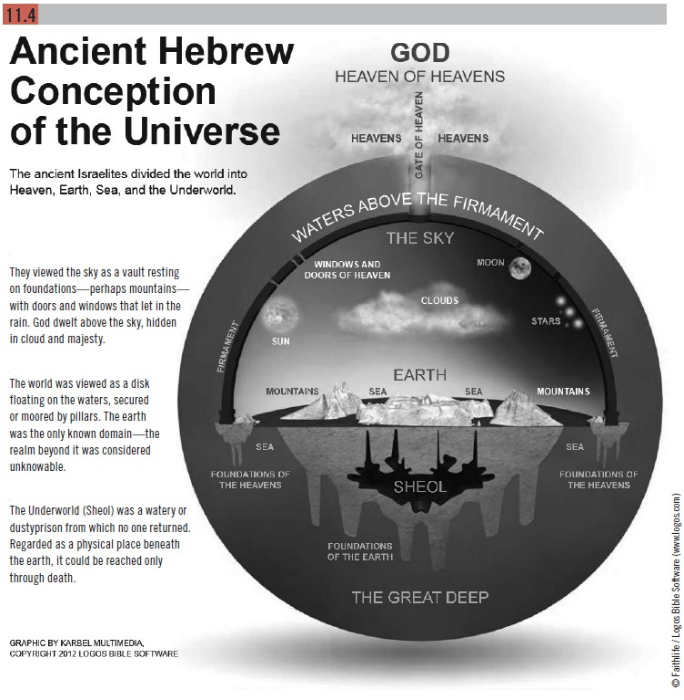
Thesis 1: The Israelites understood a three-tiered Model of the Universe
Thesis 2: Genesis 1 illustrates a coherent functional creation of a cosmic temple using this three-tiered model
Thesis 3: Adam and Eve were real, historical people, and Eden represents a sacred space for them to reflect God’s image among creation.
Thesis 4 (Cursory): They disobeyed God in some, possibly non-literal, form – leading to the stain of original sin. – this is cursory as I thought I ought to include it but it’s not essential to the topic.
So basically, Genesis 1 makes sense…as an ancient cosmological model of origins.
Prologue:Some Presumptions
A brief note on my methodology:
In the study of biblical interpretation, there exists the term ‘concordism’ – those at Biologos, a ‘Christian advocacy group that supports the view that God created the world using evolution of different species as the mechanism’ define the term as this:
“the supposition that the biblical and non-biblical data on a given topic can and should be harmonized (of course, the term “harmonized” itself is open to varying definitions, which creates the problem for understanding “concordism”)” ‘Discordant Views on Concordism’
The article above proposes more definitions, and I would likely fit into the category of 1B – leaning toward non-concordism, which is defined as such:
“Softer” Version (1B): The Bible, including an historical Adam, can be harmonized with an old universe/earth and evolution. This entails a broad sense of “harmony” as a synonym for “concordism.” Generally, however, those who accept both mainstream science and some sense of harmony or complementarity with the Bible (including many evolutionary creationists) would classify themselves “non-concordists” because they do not think the Bible is trying to teach modern science. The position proposed here (1B) differs from the following one (1C) in that 1B constitutes evolutionary-creationist models of how the biblical and scientific data can be reconciled to uphold an historical Adam. These proponents are Christians who accept the genetic evidence for evolution (both the genetic similarity across species and the genetic diversity within the human species), yet believe the Bible teaches an original human pair (either alone or part of an original population).
Some reasons for this methodology:
It’s important to remember that the Bible was written for us, but not to us. It is not reasonable to expect God to speak to the Ancient Israelites in modern scientific language, but rather, we would expect him to speak to him in their ‘own language’, or to ‘condescend’ such that they can understand the necessary truth without getting too confused, considering we can’t expect God to teach Moses Newtonian mechanics now, can we?
To first understand the Genesis story, we need to understand what Old Testament Scholar John Walton calls the ‘cultural river’ – which could be defined as a collection of ideas/understandings that underpin the collective ‘thinking’ of a given society. One such example might be that which I gave in my first post on the Old Testament series, where I spoke about how the Israelites understood the law code of the Torah to be mainly casuistic (case wisdom), rather than exhaustive.
We know that the Israelites that would have written the Torah would have been well immersed in Egyptian mythology, and therefore, we might expect the biblical creation story to have some parallels to other ANE creation stories (such as the Epic of Gilgamesh, or Enuma Elish), which is exactly what we find. Note that parallels do not entail that Moses copied these stories. Rather, their perversions (multiple carnal deities, humans not created with dignity, our roles of stewardship), make it seem more probable that they perverted the form of the original narrative, especially when we see that many of these ancient cultures, whether it be Persian, Egyptian, Hindu, Chinese were initially monotheistic, before descending into one or another form of polytheism.
Thesis 1: The Israelites understood a three-tiered Model of the Universe
Take a look at this:
Briefly put, the Ancient Israelites believed in a three-tiered conception of the universe – which, funnily enough, was quite a logical thing to do. Clear evidence for this is seen in Exodus 20:4 where, in the commandment against idolatry, we see the phrase:
‘ “You shall not make for yourself a carved image or any likeness of anything that is in heaven above or that is on the earth beneath or that is in the water below. ‘
Tier 1 – The Heavens:
These people knew that the waters they saw were blue (e.g., in seas) and therefore thought that there must be a clear dome in the sky with water. In Genesis 1:6, we see a line that confirms this:
‘ God said, “Let there be an expanse in the midst of the waters and let it separate water from water. ‘
The word “rā-qî-a” translated to ‘dome’ can also be translated to ‘vault’, ‘expanse’ or ‘firmament’, and although it can be translated in different ways, it generally refers to something solid and not simply an airy atmospheric expanse. Furthermore, the Septuagint (the Greek translation of the Old Testament), written in about the 3rd Century BC, uses the term ‘stereoma’ – which also connotes a solid structure.
The reasoning behind this would have looked something like this:
Premise 1: It rains only sometimes.
Premise 2: God is above us.
Premise 3: The rain is beneath him.
Premise 4: God controls the rain.
A [reasonable] conclusion*: The rain is stored in the sky that God sometimes opens.
*…there are a few more premises required to make this argument valid…
…and this reasoning is clearly illustrated in Psalm 148:4…:
” Praise him, O highest heaven, and you waters above the sky!’ ‘
…and Job 22:14…:
‘ Thick clouds are a veil for him, so he does not see us, as he goes back and forth in the vault of heaven.’’
Some translations read something like “Thick clouds enwrap Him, so that he does not see, and He walks on the dome of Heaven”. Those who say that ‘the bible says that God can’t see so therefore he doesn’t know everything’ should note that this is Job’s friend speaking, who isn’t a theologian at all.
Tier 2 – The Earth:
Like most, the Israelites would have seen the Earth as some sort of disc or Island with water beneath it. This disc would have been held up with some sort of ‘foundation’. We see evidence for this in:
1 Samuel 2:8:
‘…The foundations of the earth belong to the Lord, and he has placed the world on them.’
Job 9:6:
‘ he who shakes the earth out of its place so that its pillars tremble;’
…and Psalm 104:5:
‘’ He established the earth on its foundations; it will never be upended.’
Tier 3 – “Sheol”, and waters below the Earth:
The reasoning for this would look like this:
Premise 1: It rains sometimes.
Premise 2: When it rains the water goes into the ground.
Premise 3: When we dig we find water.
Conclusion: Therefore, there must be water under the Earth.
Now, note that Sheol and the waters under the earth are not equivalent – for Sheol was said to house the spirits of the dead, whereas the great deep (waters under the earth) was simply water. The actual evidence for the idea of this tier is found in these verses.
Isaiah 14:9-15:
‘Sheol below is stirred up about you, ready to meet you when you arrive. It rouses the spirits of the dead for you, all the former leaders of the earth; it makes all the former kings of the nations rise from their thrones…Your splendor has been brought down to Sheol, along with the sound of your stringed instruments. …But you were brought down to Sheol, to the remote slopes of the pit.’
Ezekiel 31:16-17:
‘I made the nations shake with the sound of its fall when I threw it down to Sheol, along with those who descend to the pit. …They also descended with it to Sheol, to those killed by the sword…’
Job 11:8:
‘It is higher than the heavens—what can you do? It is deeper than Sheol—what can you know?’
Here are verses that support the idea of waters “under the earth”:
Genesis 7:11:
‘…on that day all the fountains of the great deep burst open and the floodgates of the heavens were opened.’
Genesis 49:25:
‘…because of the sovereign God, who will bless you with blessings from the sky above, blessings from the deep that lies below…’
…along with Exodus 20:4 – scroll up to read that one again.
Thesis 2: Genesis 1 illustrates a coherent functional creation of a cosmic temple using this three-tiered model
In our society, when we think about ‘creation’, we tend to think about ‘material’ creation – such as something forming anew, or even ex nihilo. However, according to John Walton, Old Testament peoples tended to think more about the existence of things in terms of functions – as such, ‘creation’ for them was not necessarily material, but functional – i.e., something ‘came into existence’ when it received its function, or more accurately, it’s ‘telos’ (purpose). Therefore, under ancient cosmology, it is possible that the universe existed in a ‘formless and void’ matter before it became what it currently is. Walton argues that a ‘functional’ view of creation is a more coherent view of Genesis 1 and I will utilise the premise of this functional model to interpret Genesis 1.
We have already seen how Genesis 1:6, and much of the Torah presuppose a three-tiered cosmology, and so here – I will exegete (interpret) Genesis 1 and 2 in light of this, proposing that Genesis 2:4-24 is a ‘secondary creation account’ – unlike Walton, I won’t place it after the first account (Genesis 1:1-2:3), which represents general creation and creating the world – I think that it is rather an elaboration of Day 6, zooming in on Eden.
Walton suggests in proposition 5 of ‘The Lost World of Genesis One’ that ‘Days One to Three establish functions’, and proposition 6 that ‘Days Four to Six Install Functionaries’. Here’s the distinction between a ‘function’ and a ‘functionary’:
Function: the roles or purposes that different aspects of creation serve within this cosmic temple [I’ll explain the ‘temple’ bit in more detail later].
Functionary: the entities or agents that perform the functions established by God. In Walton’s interpretation, functionaries in Genesis 1 include the sun, moon, and stars, which serve specific roles like marking time and giving light. Human beings, created on the sixth day, are seen as the pinnacle of these functionaries.
Prologue: Ex-nihilo?
‘Bara’ – translated ‘create’ in Genesis 1:1, can mean creation ex-nihilo (out of nothing/using no material resources to create), but it can also refer to the bringing of order, organization, roles, or functions – e.g., the creation of a clean heart in Psalm 51:20 and the creation of Israel in Isaiah 43:1. This doesn’t at all preclude the possibility that God didn’t create the universe ex-nihilo – just that this verse might not be trying to convey creation ex-nihilo. Both interpretations are compatible with orthodoxy.
Day 1: Creation of a Function – Day
Walton (2011, p153) argues that God creates a period of light that interrupted the darkness of Genesis 1:2 – naming these periods ‘day’ and ‘night’. More clearly, it is a regularization of day and night, which may have existed before but might not have been regular.
Day 2: Creation of a Function – The Water Cycle
This would be a setting up of the Water cycle (remember, ancient cosmology!). God creates the ‘vault’ – “rā-qî-a” separating the waters below from the waters above. One might question why the second day is not called ‘good’ like the others are, but it should be noted that the creation of the water cycle isn’t finished until day 3 – which provides a plausible reason for this.
Day 3: Creation of a Function – The Function of Plant Growth, and the Sea-Land Separation
This day is a little harder to explain, but it should be noted that ‘Functional creation’ does not have to be tied with the declaration of function – it’s also okay to refer to the initiation of an ordering process. Initially, the land was declared as ‘lacking order and purpose/without shape and empty’ (Gen 1:2), but now the land is commanded to ‘produce vegetation’ (see Gen 1:11).
Day 4: Creation of a Functionary – The Creation of the Sun, Moon and Stars
Aha. We’ve run into a dilemma! If Genesis 1:1-2 states that the earth was already present on the First day and Genesis 1:14-19 says that the sun, moon and stars only appear on day four, aren’t we in trouble? Also, how did ‘day’ even exist without a ‘sun’ for the earth?
Remember, this is ancient cosmology – i.e., forget photosynthesis.
According to the functional creation view, it is not necessarily the case that the sun, moon, and stars only began to exist on day four – rather, it is the case that from day four onwards these started to function as luminaries that ‘separate the day from the night’, serving as ‘signs to indicate seasons and days and years…as lights in the expanse of the sky’.
This therefore does not mean that light only began to exist on day one [since ‘light’ is called ‘day’ on day one]. On day four, actual, physical light can now be seen on the Earth’s surface to mark daytime.
This idea is consistent with what we see in Job 38:9, where it says that God ‘made the clouds its [the seas’ or the waters’] garment and wrapped it in thick darkness’. This can be understood as affirming an opaque primordial atmosphere, not the sun’s non-existence, as the cause of darkness ‘over the surface of the deep’ – so the sun already existed. Basically, by day four, whatever was obscuring the sun had sufficiently dispersed, allowing the pre-existent sun, moon, and stars to become visible enough to serve as the functionaries of ‘seasons and days and years’.
Day 5: Creation of a Functionary – Creatures are tasked with filling the seas and the skies
Walton argues that the phrase ‘let the waters teem with swarms’ signifies the functional placement of sea creatures – assigning them a role within the ordered cosmos, rather than indicating material creation. The installation of order that also brings about the fruitfulness of filling the seas should be taken into account.
The reason this interpretation makes a lot of sense here is because there was a very prevalent view in the Ancient Near East that the sea was the very embodiment of non-order (which is against what creation – functional creation – intends to bring about – order).
“Walton notes that ‘the tannîn referred to here (NIV: ‘great creatures of the sea’) are counted among the chaos creatures in the Old Testament (see Job 7.12; Ps. 74.13; Isa. 27.1; 51.9; Ezek. 32.2; cf. the Ugaritic chaos creature tunnanu)’.” The Origin of Humanity and Evolution: Science and Scripture in Conversation, P.58, Andrew Loke
The skies weren’t similarly seen as disordered, but Walton again thinks that this blessing to ‘fill the skies’ is more about installing order and functionaries.
One might ask, if Day 5 is supposed to eliminate the disorder in the seas by establishing order in these functionaries, why did the Old Testament people see the sea as disordered?
It could be that God did not completely order all disorder within the seas but began the process by assigning roles and instilling a measure of order through the creation and functional placement of sea creatures and birds. Day 5 also does not say ‘it was good’. It could be that this process was finished, or had reached its intended end [the point at which man was supposed to ‘subdue’], on day 6.
Day 5 instead lays the groundwork for a more structured and ordered creation as opposed to completing the process – see (1).
Day 6: Creation of a Functionary – Land Animals and Humans
Here, at least in Genesis 1:26-28, I think we see a brief description of the establishment of the human’s role of ‘filling the land’ and having ‘dominion over the Earth’. I would say that Genesis 1 provides an unspecified summary of the accounts of Genesis 2.
One might have gotten confused with the ‘creation of animals’ – but, remember – this is a functional model. It can be said that pre-existing animals here are moving into the place where humans were supposed to be – Eden.
A brief note on Genesis 2:5 – one may worry that because the verse says that ‘no shrub had yet appeared’ and ‘the Lord had not yet caused it to rain on the Earth’, we have a problem – because necessarily the flying animals of Genesis 1:20 would have needed to eat food (e.g., like worms/seeds) that necessarily depended on the water cycle which (allegedly) began on Day Two.
Two things can be said:
Genesis 1 could be speaking about the plants that can grow wild, whereas those in Genesis 2 are those that require human cultivation through planting and artificial irrigation.
(1) would also answer the ‘rain’ question. Although rain might materially exist as functional creation allows, it may not be acting in the intended form that Eden and humans needed.
Day 7: Divine Rest and the Sabbath
Here is where the model shines.
Christians are not ‘deists’ – that is, people who believe that God exists, yet don’t believe he has any interest or meaningful interaction with creation. However, one could make the charge that Genesis 2:3 implies this. John Walton provides a more interesting interpretation, making the point that when a deity in the ANE culture ‘rests’, it is not necessarily the case that they are simply ‘ceasing from activity’. Rather, they are generally taking residence in a temple and assuming control and governance over the cosmos – switching from the active, creative role to one of governance.
From this follows Walton’s idea of the ‘cosmic temple’. These six days are the inauguration process of God’s cosmic temple – essentially Eden, and on the seventh day, it is now able to function with God at its centre. This also lines up quite nicely with the poetic form of Genesis 1, which continually repeats (depending on the translation you are reading) ‘and God said’ or ‘let there be’, impliying a liturgical celebration of creation, but this last point is speculative – since we have no direct evidence that this chapter was celebrated liturgically.
Also, this provides an interesting, and very plausible understanding of the Sabbath. We know that Israelites were not permitted to do any kind of servile work on the Sabbath, but that didn’t mean that they were to remain static all day. Rather, they were to keep the day ‘holy’ and to ‘set it apart’ (Exodus 20:11). Through this interpretation, we more clearly see that observing the Sabbath is a way of acknowledging and participating in the divine order and rest that the six days of creation established.
Thesis 3:Adam and Eve were real, historical people, and the Eden of Genesis 2 represents a sacred space for them to reflect God’s image among creation
The following will try to provide a theological understanding of Genesis 2:4-25 whilst maintaining the functional framework.
Point 1: Adam and Eve are real, historical people
The first point to make is that Adam and Eve were real people. The arguments will be theological, and so I won’t be going into the scientific side of things here as that will be done in the next part.
“’ So then, just as sin entered the world through one man and death through sin, and so death spread to all people because all sinned – ‘”
I think it is quite hard to get around the interpretation that Paul thinks that Adam represents ‘one man’.
Romans 5:14 reads:
‘ Yet death reigned from Adam until Moses even over those who did not sin in the same way that Adam (who is a type of the coming one) transgressed. ‘
Paul doubles up here, even referencing Moses – a man who the Israelites held in very high esteem. However, it should be noted that here ‘Adam’ is used in an archetypal manner the second time, so we know that when Paul uses the name, it is not in a univocal sense.
1 Corinthians 15:21-22 reads:
“’ For since death came through a man, the resurrection of the dead also came through a man. For just as in Adam all die, so also in Christ all will be made alive. ‘”
Yeah, after this one, it’s not clear how anyone can get around the idea that Paul thought Adam was a real man. Although the true essence of the message being propounded here is not that Adam was a man (because we are seeing theological language intended to tell us that Christ has provided the means of undoing the wound of original sin), if Paul thought Adam was a real man, a representative, rather than simply a name for a population, it makes this idea much harder to argue against.
1 Corintians 15:45-9 reads:
“’ So also it is written, “ The first man, Adam, became a living person ”; the last Adam became a life-giving spirit. However, the spiritual did not come first, but the natural, and then the spiritual. The first man is from the earth, made of dust; the second man is from heaven. Like the one made of dust, so too are those made of dust, and like the one from heaven, so too those who are heavenly. And just as we have borne the image of the man of dust, let us also bear the image of the man of heaven.’”
Mic drop? This pretty much captures the essence of my argument. The typological parallels between Adam and Jesus, Eve and Mary are so strong in the Bible that, I argue, the story becomes so much clearer if you affirm that Adam and Eve were real people.
Exhibit B: The Narrative of Genesis 3
My argument with this point isn’t intended to be laborious, because I don’t think it needs to be. Genesis 3 is clear in that it tells us that there was a point at which sin entered the world. If this is the case, then it seems ad hoc for those who disagree to ignore the message of Genesis 3 that disobeying God was what brought sin into the world. Genesis 3:9+ clearly illustrates God speaking directly to Adam and Eve after their sin – I’m not sure I need to add any more justification for this point.
Point 2.1: …and the Eden of Genesis 2 represents a sacred space for them to reflect God’s image among creation. – Adam
I have already argued that Genesis 1 provides an ‘unspecified’ view of the creation of man, functionally. Following on from the ideas that I brought to light in the previous thesis on ‘Day 7’, Walton brings the idea that Genesis 2 specifies Eden as the centre of the ‘cosmic temple’, in which Adam, Eve (although used archetypically at many points in the Biblical narrative) and mankind, are to serve as stewards. More specifically, Adam was to serve as a Priest before God, with Eve as his ‘helpmate’. I make this point by drawing parallels through covenants that God makes with other Patriarchs in the Bible. A list of these covenants and their references are found here, but I won’t write out the verses as that would be too much:
The Noahic Covenant: Genesis 9:8-17
The Abrahamic Covenant: Genesis 12:1-3, Genesis 15, Genesis 17
The Mosaic Covenant (Sinaitic Covenant): Exodus 19-24, Deuteronomy 4-5
The Priestly Covenant (Aaronic Covenant): Numbers 25:10-13
The Davidic Covenant: 2 Samuel 7:12-16, 1 Chronicles 17:11-14
The New Covenant: Jeremiah 31:31-34, Ezekiel 36:26-28
Although only the Aaronic Covenant is explicitly priestly, all of the others are ‘priestly’ in one form or another – i.e., they have one representative that represents the people before God and ‘communicates’ with him on behalf of, or offering supplication/penance for, the population.
Rolling these ideas back into Genesis 1 and 2’s ‘cosmic temple’, with Adam (as Paul has so clearly outlined above) being an archetypal representative (and also historical, as I have argued), of man before God – which is practically identical to the role of a priest.
A final line of evidence for this point comes from Genesis 2 itself, which uses the words “shamar (שָׁמַר)” and “abad (עָבַד)”. The full verse reads:
“’ The Lord God took the man and placed him in the orchard in Eden to care [shamar] for it and to maintain [abad] it. ‘”
Walton tells us that the word “shamar” is often used in the context of priests who guard and keep the sanctuary (e.g., Numbers 3:7-8, 8:26). Adam’s role in “keeping” the Garden parallels the priestly duty of guarding the sacred space. Similarly, the term ‘abad’ is also used in Numbers 8:26 to describe the service performed by priests in the Tabernacle and temple.
The explicit use (in Numbers 8:26) is shown here (thanks to ChatGPT for this bit):
“Performing their duties”: לַעֲבֹד (la’avad) – from the root “abad” (עָבַד), meaning to work or serve.
“Guard duty”: וּשְׁמְרוּ (u’shemru) – from the root “shamar” (שָׁמַר), meaning to keep, guard, or watch.
Point 2.1: …and the Eden of Genesis 2 represents a sacred space for them to reflect God’s image among creation. – Eve
John Walton thinks that ‘dust’ (or ‘soil’ in the NET) and ‘rib’ (or ‘side’ in the NET) are not explicitly material claims, but rather archetypal claims. God is instituting how Adam and Eve are supposed to function.
This kind of makes sense because to remove Adam’s rib would have required serious surgery (which would have put him to sleep through anaesthesia), and it’s debatable how much the Israelites would have understood about this process, so Walton thinks it makes more sense that the following section (v.21) is a statement that causing Adam to sleep gave him insight in the visionary realm to be gained. He further makes the point that ‘All womenkind’ comes from ‘all mankind’. Therefore, becoming ‘one flesh’ is returning to the ontological fullness of man before the split – showing the true design of marriage and what sexuality represents.
Here, we have a verse that makes the postmodern world seethe. I don’t plan to go into too much detail on male-female dynamics, because it’s not necessarily the priority of this blog post, and so my points will be cursory.
For those that think ‘helper’ or ‘rib’ entails intrinsic inferiority before God:
Galatians 3:28 tells us that we all have the same intrinsic value before God.
‘helper’’s Hebrew equivalent ‘ezer’ often refers to God, for example in Psalm 33:20. Have fun trying to prove that it necessarily implies intrinsic ontological inferiority. More reasonably ‘helper’ conveys a sense of vital assistance or partnership – after all, “it is not good for the man to be alone”.
‘rib’’s Hebrew equivalent ‘tsela’ is translated as ‘side’ in many other parts of the Bible, for example for the Ark of the Covenant (Exodus 25:12).
Objection: 1 Timothy 2:11-14 reads:
“’ A woman must learn quietly with all submissiveness. But I do not allow a woman to teach or exercise authority over a man. She must remain quiet. For Adam was formed first and then Eve. And Adam was not deceived, but the woman, because she was fully deceived, fell into transgression. ‘”
…therefore the Bible promotes misogyny!
Response: 1. I already dealt with the context of this verse in a previous post. 2. Secondly, I have already quoted Paul in the previous section on Adam, grilling Adam, for introducing sin into the world. So, both genders are equally useless.
For those who think there is no real distinction between the gender roles of ‘man’ and ‘woman’:
I’ll try to put this as succinctly as possible – since this contemporary premise is part of the reason I started to do this.
This is the hallmark entailment of postmodernist existentialism – where ‘essence follows existence’. Put more simply, this entails that you decide ‘what’ are after you come into existence. Now, I’m no red-piller, but Christianity has no room for this. Man and woman are complementary, and similarly to how (and I thank a friend for bringing up this saying) “a car does not have two steering wheels”, neither can a relationship have two leaders. At least in a biological sense, men, ordinarily, tend to be more ‘goal-oriented’, and ‘driven’ and show characteristics essential to leadership, whereas women tend to be superior in the ‘nurturing characteristic’ and ‘emotional intelligence’ categories. Again, men and women are complementary with, as some may put it, man as the ‘head’ of the family, and women as the ‘neck’. A body without a head cannot move, and a body without a neck starves to death of oxygen. Clearly, I am not saying this to mean that a single-parent family is doomed, but rather, that it is not God’s design.
Children need their fathers, and they need their mothers, and men and women need each other.
I am tempted to go into detail on how Christianity teaches us to live out this dynamic, but that is not the aim of this post. If you’re curious, you can find my email at the bottom of this page.
Thesis 4 (Cursory): They disobeyed God in some, possibly non-literal, form – leading to the stain of original sin.
Intermission:
Now, I would place Genesis 3 after the seventh day, but Genesis 2 within the sixth day of Genesis 1, since (I think) by the beginning of Genesis 3, it seems Adam and Eve have gotten used to each other. At this point, creation is finished, and it has been said to be ‘very good’ (Genesis 1:31). Note that ‘good’ is not the same as ‘perfect’ – which will be important for following posts.
The Garden, Trees and Serpent
Walton seems to have an interesting interpretation that the Garden, Trees, and Serpent are all symbolic. I think to an extent they represent more important things/entities, and I don’t think that they are merely symbolic. With all the cosmic imagery we have worked through thus far, it doesn’t seem clear to reduce the garden to a mere ‘symbol’. The Trees, however, seem to represent gifts that God had planned to give humans. We constantly remember the tree of the knowledge of Good and Evil (Genesis 2:9), but we also seem to constantly forget that the tree of Life is present in the same verse. It also seems quite clear what, or who the serpent represents.
The Nature of the Sin and the Fall
Rolling these ideas together, we see that Adam and Eve’s decision to eat from the Tree of Life was not due to an inherent inclination to sin (as original sin defines), but rather due to a deliberate and ultimately non-rational choice to become ‘like God’ (Genesis 3:5) as they had been tempted. By becoming like God, they intended to become the centres of order, and so the decision to eat from the tree of knowledge of good and evil is, in essence, a statement telling us that the core of the wrongdoing wasn’t in eating the fruit, but what eating the fruit meant.
Separation.
If you enjoyed this post – let me know @rookieapologist! This will likely be a seven part series, and the next post will be out in a few weeks regarding the state of the archaeological, biological, and scientific questions about Adam and Eve.
Thanks,
Rookie
Sources:
How (not) to read the Bible – Dan Kimball
The Lost World of Genesis 1 – John Walton
The Lost World of Adam and Eve – John Walton
The Origin of Humanity and Evolution: Science and Scripture in Conversation – Andrew Loke
 RookieApologises